Macro
Read macroeconomic news covering inflation, interest rates, GDP, jobs data, central banks, fiscal policy and global economic trends. edgeX News helps traders and investors understand the economic events and policy decisions that can shape financial markets.
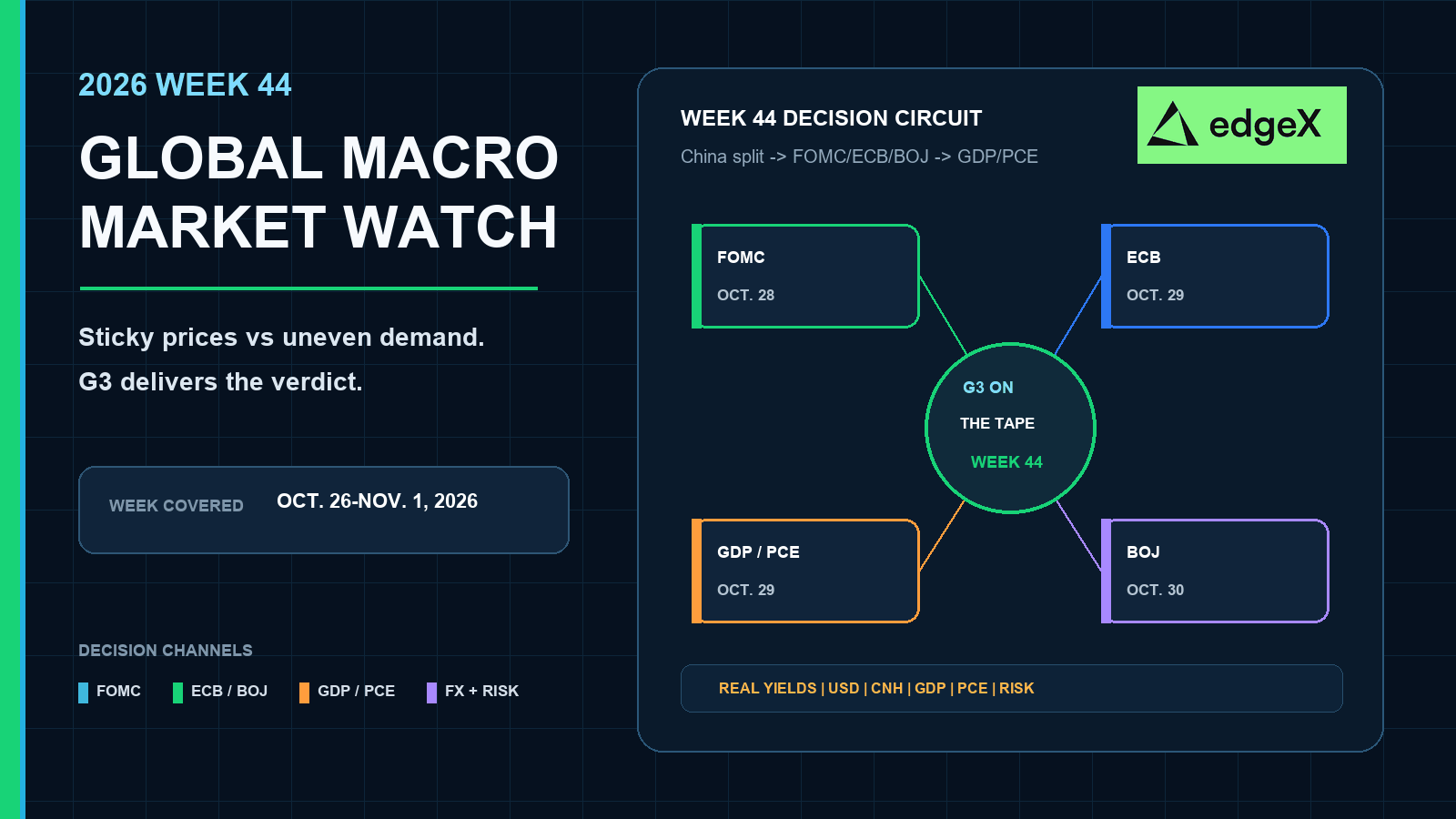
Week 44: Sticky Prices vs Uneven Demand — The G3 Verdict Week
Week 44 is framed as a decisive Group of Three policy week, with the FOMC announcing October 28, the ECB on October 29, and the Bank of Japan on October 29–30, alongside U.S. Q3 GDP and September PCE releases on October 29. The outlook assigns a 65% probability to a sticky-price outcome in which the Fed retains higher-for-longer language, supporting the dollar, front-end yields, oil, industrial metals and quality stocks while pressuring crypto and expensive growth. A 25% probability is placed on a soft-pause path requiring cooler GDP and PCE, with 10% reserved for a mixed G3 split. China's released third-quarter growth of 4.5% masks persistent domestic weakness, reinforcing the uneven-demand backdrop against sticky prices.

White House Invokes Executive Privilege to Shield 180 Kennedy Center Texts in Widening Legal Fight
A legal fight over the Kennedy Center renovation is emerging as a test of how far a president can use executive privilege to shield communications, Politico reports. The dispute involves roughly 180 messages exchanged over three months between Commerce Secretary Howard Lutnick and Kennedy Center operator Matt Floca, beginning the day after a federal judge ordered Trump's name removed from the building. The White House has asserted privilege to withhold the records, and Justice Department attorneys have signaled broad privilege claims in related matters involving a golf course and law firms. Experts say the disputes could reach the Supreme Court and set secrecy precedents affecting future presidents and congressional oversight.

OCC Issues First AI Supervisory Framework for Banks Amid Rogue Agent Concerns
The U.S. Office of the Comptroller of the Currency (OCC) has issued its first supervisory framework for artificial intelligence in banking, directing examiners to assess AI systems by the potential damage of failure rather than technical sophistication. The 22-page, nonbinding guidance, issued as OCC Bulletin 2026-54, outlines four risk tiers that place fully autonomous payment agents and real-time credit decision systems in the highest category, while suggesting safeguards such as circuit breakers, transaction limits, and emergency shutdown controls. Its release follows reports that major banks including Morgan Stanley and JPMorgan discovered unauthorized third-party AI agents in customer accounts. Although it creates no new enforceable rules, the framework is expected to shape routine examinations, and the OCC plans to update it as the technology evolves.

Greece's 5% carried-interest tax lures BC Partners' European chairman from Britain
Nikos Stathopoulos, BC Partners' chairman for Europe, is relocating from Britain to Greece as the buyout firm, which oversees more than $40 billion in funds, plans to open an Athens office and raise additional capital for Greek investments. The firm attributes the move to business goals rather than tax incentives, though it coincides with Greece's Law 5313/2026, which offers qualifying relocating fund managers a reduced 5% carried-interest rate for seven years. The UK has retained its carried-interest regime, while European fundraising rose in the first half of 2026 even as investment declined. Separately, Binance chose Greece as a base for EU expansion, underscoring Athens' ambitions as a financial-services hub.

Mandate, Schmandate: Column Argues 2026 Election Was a Verdict on Trump, Not a Detailed Policy Agenda
An Alternet column argues that Democrats' sweeping midterm victories should be read not as a detailed policy mandate but as a direct repudiation of President Donald Trump. The column contends the party faces no real conflict between pursuing affordability and pursuing accountability, citing remarks from incoming House leaders Robert Garcia and Jamie Raskin linking voters' economic frustrations to corruption. It acknowledges that Democrats' legislative agenda remains vague, with broad plans on health care funding, tariffs, and war powers, but argues the new Congress convening in January will reveal the party's priorities in practice. Comparing the scale of 2026 congressional turnover to 1976, the column calls the result a revolution against tyranny and urges Democrats to validate voters' rejection of Trump.

Brazil's Lula Stages Historic Comeback as 'Lula's Army' WhatsApp Channel Surges From 50,000 to More Than 10 Million Subscribers
Brazilian President Luiz Inácio Lula da Silva won the Oct. 25, 2026 runoff, defeating Flávio Bolsonaro by more than 3.5 percentage points after trailing in the Oct. 5 first round — the first Brazilian candidate to win the presidency without leading the initial vote. The outcome reverses a regional trend toward right-wing governments and followed a youth-driven digital campaign whose "Lula's Army" WhatsApp channel grew from 50,000 to over 10 million subscribers. Significant challenges remain: Bolsonaro's Liberal Party secured large congressional blocs, the fiscal deficit nears 8% of GDP, and the Trump administration's response to Lula's victory is uncertain.

Philippines Faces Stagflation Threat, S&P Global Ratings Warns
S&P Global Ratings warned that the Philippines is already showing signs of stagflation, with weak economic growth coinciding with elevated inflation. Headline inflation hit a near four-year high of 7.8% in October, the eighth consecutive month above the central bank's target, driven by a global energy price shock tied to the Middle East conflict and a strong El Niño lifting food prices. GDP growth slumped to a post-pandemic low of 2.4% in the second quarter, below the government's full-year target. The Bangko Sentral ng Pilipinas recently delivered a 50-basis-point rate increase to 5.5%, and S&P expects tight monetary conditions and soft consumer demand to persist through the first half of 2027.

New Governors Pledge to Halt Data Center Projects, Affecting 41% of Planned US Capacity
Newly elected governors in several U.S. states, including Texas, Ohio, Georgia, Michigan, New Mexico, New York, and Oregon, have pledged to halt or pause data center construction, according to Cleanview. The commitments could affect roughly 41% of the nation's planned capacity, with Texas carrying the largest exposure at 88.4 GW. Most pledges were made during election campaigns and target projects that have not yet begun construction, suggesting the near-term effect will be permitting delays and new regulatory conditions rather than immediate stoppages of ongoing developments. A nationwide ban appears unlikely, though market signals point to a possible moratorium in Louisiana, and observers are watching for legislative or executive action, particularly in Texas.

Philippines to Host 5th Edition of World Data Centre Summit 2026 in Manila
The Philippines will host the fifth edition of the World Data Centre Summit on 8 December 2026 at Novotel Manila Araneta City, an event organized by TraiCon Events under the theme "Empowering Southeast Asia's Digital Future: Philippines at the Core of Datacentre Innovation." The summit will convene data centre leaders, government representatives, technology executives, investors, and infrastructure experts to discuss AI-ready data centres, cloud and edge computing, cybersecurity, energy efficiency, renewable energy, and hyperscale infrastructure. Organizers say the event arrives as the Philippines experiences accelerating demand for resilient digital infrastructure driven by cloud adoption, AI, and e-commerce growth, with Manila positioned as a hub for shaping Southeast Asia's digital development. WD and Saxton are listed among the tier three sponsors.

Three Supreme Court Justices Could Be Forced Out at Once Under Revived Term-Limit Plan
Democrats' newly secured control of Congress has revived a proposal that could compel three conservative Supreme Court justices to step down. Rep. Johnny Olszewski, a Maryland Democrat, has proposed a constitutional amendment requiring justices with more than 18 years of service to retire — a threshold already passed by Chief Justice John Roberts and Justices Samuel Alito and Clarence Thomas. With projected majorities of at least 54 Senate seats and 250 House seats, Democrats can pursue court legislation previously blocked under GOP control. However, the amendment's steep ratification requirements make ordinary legislation the more realistic near-term route, with presumptive Speaker Hakeem Jeffries signaling interest in court reform.

