Will the September FOMC, China Activity Data, and the BOJ Reset Global Policy Pricing in Week 38?
Key Takeaways
- •The September 16 FOMC decision includes a Summary of Economic Projections, making the median rate 'dots' path the single most market-moving element of the meeting.
- •August U.S. payrolls rose 162,000 with unemployment unchanged at 4.1%, and June-July figures were revised up by a combined 55,000, weakening the case for Fed easing based on labor weakness.
- •China's September 15 activity package—industrial production, retail sales, and investment—must confirm demand broadening, as manufacturing PMI at 49.8 and non-manufacturing at 49.0 remain below expansion territory.
- •The Bank of Japan's September 17-18 meeting can reprice the yen, JGB yields, and global carry trades independently of the Fed decision.
- •U.S. August retail sales, trade prices, industrial production, and state employment data will test whether the payroll rebound extends to household spending and goods output.
Quick Answer
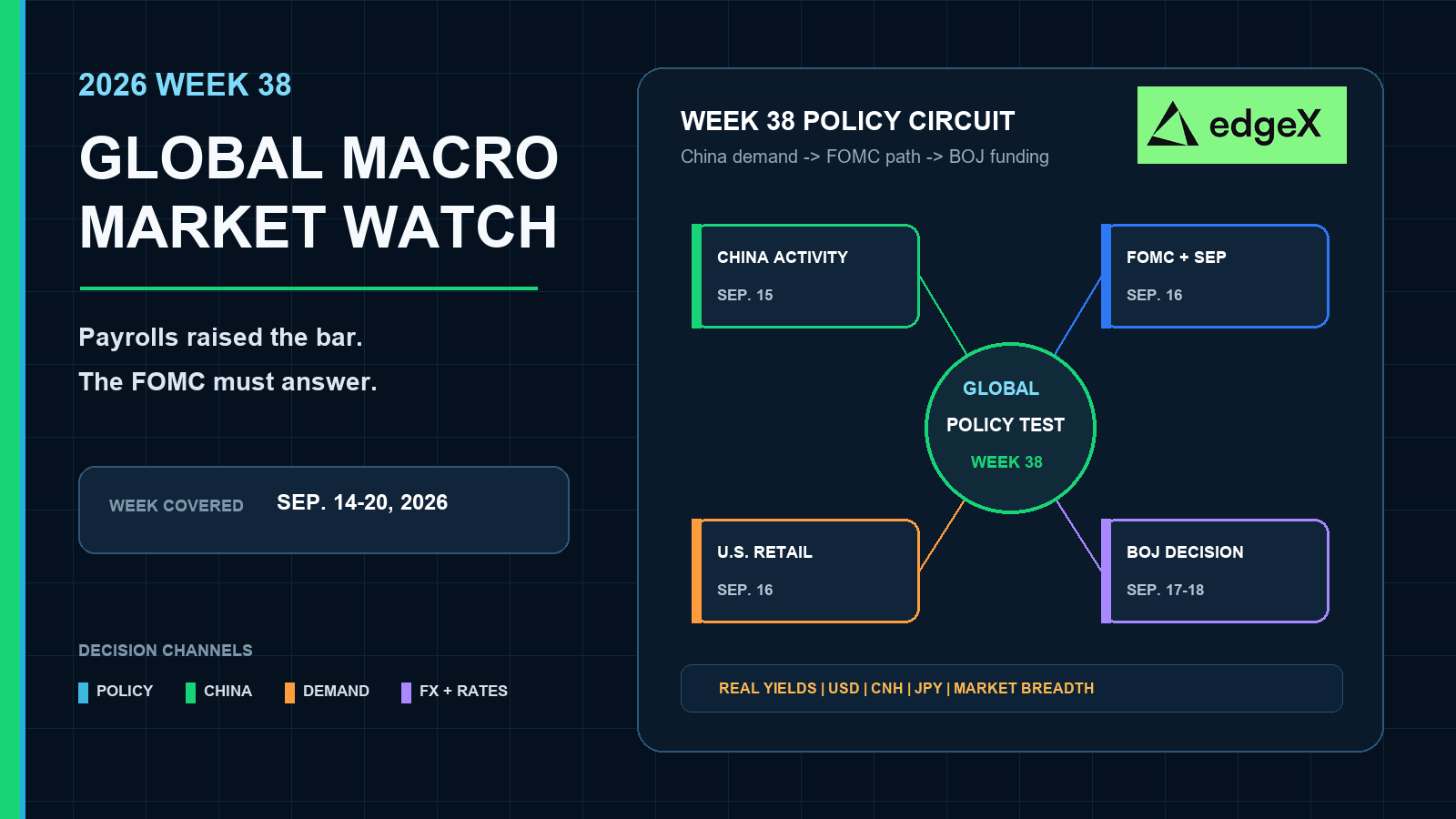
Week 38 is a global policy-and-activity test after Week 36 restored labor-market resilience. A measured FOMC outcome that keeps inflation vigilance without a sharp tightening surprise, firmer Chinese industrial and retail readings, and a BOJ stance that does not force disorderly yen moves would support a more orderly risk environment. A hawkish FOMC shift after the strong payrolls print, weak Chinese domestic demand, and a BOJ surprise that destabilizes funding markets would tighten financial conditions through higher real yields, a stronger dollar, and narrower market breadth. Week 36's completed data already warned against pricing policy relief from labor weakness alone.
Why Week 38 Can Reprice Global Conditions
The week opens with China's August activity package, then moves into the highest-impact U.S. policy event of the quarter, and closes with a BOJ decision that can reprice JPY, JGBs, and global carry. That sequence matters because the same inflation and growth facts can transmit differently through U.S. duration, Asian demand, and Japanese funding conditions.
Week 37's inflation calendar and the ECB Governing Council schedule still sit immediately ahead of the FOMC blackout end, so the September 16 decision will not arrive in isolation. Even so, Week 38's distinctive feature is the combination of a projection-bearing Fed meeting, a China demand checkpoint, and a BOJ meeting within three sessions. Cross-asset confirmation must therefore come from real yields, the dollar complex, equity breadth, credit spreads, and commodity demand together.
The policy path now runs through labor resilience
The Bureau of Labor Statistics Employment Situation reported that August payroll employment rose 162,000 and the unemployment rate was unchanged at 4.1%, matching the release window on the BLS Employment Situation schedule. Average hourly earnings increased 0.3% on the month and 3.1% over the year. June and July payrolls were revised higher by a combined 55,000. That package reduced the case that the labor market was already weak enough to dominate the Fed reaction function.
Participation edged up to 61.6%, and the number of people working part time for economic reasons fell by 414,000 to 4.4 million. Those details support a labor market that is still absorbing workers even after a soft summer. For Week 38, the implication is mechanical: the FOMC statement, press conference, and Summary of Economic Projections must explain how officials balance firmer employment against still-unresolved inflation risk.
Week 38 Global Macro Calendar
| Date | Region | Scheduled Event | Why Markets Care |
|---|---|---|---|
| September 15 | China | August industrial production, retail sales, fixed-asset investment, real-estate development, and energy production | Tests factory output, household demand, construction, property sales, CNH, Asian equities, and industrial commodities. |
| September 15-16 | United States | FOMC meeting; decision and SEP on September 16 | Reprices the policy path, real yields, USD, equity duration, bank net interest margins, and global funding conditions. |
| September 16 | United States | August advance retail sales | Checks whether household spending can confirm the payroll rebound without forcing a hotter demand narrative. |
| September 16 | United States | August import and export price indexes | Adds pipeline and trade-price evidence after Week 37's PPI and CPI sequence. |
| September 17-18 | Japan | Bank of Japan Monetary Policy Meeting | Can move JPY, JGBs, Japanese banks, exporters, and global carry trades. |
| September 18 | United States | August industrial production and capacity utilization | Tests factory, mining, and utility output after July's 0.2% IP gain and 76.3% utilization rate. |
| September 18 | United States | August state employment and unemployment | Maps the national payroll rebound across states and local labor markets. |
The FOMC Decision Carries Projections and a Labor Overlay
The Federal Reserve FOMC calendar schedules the September meeting for September 15-16, with a Summary of Economic Projections. That makes the week more than a binary rate decision. Officials will update growth, unemployment, inflation, and the longer-run rate path just after markets absorbed a stronger payroll report and while inflation evidence from Week 37 is still being digested.
A measured outcome would acknowledge labor resilience, keep inflation vigilance intact, and avoid an abrupt shift in the projected path that forces a disorderly real-yield spike. A hawkish surprise would arrive through a higher median dots path, firmer inflation forecasts, or language that treats the August employment rebound as evidence demand is re-accelerating. A dovish surprise would need to rest on clearer disinflation evidence rather than on labor-market weakness that Week 36 did not deliver.
Retail sales and trade prices arrive on decision day
The U.S. Census Bureau schedules August advance retail sales for September 16 at 8:30 a.m. Eastern, the same morning as the BLS import and export price indexes. Those releases can move the front end before the afternoon FOMC statement even if they do not rewrite the longer-run projections.
Strong control-group spending alongside firm import prices would support a restrictive interpretation of the labor rebound. Soft retail sales with cooler trade prices would give officials more room to emphasize two-sided risks. Equity and credit markets should treat morning data as conditioning information, not as a substitute for the statement, dots, and press conference.
China Activity Data Test Whether the PMI Bounce Broadened
China's National Bureau of Statistics 2026 calendar places the August industrial production, retail sales, fixed-asset investment, real-estate development, and energy package on September 15 at 10:00 Beijing time. That release is the week's required China event because Week 36's PMI improvement stopped short of expansion territory.
Manufacturing PMI rose to 49.8 from 49.2, while non-manufacturing held at 49.0. An activity package that shows industrial output stabilizing, retail sales improving beyond food and essentials, and less severe fixed-asset or property contraction would support CNH, Asian cyclicals, copper, and multinational earnings tied to Chinese demand. A package that improves only export-linked production while retail and property remain weak would keep the Asian demand story selective.
Transmission runs through FX, metals, and earnings
China's data do not need to print a boom to matter. The market distinction is whether domestic demand is stabilizing enough to absorb factory output and support margins. Stronger industrial production without retail confirmation can leave inventories and price pressure unresolved. Better retail sales with still-contracting investment would help household-facing equities more than heavy industry.
Cross-asset confirmation should appear in CNH, Hang Seng and onshore cyclicals, industrial metals, and the relative performance of global firms with China revenue. A soft China print on the eve of the FOMC would raise the odds that lower U.S. yields, if they occur, reflect growth concern rather than clean disinflation.
The BOJ Adds a Separate Funding Shock
The Bank of Japan schedules its Monetary Policy Meeting for September 17-18. The decision lands after the FOMC and can reprice JPY, JGB yields, Japanese bank shares, exporters, and global carry positions independently of the U.S. dots.
A steady BOJ outcome would limit immediate yen volatility and keep attention on the Fed path. A hike or hawkish guidance could strengthen JPY and tighten global funding conditions if leveraged positions are forced to adjust quickly. A more patient stance would support risk assets sensitive to yen-funded carry, but only if U.S. real yields are not rising at the same time.
Industrial production closes the U.S. activity loop
The Federal Reserve G.17 release calendar schedules August industrial production for September 18 at 9:15 a.m. Eastern.
The current G.17 report showed July industrial production up 0.2% and capacity utilization at 76.3%. The August report will show whether factory, mining, and utility output confirmed the payroll rebound or lagged behind services-led hiring.
A broad IP gain with stable utilization would reinforce the labor-resilience narrative. Soft manufacturing output after strong payrolls would point to composition risk: hiring concentrated in services while goods production remains uneven. State employment data the same morning map whether the national payroll gain was geographically broad or concentrated.
Week 36 Review: Payrolls Rebound Met Incomplete China Expansion
Week 36, August 31-September 6, supplied the latest completed weekly baseline available at the September 8 production cutoff. The decisive U.S. release was the August Employment Situation on September 4. Payrolls rose 162,000, far above the subdued summer run rate, while unemployment held at 4.1% and average hourly earnings increased 0.3% to $37.75. Combined upward revisions of 55,000 to June and July removed part of the earlier soft-labor narrative.
Sector detail mattered. Food services and drinking places added 59,000 jobs, local government education added 42,000, manufacturing rose 16,000, and health care continued to trend up. Information employment fell 23,000. The household survey showed fewer people stuck in part-time work for economic reasons, which supported the view that labor utilization improved even if wage growth remained moderate rather than collapsing.
China opened the week with a partial improvement rather than a clean expansion signal. Official manufacturing PMI rose to 49.8 from 49.2 but stayed below 50 for a second month, and non-manufacturing held at 49.0. That combination left Asian markets dependent on the September 15 activity package for proof that orders and domestic demand are broadening. Industrial metals and CNH therefore entered Week 38 still sensitive to confirmation rather than celebrating a completed manufacturing recovery.
Outside those anchors, the Federal Reserve's July industrial production report, released just before Week 36, showed output up 0.2% and capacity utilization at 76.3%. That provided a goods-side baseline consistent with gradual expansion rather than a sharp industrial downturn. Public market commentary after the payrolls release shifted toward a higher bar for near-term Fed easing and renewed focus on inflation and political pressure around Chair Warsh, without converting incomplete Week 37 inflation data into finished outcomes.
The Week 36 implication is conditional. Stronger U.S. employment reduced the odds that policy would ease simply because the labor market was breaking. Incomplete Chinese PMI recovery kept Asian demand as an open risk. Week 38 can improve that balance only if the FOMC communicates a coherent reaction function, China activity broadens beyond a sub-50 PMI bounce, and the BOJ avoids a funding shock that overwhelms local and global risk assets.
Cross-Asset Decision Map
| Week 38 Mix | Crypto | Stocks | Commodities | FX and Rates |
|---|---|---|---|---|
| FOMC stays measured, China activity broadens, BOJ avoids shock | Lower real-yield volatility and better liquidity can support BTC and ETH if spot demand confirms. | Leadership can broaden beyond defensives if earnings confidence improves with Asia. | Copper and crude gain demand support; gold depends on real yields. | USD softens selectively; CNH and JPY stabilize; front-end volatility fades after the dots. |
| FOMC turns hawkish after strong payrolls, China demand stays weak | Higher funding costs and narrower liquidity pressure leveraged crypto positions. | Long-duration and China-sensitive shares underperform; banks may gain briefly from higher yields. | Gold faces a yield headwind; industrial metals absorb Asia demand risk. | Real yields and USD rise; CNH stays vulnerable; JPY reaction depends on the BOJ. |
| Growth softens into the FOMC while inflation stays sticky | Rate-cut hopes help only if deleveraging does not dominate. | Quality and defensives outperform cyclicals; earnings revisions become central. | Gold can outperform industrial commodities. | Curves can bull-steepen or twist; safe-haven USD demand may persist. |
| BOJ tightens while Fed stays firm | Global carry unwind can hit high-beta crypto and Asia risk assets. | Japanese banks may gain while exporters and yen-sensitive multinationals diverge. | Commodity currencies face FX volatility more than a clean demand signal. | JPY strengthens; JGB yields rise; cross-asset volatility increases through funding channels. |
What Would Confirm the Week 38 Signal?
The base case is volatility around the FOMC reaction function, China demand confirmation, and BOJ transmission rather than a clean one-way trend. The September 16 decision should be checked against the dots, the press conference, retail sales, trade prices, real yields, the dollar, credit spreads, and equity breadth. A policy surprise that moves only one market is less durable than a synchronized adjustment across rates, currencies, and cash equities.
Asia requires its own confirmation. China needs industrial output, retail sales, and investment signals that improve together, not merely a sub-50 PMI bounce. Japan needs a BOJ outcome that markets can absorb without a disorderly yen squeeze. U.S. industrial production on September 18 then tests whether goods output validates the payroll rebound. A durable risk-on result requires coherent Fed communication, broader Chinese nominal demand, and funding-market stability after the BOJ.
Trade with an Edge
In fast-moving markets, execution matters just as much as direction. That's why more traders are turning to decentralized venues like edgeX for perpetuals and spot trading.
Unlike traditional centralized platforms, edgeX is built around self-custody, meaning you keep control of your assets and authorize fund movements yourself. For active traders, that offers a meaningful advantage: market access without handing custody to an exchange.
edgeX also combines the core benefits of DeFi with a trading experience designed for serious execution. The platform emphasizes deep liquidity, high-speed order matching, and low-slippage performance, helping traders stay responsive during volatile conditions. With support for high leverage, it gives experienced market participants more flexibility in how they express macro views and manage risk.
Beyond execution, decentralized trading infrastructure can offer structural advantages: greater transparency, on-chain verification, and reduced dependence on centralized intermediaries. For traders who want performance without giving up control, that model is increasingly compelling.
edgeX is built for that balance: bringing together a professional trading experience with the core principles of decentralized markets.
Traders looking to explore a more capital-efficient, self-custodial way to trade can take a closer look at edgeX.
Frequently Asked Questions
What is the biggest event in Global Macro Week 38?
The FOMC decision and Summary of Economic Projections on September 16 are the largest single global policy catalyst. China activity data on September 15 and the BOJ meeting on September 17-18 determine whether the Fed signal has Asian demand and funding-market confirmation.
Why review Week 36 instead of Week 37?
Production closed on September 8, while Week 37 was still in progress. Week 36, August 31-September 6, was the latest completed weekly window. The review is labeled explicitly and does not treat partial Week 37 inflation or ECB outcomes as finished weekly results.
Why does China's September 15 activity package matter globally?
Industrial production, retail sales, fixed-asset investment, and property data connect factory output and household demand to CNH, Asian equities, industrial commodities, and multinational earnings. A PMI bounce without activity confirmation remains incomplete.
How can the BOJ decision affect markets outside Japan?
The BOJ can move JPY, JGB yields, and global carry positions after the FOMC. Those funding-market adjustments can reinforce or offset the dollar and duration response to the Fed decision.
What did Week 36 change for the Week 38 outlook?
Week 36 restored U.S. payroll momentum, held unemployment at 4.1%, and left Chinese PMIs still below 50. That mix raises the bar for policy relief: the FOMC must explain labor resilience, while China still needs broader demand proof.
What is the constructive Week 38 scenario?
The constructive combination is a measured FOMC communication after strong payrolls, broader Chinese industrial and retail demand, stable U.S. retail sales and industrial production, and a BOJ outcome that avoids disorderly yen volatility. Confirmation should appear in contained real-yield spikes, selective dollar softening, wider equity breadth, and firmer industrial commodities.
