Pinned
Latest News
edgeX Joins Arc as Day 1 Partner: the First 24/7 FX Perpetual Market on Arc Mainnet
edgeX will launch on Arc mainnet on September 16, 2026, introducing onchain FX perpetuals starting with JPY alongside more than 150 existing markets covering stocks, commodities, and crypto, all margined and settled in native USDC. The move builds on edgeX's relationship with Circle, whose ventures arm is an investor and with which it has worked on USDC issuance and CCTP integration. Arc is positioned as a chain purpose-built for around-the-clock, internet-native money with USDC-denominated gas and a native FX engine, addressing structural gaps in traditional FX such as weekend closures and slow settlement. Post-launch, edgeX plans to explore additional FX pairs, FX spot markets against non-USD stablecoins, and non-USD stablecoin margin.
Stablecoin Utility Explained: Why Payments, Settlement, and Trading Matter More Than Supply
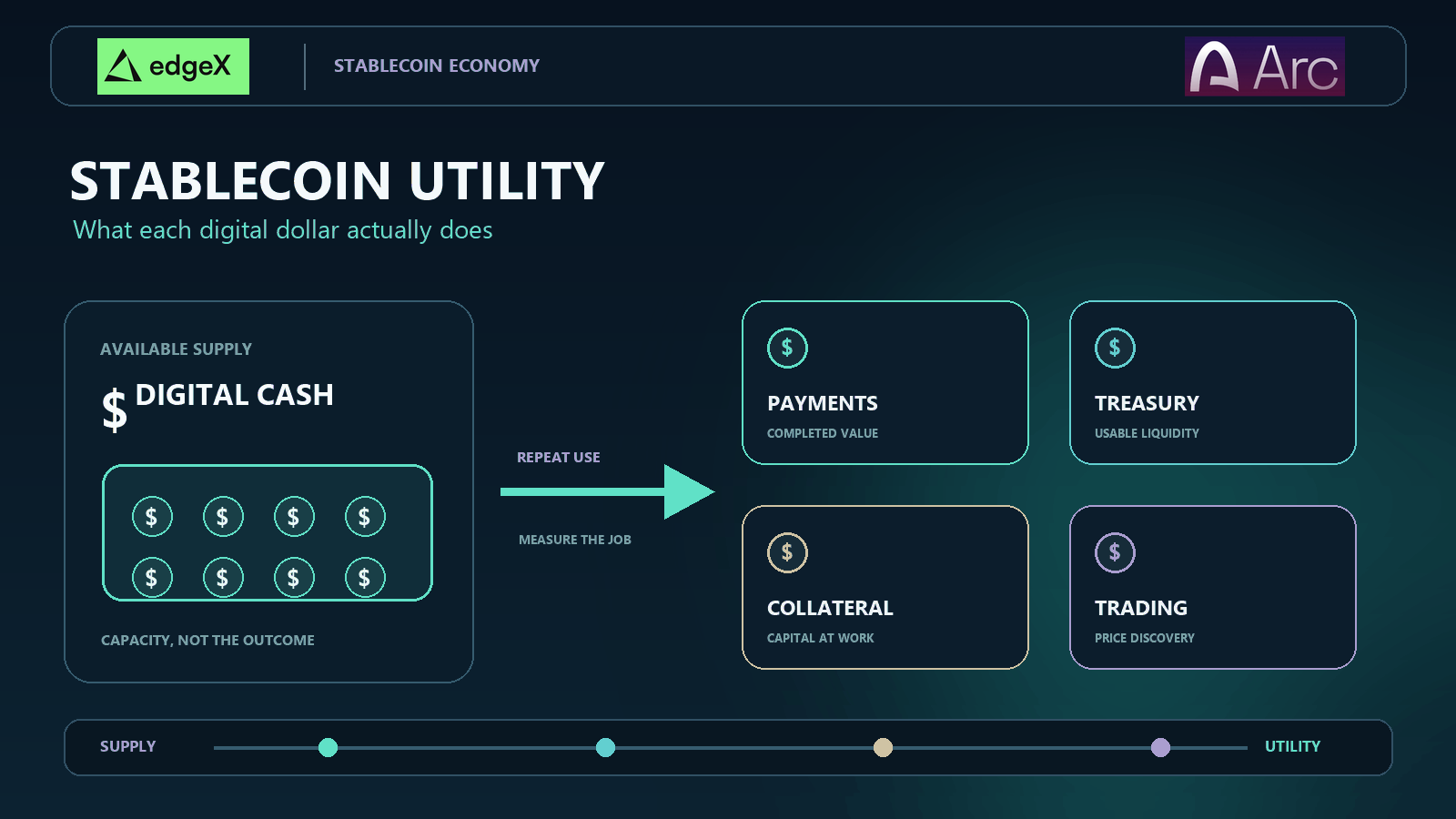
Stablecoin adoption is entering a phase where utility, not supply growth, determines economic value. Circle reported $73.3 billion in USDC circulation at the end of Q2 2026, up 19% year-over-year, alongside $14.8 trillion in quarterly onchain transaction volume, a 151% increase. However, the article argues that supply is a capacity metric, while meaningful adoption depends on completed workflows across payments, treasury management, collateral, and savings. Adjusted analytics, such as Visa Onchain Analytics, help filter noise from bots and internal transfers. Arc, a network designed for financial workflows with USDC-denominated fees and sub-second deterministic finality, plans a public mainnet launch on September 16, 2026, and edgeX has announced plans to deploy perpetual trading on it, though production adoption remains unproven.

UK Crypto Firms Get Five-Month FCA Approval Window Ahead of 2027 Regime
UK crypto firms will have from September 30, 2026, to February 28, 2027, to seek FCA approval ahead of the wider cryptoasset regime’s planned launch on October 25, 2027. Existing anti-money-laundering registration will not automatically confer authorisation, requiring affected businesses to submit new applications or amend permissions. Firms applying on time may continue specified activities during assessment if they meet the conditions, while late applicants could face service suspensions. The regime will broaden FCA oversight across activities including custody, trading, stablecoins, lending and some staking, with requirements covering governance, safeguarding, resilience and market conduct.

Fake Government Email Led Revolut to Disclose Customers’ Bitcoin Records
Revolut disclosed customer information to an unauthorized party after processing a fraudulent government request that used an official agency domain and passed standard email authentication checks. The exposed material included personal details, identity documents, account records, and Bitcoin transaction histories, potentially connecting crypto activity with customer identities. Private keys, passwords, full card details, and biometric facial telemetry were reportedly excluded. The number of affected customers remains unknown, though an investigator described the incident as limited and possibly focused on high-net-worth users. Revolut has not identified the impersonated agency or confirmed regulatory notification.

Bessent Urges Senate Vote on CLARITY Act as Crypto Platforms Reorganize
U.S. Treasury Secretary Brian Bessent on September 9 urged the Senate to advance the CLARITY Act, which would establish the first comprehensive U.S. regulatory framework for digital assets. The Senate is scheduled to vote on September 15, with 60 affirmative votes required to proceed, though Galaxy Digital has lowered its estimated probability of passage in 2026 to 10% from 75% in May. In the same news cycle, Consensys announced it will split into two independent companies by the end of 2026, separating the MetaMask wallet from its protocol and institutional banking operations. Separately, the Pepeto presale has raised over $10.9 million, reflecting market focus on audited, operational crypto infrastructure.

Robinhood CEO Defends Stock-Token Strategy Amid AMC Dispute
Robinhood CEO Vlad Tenev publicly argued on September 11, 2026, that companies should not be able to veto third-party tokenization of their stocks when tokens preserve shareholder rights, leave official registries intact, and add no issuer obligations. The statement came a week after AMC Entertainment CEO Adam Aron denounced Robinhood's AMC Stock Token, denied any affiliation, demanded a cease and desist, and warned of possible SEC escalation. Robinhood's tokens, issued via a Jersey entity, are 1:1 backed, offer dividend-equivalent economics, and are unavailable to U.S. persons. Tokenized-stock trading on decentralized exchanges reached $4.3 billion in the prior week, with Robinhood capturing 66.3%. Regulatory questions around issuer consent remain unresolved ahead of an expected CLARITY Act vote.

CoinShares Says Sticky Inflation Could Limit Bitcoin Upside Below $80,000
CoinShares said firmer inflation has increased the probability of a September Federal Reserve rate hike, which could constrain Bitcoin’s near-term gains and keep monetary policy restrictive. In its September 11, 2026 update, the firm identified $80,000 as a level requiring softer economic data or a more accommodative policy catalyst for a sustained breakout; Bitcoin was about $77,330 in a September 12 snapshot. CoinShares also pointed to a potentially larger Treasury purchasing program as a conditional medium-term upside scenario. Digital-asset products saw roughly $1.3 billion of inflows the prior week and $243 million of partial-week outflows.

Robinhood Crypto Trading Volume Rebounds 61% to $17.5 Billion in August 2026
Robinhood reported a 61% monthly increase in cryptocurrency trading volume to $17.5 billion in August 2026, rebounding from weaker July activity. However, volume remained 38% below August 2025 levels, indicating that the recovery did not restore year-over-year strength. Trading on Robinhood’s app climbed 72% to $7.4 billion, while BitStamp activity rose 53% to $10.1 billion and accounted for the larger share of total volume. The data underscore the crypto business’s dependence on market activity as Robinhood broadens its products to include prediction markets, tokenized assets, and other offerings.

Report: Russia Targets Civilians in Kramatorsk as Conflict in Ukraine Escalates
The Kyiv Post has reported that Russian forces are targeting civilians in Kramatorsk, Ukraine, using drones, bombs, and strikes against humanitarian vehicles, in what the outlet describes as a significant escalation in the eastern Ukraine conflict. Kramatorsk, in the Donetsk oblast, has been a focal point of Russia's regional military strategy, and the reported attacks on non-combatants in residential areas and emergency-response vehicles suggest an offensive extending beyond conventional military objectives. Market pricing now reflects an increased likelihood of Russian forces entering nearby cities, notably Sloviansk, signaling expectations of further territorial advances. Observers are monitoring troop movements toward strategic cities, diplomatic shifts, and NATO support levels, as these developments may influence regional stability and market expectations.

OKX Expands Trading Offerings With ARB, Tokenized Stocks and X-Perps
OKX has broadened its trading platform by adding ARB, the token linked to Ethereum layer-2 network Arbitrum, to its X Drops alongside ONDO, NEAR and other assets. The exchange also announced nine tokenized stocks, 13 X-Perps pairs, and access to tokenized stock and pre-IPO markets. The expansion combines crypto assets with stock-linked and leveraged products, although details about product structure and availability were not provided. ARB’s trading volume was unavailable, and the article listed its price at $0, describing the offering as being at an early stage.
