Crypto
Stay updated on the latest crypto market news, including Bitcoin, Ethereum, DeFi, Web3, token listings, regulation, ETFs and major project developments. edgeX News curates important crypto updates to help traders and investors follow market-moving stories across the digital asset ecosystem.
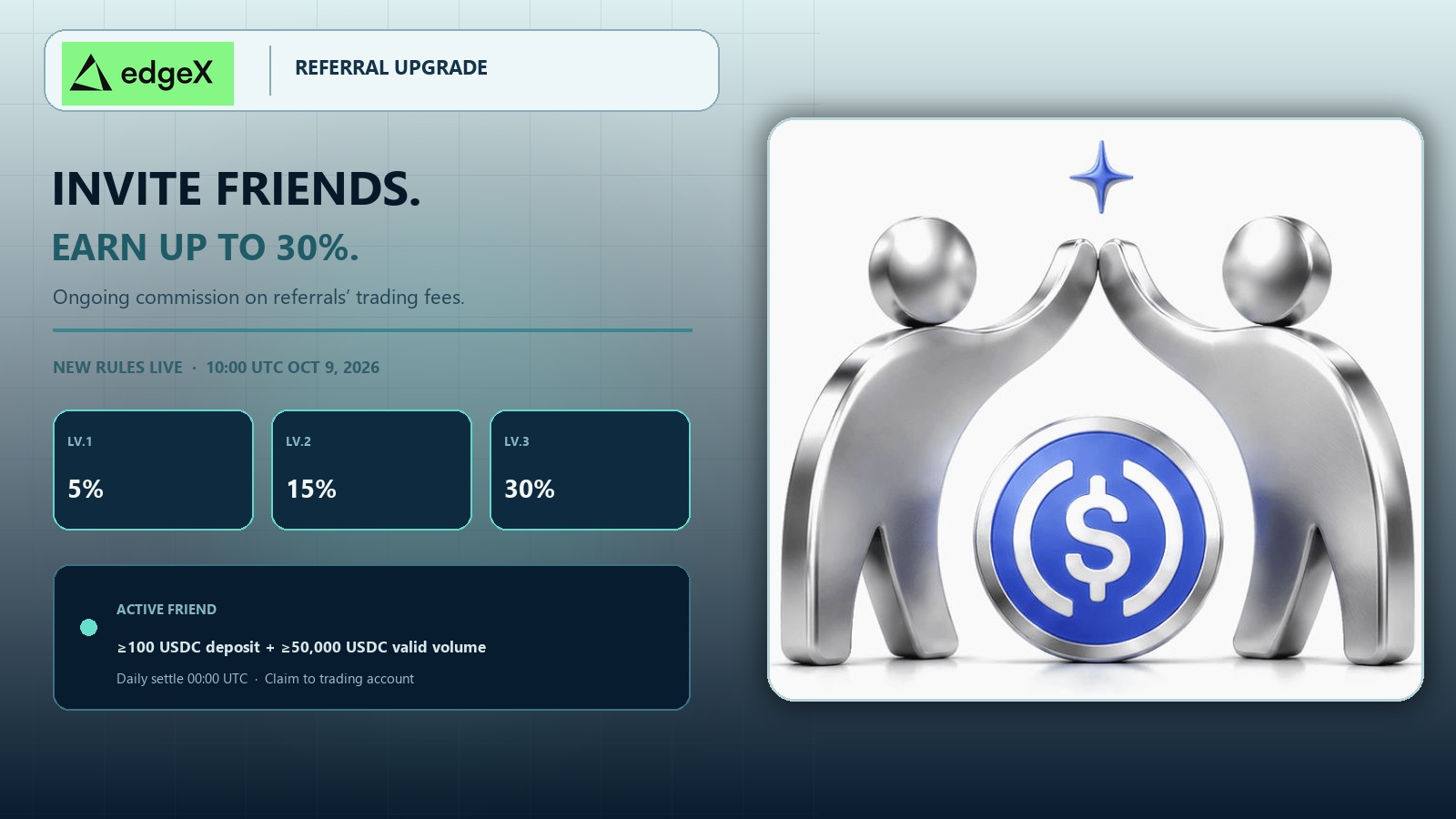
edgeX Referral Commission Upgrade: Earn Up to 30% on Friends’ Trading Fees
edgeX has overhauled its Referral Commission Program, introducing a tiered structure that lets referrers earn up to 30% of their referrals' trading fees, effective 10:00 UTC on October 9, 2026. The published three-level ladder pays 5%, 15%, or 30% based on two combined thresholds: the number of active referrals and their trading volume over a rolling 14-day window. A referral becomes active after depositing at least 100 USDC and reaching 50,000 USDC in valid trading volume. Tier benefits apply immediately, hold for a 14-day review period, and can automatically downgrade if criteria lapse, while rewards settle daily at 00:00 UTC for claiming.

Amundi Expands Into Tokenized Stocks With STOXX Europe 600 Fund on Ethereum
Amundi, Europe's largest fund manager by assets under management, has launched a tokenized share class of its STOXX Europe 600 equity index fund on Ethereum, extending its blockchain offerings beyond money market funds. The share class was issued with CACEIS, which supplied the tokenization infrastructure, and the fund remains available through traditional channels. Amundi plans a broader range of tokenized funds for institutional clients and digital platforms, citing potential gains in accessibility, settlement speed and operational efficiency. The launch follows Amundi's first tokenized money market fund in November 2025 and comes as the tokenized equities market reaches $4.24 billion, up nearly 27% over 30 days, though US-linked products dominate.

Circle's Kris Gower Makes the Case for Arc and USDC in Securities Lending
Circle executive Kris Gower has argued that the company's Arc blockchain and USDC stablecoin could reduce settlement failures and costs in securities lending, where delayed or missing collateral legs leave capital idle. Speaking on the BitGo podcast aired around November 4-5, 2026, Gower said sub-second, around-the-clock settlement allows both legs of a trade to move on a single network, removing traditional cutoffs. Circle is also promoting instant repo settlement as an alternative to conventional systems such as Fedwire. Arc's public mainnet launched on September 16, 2026, with over 100 institutional partners, including a DTCC collaboration, while USDC circulation stood near $74 billion in late October 2026.
US Treasury Cuts MEXC Off From US Financial System Over Alleged $16 Billion in Illicit Flows
The U.S. Treasury's Financial Crimes Enforcement Network issued a final order Friday to cut offshore cryptocurrency exchange MEXC Global off from the American banking system, citing alleged links to sanctions evasion by Iran, North Korea, and Russia. Issued under section 9714(a) of the Combating Russian Money Laundering Act, the order finds MEXC a primary money laundering concern and will bar covered U.S. financial institutions from processing any funds transfers to or from the exchange 30 days after Federal Register publication, which is still pending. Treasury alleges MEXC facilitated at least $16 billion in illicit flows between May 2021 and May 2026. Once effective, the ban will sever the top-20 exchange's remaining U.S. dollar access.

Bitcoin Reclaims $80,000 After Election-Night Drop to $75,600
Bitcoin fell to roughly $75,600 on U.S. midterm election night before recovering above $80,000, according to a CryptoSlate report that documents the swing without establishing a cause for either leg. The report's headline framed the rebound as Bitcoin's first return above the level since the Binance hack, presented as context rather than a verified explanation. CryptoQuant analyst Darkfost observed that seller pressure has calmed, a characterization of selling activity rather than a sign of new demand or a sustained advance. The article notes no verified NFT market data, leaving watchpoints on whether Bitcoin holds the reclaimed level and whether selling stays subdued.

US Spot Bitcoin ETFs Post $74.6 Million in Net Inflows as Fidelity's FBTC Leads
US spot Bitcoin ETFs recorded a collective net inflow of $74.6 million on Wednesday, November 4, ending a three-session streak of heavy redemptions, according to Farside Investors data. Fidelity's FBTC drove the rebound with $236.7 million in creations, the day's largest inflow, while smaller gains at ARK Invest and 21Shares' ARKB, Bitwise's BITB, and Invesco's BTCO helped offset continued selling in BlackRock's IBIT, which shed $201.2 million. The intake follows roughly $1.16 billion in combined withdrawals across the prior three sessions, making the rebound modest rather than a full recovery. Flow watchers are tracking whether FBTC's lead broadens and whether IBIT redemptions continue to cap the recovery.

Vitalik Buterin Urges Crypto Exchanges to Prioritize Security Over Competition
Ethereum co-founder Vitalik Buterin has called on cryptocurrency exchanges to prioritize security and long-term survival over aggressive competition during the next two years, in an interview with Moneycontrol reported by Wu Blockchain. He warned that recent major hacks increasingly target user interfaces and centralized infrastructure, such as front ends and key management systems, rather than smart contract vulnerabilities, meaning user assets can be at risk even when protocol code is sound. His remarks come amid a wave of exchange security incidents, and he cautioned that continued breaches could lead to stricter regulatory requirements. Buterin also highlighted zero-knowledge proofs, AI and formal verification for Ethereum's roadmap, and urged Layer 2 networks to build differentiated applications in high-performance DeFi, privacy and enterprise use cases.

Bittensor Review 2026: TAO, Subnets, Validators and Market Data
A hands-on review published after examining Bittensor on 5 November 2026 assessed the project's official site, documentation, and third-party data platforms without connecting a wallet or executing transactions. TAO traded near $234.95 with a $2.74 billion market capitalization and a circulating supply of 11.69 million against a fixed 21 million maximum, following the network's first halving in December 2025 that cut issuance to roughly 3,600 TAO per day. Under the dTAO system, 128 subnets compete for emissions, with lium.io, Chutes, and Targon holding the largest shares. Displayed validator APYs ranged from about 2.39% to 6.32% with fees between 0% and 9%. The review rated the ecosystem 6.5 out of 10, citing strong documentation but concentrated emissions and untested staking.

Bitcoin Faces Key Test of $75,000 Support as Futures Activity Raises Volatility Concerns
Bitcoin is testing critical support near $75,000 after a Thursday sell-off of more than 5% took the price from above $80,800 to roughly $76,000, driven by weakness in US technology stocks and approximately $428 million in crypto long liquidations within a single hour. Adding to caution, Binance's spot-to-futures volume ratio has fallen to 9.2%, near its late-February low, meaning futures trading is nearly 11 times larger than spot activity and leaving prices more sensitive to leverage-driven moves. A sustained break below roughly $75,230 could expose the 200-day moving average near $73,200, while reclaiming $76,950, and eventually $80,000, would signal that buyers are regaining control.

MEXC Cut Off From U.S. Financial System Over $16 Billion in Flagged Transactions
The U.S. Treasury Department, through FinCEN, has moved to cut cryptocurrency exchange MEXC Global off from the American financial system, alleging the platform processed at least $16 billion in transactions tied to sanctions evasion, cybercrime and illicit finance involving Iran, North Korea and Russia. The November 6 order, issued under Section 9714 of the Combating Russian Money Laundering Act as part of Operation Economic Outcast, bars U.S. financial institutions from handling transfers to or from MEXC and its overseas affiliates, with violations carrying civil or criminal penalties. The restriction takes effect 30 days after Federal Register publication, and MEXC's future international operations now depend partly on how foreign institutions and jurisdictions respond.

