Nigerian students criticise FG’s 100MB daily data plan and demand campus Wi-Fi
Key Takeaways
- •The programme will initially serve about five million students in public senior secondary schools and tertiary institutions.
- •The daily 100MB allowance, equivalent to roughly 3GB per month, will be restricted to approved educational platforms such as learning management systems and digital libraries.
- •Students questioned whether the allocation would support access to portals and ordinary study-related communication, with some saying campus Wi-Fi would be a better investment.
- •Agezeh Victor estimated that equivalent funding could provide Wi-Fi at 30 to 40 strategic locations on a campus, serving 100 to 200 users per location.
- •The initiative is projected to cost the government N180 billion annually.
Nigerian students have criticised the Federal Government’s plan to provide 100 megabytes (MB) of free mobile data daily from October 1, saying the allowance is too small to make a meaningful difference to their studies.
The Nigerian Communications Commission (NCC) unveiled the initiative on Thursday in Abuja alongside the Federal Ministry of Education and telecom operators represented by the Association of Licensed Telecommunications Operators of Nigeria (ALTON). The programme is projected to cost N180 billion annually and will initially cover about five million students in public senior secondary schools and tertiary institutions.
The NCC said the daily allowance, equivalent to about 3GB monthly, will be limited to a whitelist of approved educational platforms, including learning management systems and digital libraries. That restriction means the scheme is intended for access to specific education services rather than general internet use, a distinction reflected in students’ complaints about using the allowance for portals, messaging and other study-related activity.
Reactions on X were swift. Student Mimi Jaja wrote, “100MB data is nonsense. Only two minutes of browsing,” adding that students would rather see a 60% reduction in federal university fees.
Another X user, who goes by IjUgho, described the scheme as “another way to embezzle money.” The user argued that 100mb of Nigeria’s mobile data “won’t last 30 minutes.”
Students question why campus Wi-Fi was not prioritised
Some students questioned why the government chose individual data allocations instead of developing campus-wide Wi-Fi infrastructure.
“What happened to Metropolitan Area Network WiFi to be accessible to students through their student portal?” X user boltonchimdi asked, noting that university fees already reach as high as N180,000.
Agezeh Victor, the immediate past president of the University of Ibadan Students’ Union, proposed an alternative based on the estimated costs. He said providing 100MB daily to the roughly 45,000 students at the University of Ilorin would cost the government about N3.6 million per day and N111.6 million per month.
According to Victor, the same budget could instead fund Wi-Fi infrastructure at 30 to 40 strategic locations across a campus, with each location supporting between 100 and 200 simultaneous users.
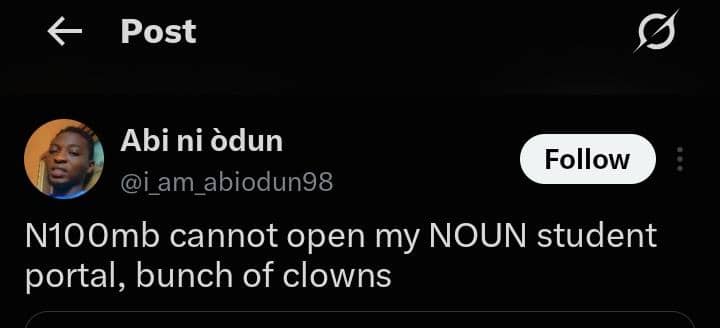
Other students focused on the practical limitations of the proposed allowance. “N100mb cannot open my NOUN student portal,” X user i_am_abiodunag wrote, referring to the National Open University of Nigeria’s student portal. Another user, KennyRoskyn13, said the allowance would be exhausted within 20 minutes of ordinary WhatsApp use.
Not all the criticism focused on the size of the data package. X user mainabikeade argued that the government should prioritise paying lecturers adequately and curbing extortion in tertiary institutions before introducing data schemes.
Technext contacted the president of the National Association of Nigerian Students (NANS) and the leadership of three federal universities for comment. None had responded by the time of publication.
The initiative is part of the NCC’s plan to support students’ access to approved digital education resources, but the students’ reactions have focused on whether a daily 100MB allocation can meet their broader academic and connectivity needs.
