Stablecoin Utility Explained: Why Payments, Settlement, and Trading Matter More Than Supply
Key Takeaways
- •USDC circulation reached $73.3 billion at the end of Q2 2026, a 19% year-over-year increase, while quarterly onchain transaction volume climbed 151% to $14.8 trillion, according to company-reported figures.
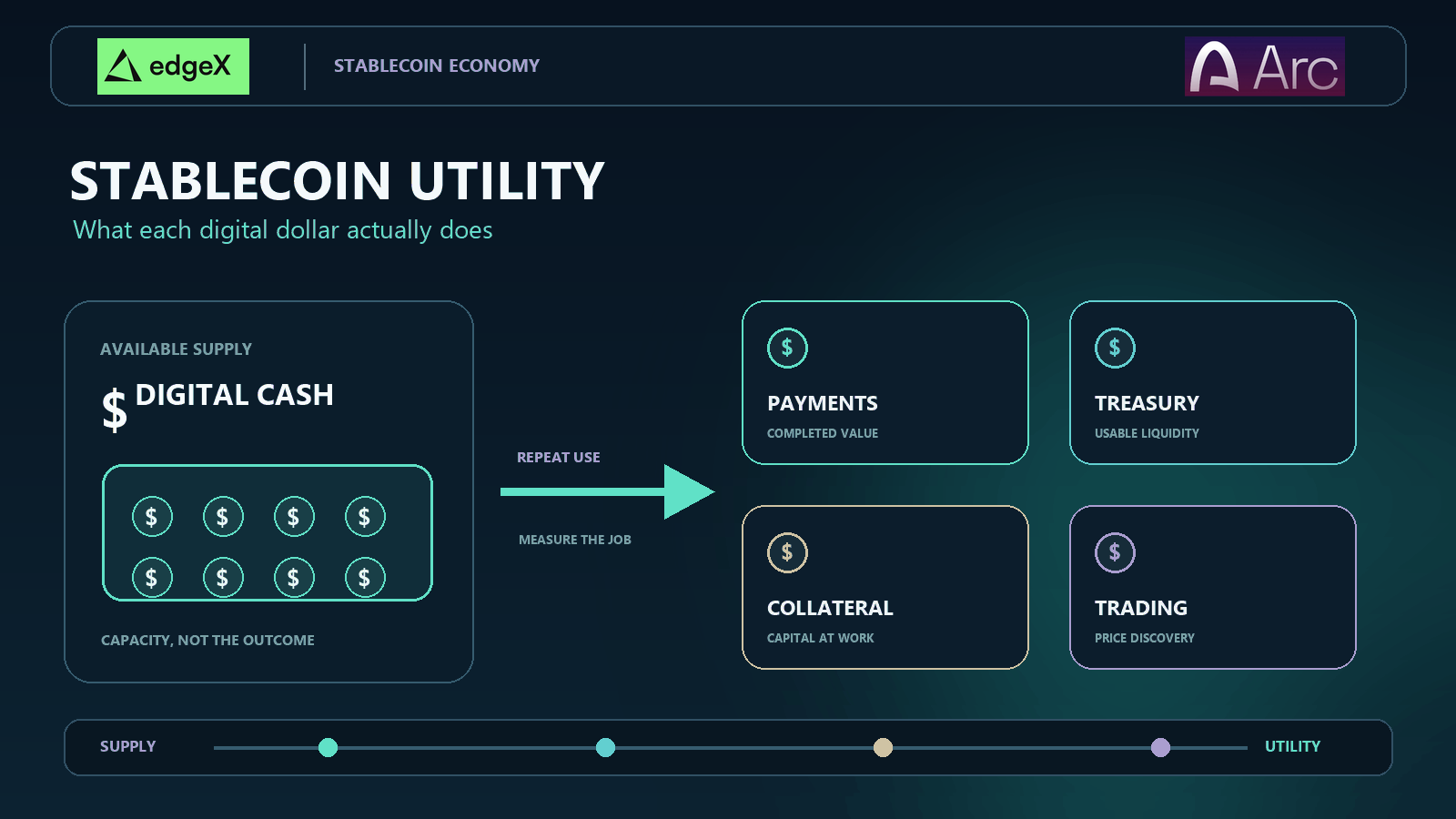
- •Stablecoin supply measures capacity rather than actual usage, so durable adoption must be assessed through completed economic jobs such as payments, treasury transfers, collateral, and savings.
- •Raw transaction volume can be misleading because bots, bridges, minting, and internal smart-contract operations inflate it, which is why adjusted methodologies like Visa Onchain Analytics classify activity into distinct categories.
- •Arc is a network built for financial workflows that uses USDC-denominated fees and delivers deterministic finality in under a second, with its public mainnet scheduled to launch on September 16, 2026.
- •edgeX has announced plans to launch cross-asset perpetual trading on Arc, but neither network adoption nor post-launch retention has yet been demonstrated in production.
Quick Answer
The next phase of stablecoin adoption will be judged less by headline supply and more by what each dollar actually does. A growing balance is evidence of demand to hold stablecoins. Durable utility appears when users repeatedly employ them for payments, treasury transfers, collateral, market settlement, or trading. The right question is therefore not only “How many stablecoins exist?” but “Which economic workflows depend on them, how often are they used, and what risks stand between a transfer and a completed outcome?”
Stablecoin Supply Is the Starting Point, Not the Finish Line
Stablecoin market capitalization is easy to understand. It is the outstanding value of tokens such as USDC and USDT, usually expressed in dollars. Rising supply can show that users want more blockchain-based cash, that issuers can distribute it, and that exchanges or financial applications need more liquid settlement assets. It is an important base layer.
But supply is a stock, not a flow. Ten billion dollars sitting idle and ten billion dollars supporting payroll, merchant settlement, collateral movements, and active markets produce the same supply figure. They do not produce the same economic value. This is why stablecoin adoption cannot be reduced to a single market-cap chart.
Circle reported USDC circulation of $73.3 billion at the end of the second quarter of 2026, up 19% year over year. It also reported $14.8 trillion of USDC onchain transaction volume during the quarter, up 151%. Those figures show expansion, but they answer different questions. Circulation measures outstanding balances. Onchain volume measures transfers. Neither figure, by itself, proves how much activity represented customer payments, trading collateral, internal routing, or repeated automated movement. The figures are company-reported and should be read with that distinction in mind.
Inventory can grow before everyday usage
New supply may support quote liquidity, treasury balances, new-network distribution, or temporary shelter from volatile assets. Each is legitimate demand, but none alone proves recurring usage.
Like store inventory, stablecoin supply creates capacity. Applications and markets determine whether customers return.
Velocity needs context
Dividing transfer volume by supply can estimate velocity, but only after transfers are cleaned and classified. One workflow may pass through a bridge, exchange wallet, market maker, and smart contract.
Volume therefore needs a denominator, category, and purpose: who initiated it, which job it completed, whether value reached a distinct counterparty, and whether activity persisted without traffic-manufacturing incentives.
How to Measure Real Stablecoin Usage
No dashboard can identify every transfer perfectly. Addresses can be unlabeled, one entity can control many wallets, and smart contracts can combine multiple operations. A sound measurement framework therefore uses several indicators rather than pretending one number captures the economy.
Visa Onchain Analytics explicitly separates adjusted and unadjusted stablecoin activity. Its methodology attempts to remove distortions from bots, bridge routing, minting and burning, centralized-exchange operations, and redundant internal smart-contract transfers. It also classifies activity into payments, decentralized finance, investment and trading, store of value, infrastructure, and other categories. The approach demonstrates why raw volume needs interpretation.
| Indicator | What it can show | What it can miss or overstate | Best question to ask |
|---|---|---|---|
| Circulating supply | Demand to hold or deploy stablecoins | Whether balances are active | Why was new supply created? |
| Adjusted transfer volume | Economically meaningful value movement | Classification errors and unlabeled wallets | Which activity survives noise filters? |
| Active or meaningful wallets | Breadth of participation | One user with many wallets | Are distinct users returning? |
| Payment count and size | Commerce and person-to-person usage | Internal merchant or provider flows | Did a payment reach its intended recipient? |
| Collateral utilization | Capital committed to financial activity | Leverage and liquidation risk | Is collateral supporting productive, repeat demand? |
| Redemption and market liquidity | Ability to enter, exit, and maintain the peg | Stress outside the observation period | Can users convert at scale when conditions worsen? |
Follow the completed economic job
A payment should be evaluated as a payment. Did the merchant or recipient receive value? How long did the full process take, including conversion to local money if needed? What fees appeared at the on-ramp, blockchain, application, and off-ramp? A fast token transfer is only one part of that outcome.
Trading and settlement require different tests. Useful measures include open interest backed by real collateral, repeat trading activity, order-book depth, funding behavior, liquidation performance, and the time needed to settle gains and losses. High turnover may represent genuine price discovery, but it can also reflect market-making loops or incentive-driven activity. The category matters.
Look for repeat demand, not one-time campaigns
Rewards can attract balances without creating a durable reason to stay. Better evidence appears when users remain after subsidies decline, businesses adopt routine treasury flows, and traders keep collateral because markets and execution remain useful.
Retention, frequency, and concentration matter alongside volume. Diverse recurring usage is more resilient than dependence on one program or liquidity provider.
Four Jobs That Turn Stablecoins Into Working Capital
Stablecoins become economically useful when they reduce friction in a specific workflow. These four jobs are not interchangeable; each has different success metrics.
Payments and payouts
For a buyer or employer, the objective is delivery of value to another party. Stablecoins can extend operating hours and make programmable disbursement possible, but the user still needs reliable identity checks, fraud controls, local conversion, and customer support. The relevant outcome is a completed payment, not merely an onchain transfer.
Treasury and cash management
A business may use stablecoins to move funds between entities, rebalance balances outside banking hours, or prepare liquidity for a future obligation. This can reduce idle time, especially across time zones. Yet treasury utility depends on approval controls, accounting treatment, redemption access, banking partners, and clear responsibility when a transfer goes wrong.
Collateral and market settlement
Stablecoins can serve as margin for derivatives, a quote asset in spot markets, or settlement cash for tokenized assets. Here, the same dollar can support risk management, price discovery, and final settlement. This is a more demanding form of utility because execution quality, collateral rules, oracle integrity, and liquidation systems all affect whether the workflow remains safe under stress.
Savings and dollar access
For some users, simply holding a widely accepted dollar-linked token is the product. That behavior has economic value even when velocity is low. Analysts should not dismiss it as inactivity. They should instead examine reserve quality, redemption rights, custody arrangements, local regulation, and the liquidity available when holders need to spend or convert.
| Stablecoin job | Evidence of useful adoption | Failure signal |
|---|---|---|
| Payments | Repeat recipients, competitive total cost, reliable completion | Transfers rise but cash-out fails or fees migrate elsewhere |
| Treasury | Routine business sweeps and faster usable liquidity | Balances move but remain trapped between incompatible systems |
| Collateral | Durable open interest, deep liquidity, orderly liquidations | Volume depends on leverage, rewards, or thin markets |
| Savings | Persistent balances with credible redemption access | Peg stress, concentrated custody, or blocked exits |
Why Arc Represents the Infrastructure Side of Utility
Applications cannot create durable stablecoin usage if the underlying network makes costs hard to forecast or settlement uncertain. Arc is relevant to this discussion because it is designed around financial workflows rather than around a new definition of stablecoin supply.
According to Arc's official website, the network is built for stablecoin payments, treasury management, capital-markets settlement, collateral, onchain foreign exchange, and tokenized assets. Arc also states that fees are denominated in USDC and that transactions reach deterministic finality in under a second. These are network design claims, not proof that adoption will occur. They describe the operating conditions Arc intends to provide to applications.
Predictable operations can improve the economics of small actions
When transaction costs are paid in a volatile token, a business must manage both network demand and the gas token's market price. Arc's USDC gas design removes the second variable and uses fee smoothing to reduce short-term swings. Predictability matters for automated settlement, collateral updates, and frequent transfers because a workflow cannot scale reliably if its unit cost changes unpredictably.
This design does not make every application cheap, liquid, or safe. Application fees, spreads, custody, conversion, compliance, and smart-contract risk still exist. Network-level predictability is one ingredient in utility, not a substitute for a complete product.
Finality matters when balances support another obligation
A casual transfer can tolerate a short wait. A margin update, treasury payment, or market settlement may trigger another action immediately. Deterministic finality gives an application a clear point at which a transaction is complete, reducing uncertainty about whether a later chain reorganization could reverse it.
Arc has announced that public mainnet will launch on September 16, 2026. Until production activity develops, testnet traffic and
partner announcements should not be treated as demonstrated mainnet demand. The important measurement begins after launch: which applications attract recurring users, how much adjusted activity they create, and whether settlement remains reliable during volatile markets.
The Risks Behind Every Utility Claim
Stablecoin usefulness does not remove stablecoin risk. Reserve assets, issuer operations, banking access, smart contracts, wallets, validators, market liquidity, and local law form one connected chain. Weakness at any point can interrupt the user's intended outcome.
Supply growth can deepen concentration. Dependence on one issuer, chain, bridge, exchange, or market maker can spread a disruption across applications. Interoperability adds dependencies, while faster settlement can make errors harder to reverse.
Investors and users should distinguish three layers of claims. Issuer data explains circulation and company-reported activity. Analytics providers estimate what transactions mean. Networks and applications describe capabilities and plans. None should be presented as independent proof of the others.
A practical review asks whether the stablecoin can be redeemed, whether the application has durable demand, whether liquidity remains available under stress, whether the network performs as designed, and whether the user understands custody and liquidation rules. “More transactions” is not a complete answer to any of those questions.
Investor Summary
Stablecoin supply is a capacity metric. Adjusted activity, repeat usage, liquidity, and completed economic outcomes are utility metrics. The strongest stablecoin ecosystems should combine credible issuance with applications that create recurring demand across payments, treasury, collateral, and markets.
Arc offers a test of the infrastructure thesis: stablecoin-denominated fees and deterministic settlement may make financial workflows easier to operate, but public-mainnet adoption still needs to be demonstrated. For investors, the signal to watch is not launch-day transaction count. It is the mix, persistence, and quality of activity after incentives and novelty fade.
Final Takeaway
Stablecoins are entering a phase in which existence is no longer enough. Supply shows how much digital cash is available. Utility shows whether that cash completes a job people and businesses value.
The most credible adoption story will connect every headline number to a clear workflow, remove obvious transaction noise, and acknowledge the full path from token transfer to usable outcome. Payments, treasury, collateral, and trading can all create real demand, but each must be measured on its own terms.
Put Stablecoin Utility to Work With edgeX on Arc
The market layer is where stablecoin collateral can become active working capital. On edgeX, USDC can support margin, profit-and-loss accounting, and settlement across perpetual markets instead of remaining only a passive balance. That makes trading activity one form of stablecoin utility, provided the markets attract durable participation and maintain sound liquidity and risk controls.
edgeX has announced plans to launch on Arc. The combination places an application for cross-asset perpetual trading above infrastructure designed for predictable USDC-denominated costs and deterministic settlement. edgeX remains responsible for the trading experience and market-risk system; Arc provides the network environment. One is not a substitute for the other.
Explore the edgeX trading platform to review its broader market experience, or visit the edgeX Arc page for the Arc-specific product path. Availability, instruments, and launch details may change. Perpetuals involve leverage, funding, liquidity, and liquidation risk, and they are not suitable for every user.
Frequently Asked Questions
What is stablecoin utility?
Stablecoin utility is the value created when a stablecoin completes a useful job, such as paying a supplier, settling a trade, serving as collateral, moving treasury cash, or providing dollar-linked savings access. Supply enables these jobs but does not prove that they occur.
Why can raw stablecoin transaction volume be misleading?
One economic action can produce several technical transfers. Bots, bridges, exchange operations, minting, burning, market making, and internal smart-contract calls can also add volume. Adjusted analytics try to remove or classify this noise, although no methodology is perfect.
Does low stablecoin velocity mean a stablecoin has no value?
No. A stablecoin held for savings, treasury reserves, or future settlement can be useful even if it moves infrequently. Velocity should be interpreted alongside the purpose of the balance, redemption quality, liquidity, and user retention.
How could trading create stablecoin demand?
Trading platforms can use stablecoins as margin, quote assets, and settlement cash. Repeat trading, collateral deposits, fees, gains, losses, and liquidations all create stablecoin flows. The demand is more credible when it persists without excessive incentives and when liquidity remains robust.
Is Arc adoption already proven?
No. Arc has described its network design and announced a September 16, 2026 public-mainnet launch. Partner integrations and testnet activity show preparation, not proven production adoption. Post-launch retention, adjusted activity, application diversity, and reliability will provide better evidence.
