Trump, the USS Abraham Lincoln, and the Politics of Appearance
Key Takeaways
- •The USS Abraham Lincoln has been at sea for nine months, longer than the Navy’s typical six- to seven-month carrier deployment.
- •Reports from sailors’ families described food shortages, broken toilets, lack of hot water, mold, and missing basic toiletries aboard the ship.
- •Sen. Dick Blumenthal said the carrier’s worsening condition shows the toll of a war without strategy or an exit plan, and he said the USS Washington is being deployed to replace it.
- •An Iranian commander said Iran aims to prolong the conflict until the next presidential term, and the article says the Strait of Hormuz has been closed and may stay shut for the rest of Trump’s term.
- •The article argues that even high U.S. defense spending cannot offset a weakened military if adversaries believe the commander-in-chief is weak.
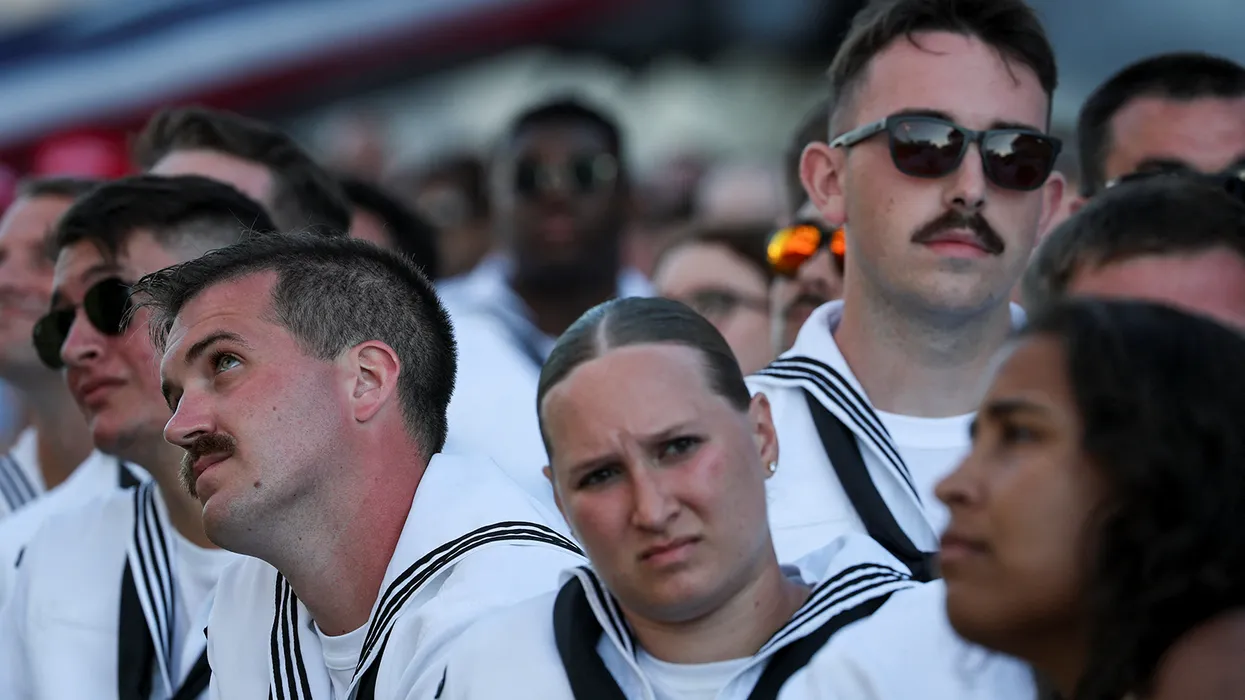
Yesterday, much of the media focused on the administration’s refusal to acknowledge the deteriorating conditions aboard the USS Abraham Lincoln. But the larger point was already visible: an aircraft carrier neglected by the commander-in-chief is one of the consequences of war. Iran defeated the United States, and the Lincoln is part of the aftermath.
On Monday, Democrats criticized the president on television for allowing the situation to worsen. The Lincoln, a nuclear-powered Nimitz-class aircraft carrier, has not touched land in nine months — far longer than the roughly six to seven months the Navy typically plans for carrier deployments, and extensions of that length strain crews, shipboard habitability, and the maintenance backlogs that await ships when they return home. According to Lucian K. Truscott IV, at least two crew members have tried to kill themselves by jumping overboard. Families of sailors have also reported "food shortages, meals missed, spoiled and rotten food, broken toilets, lack of hot water, mold and mildew in areas where sailors and Marines are quartered, lack of essential personal items like toothpaste and soap and deodorant."
Connecticut Sen. Dick Blumenthal, a Democrat who serves on the Senate Armed Services Committee, told CNN that the worsening conditions on the Lincoln show how "this endless war of impulse, without strategy and exit plan, is having a toll on our military readiness." Blumenthal also said his office had been informed that the USS Washington, a sister Nimitz-class carrier whose availability for deployment is governed by the Navy’s overhaul and training cycles, is "finally" being deployed to relieve the Lincoln.
That is one view. But the broader question is what military readiness means after a defeat. The ship’s condition, the argument goes, is the result of a war that was lost.
Truscott placed the blame on the president. "The president, the commander in chief, doesn’t care," said the former military affairs journalist for the Post. "He thinks people in the military are suckers and he treats them that way. He is wrong. Everyone in our military, and the sailors and Marines on that vessel, deserve to be treated with respect and honor. That isn’t happening, and it’s why the US military has lost the war Trump started with Iran."
The deeper claim is not only that Trump does not care about the military, but that he does not care about winning.
That may seem inconsistent with the image Trump has built around himself, but the argument is that he values the appearance of victory over actual victory. If he wanted to win, he would treat the military well and understand that morale matters. As Truscott put it, quoting his grandfather, "If you feed 'em and respect 'em and treat 'em right, soldiers honor you with their respect and their service," referring to "a famous general" — Gen. Lucian K. Truscott Jr., who commanded U.S. troops in North Africa and Sicily, took over the VI Corps at the Anzio beachhead in Italy, and later led the Seventh Army in the 1944 invasion of southern France.
Real victory, by contrast, requires sacrifice, work, commitment, motivation, principles, planning, adaptation when events go wrong, and courage in the face of possible failure. None of that fits Trump’s style. Sacrifice is for losers. Work is for suckers. In that view, he is the laziest president of our lifetimes.
Instead, the most he is willing to do is pretend to be winning, which only requires a television appearance and a lie. If pretending to fight is the real objective, then nothing else matters, especially not the well-being of the people actually doing the fighting. The result is defeat in war and a military that is deeply demoralized.
When asked whether Iran planned to wait until Trump is out of office, Mohammad Reza Naqdi, a senior commander of Iran’s Islamic Revolutionary Guard Corps, said yes. "We have to attain deterrence so that the enemy never dares to attack us, so that we can live with security. One way is to prolong this war until we get to the next term of the presidency."
That line, the argument says, should have been a banner headline. The point is that the Iranian side does not fear Trump. It sees him as a paper tiger that can be ignored. As a result, the strait — the Strait of Hormuz, the narrow chokepoint between Iran and Oman through which roughly a fifth of the world’s seaborne oil trade normally passes — has been closed and may remain closed for the rest of Trump’s term, potentially creating two more years of volatile and unpredictable global economic conditions.
The broader concern is that even enormous military spending cannot protect the United States if a determined adversary believes the commander-in-chief is weak. Military historian Phillips O’Brien, a professor of strategic studies at the University of St Andrews, wrote last week: "We need to face facts that the US military is in terrible shape and it will continue to get worse under the present leadership," adding that "This is in some ways the greatest scandal in US history. The US has spent about $9 trillion on defense since 2016, and has created this deeply flawed, deteriorating force."
The fact that Iran can ignore the president without consequences has not drawn much attention from most Americans, but Sen. Jon Ossoff has tried to make the issue harder to overlook. In an interview Monday, the Georgia senator, a Democrat who is seeking reelection in 2026 and has presidential ambitions, did not call Trump a paper tiger, but he described him in similar terms.
"The commander-in-chief has mired us in this geopolitical disaster," Ossoff said. "People have lost their lives. Our naval logistics are frayed. The global energy system is in crisis. And he retreats into this bubble of West Wing aides, who are his security blanket, to make him feel good about himself, to reassure him that he’s doing a great job, to help him while he designs his new ballroom, and he adorns the Oval Office in gold, and picks the interior decorations on this new luxury, flying palace he received from a foreign prince, when every single minute of every single day what the president of the United States should be doing is bearing his most solemn burden of care for the sailors and Marines and aviators, and all servicemembers deployed on his orders on the basis of his lies to this disaster in the Middle East."
The conclusion is stark: no country can defend itself for long, even with enormous financial resources, when the commander-in-chief cares more about appearances than about the people carrying out the mission.

