US Options Volume Hits Sixth Straight Record as 0DTE and Retail Trading Power the 2026 Pace
Key Takeaways
- •US-listed options volume hit a record 15.21 billion contracts in 2025, up 24.4% from 2024, marking the sixth consecutive record year, according to the OCC.
- •Average daily volume through September 2026 reached 70.6 million contracts, 20.6% above the same period of 2025, with Cboe projecting a full-year total of more than 18 billion contracts.
- •Zero-days-to-expiration options set a third-quarter 2026 record of 24.2 million contracts per day, about 36% of all options volume, while index and ETF products grew faster than single-stock options.
- •About 5.3 million individual customers traded US-listed options between November 2022 and the end of 2025, and retail traders are estimated to account for roughly half or more of total volume.
- •Exchanges are extending trading hours, with the NYSE adding pre-open and post-close options sessions and NYSE and Nasdaq planning 23-hour weekday trading from December 6, which could widen spreads in thinner overnight liquidity.
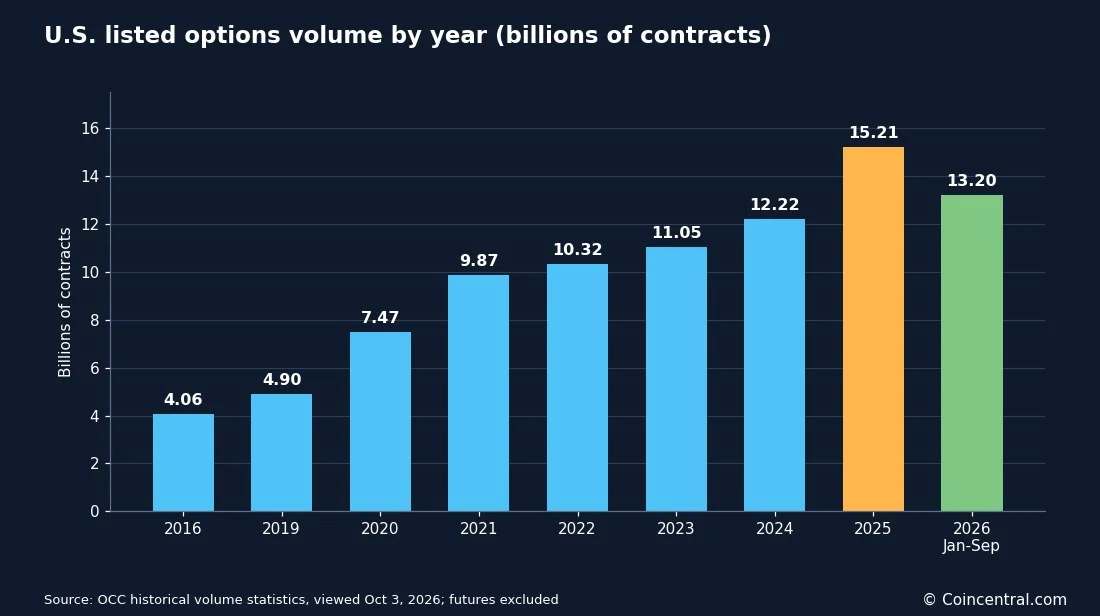
US-listed options volume reached a record 15.21 billion contracts in 2025, up 24.4% from 2024, according to the Options Clearing Corporation (OCC) — the sixth consecutive record year. Because the OCC clears every US-listed options contract, its totals serve as the industry-wide benchmark. The pace has accelerated further in 2026: through September, an average of 70.6 million contracts traded each day, a 20.6% increase over the same months of 2025.
The figures below compile the latest data on market size, product mix, trader numbers, the retail share of activity, zero-days-to-expiration (0DTE) options and trading costs. Each number is tied to its source and measurement period, and where sources disagree, both figures are cited.
Options Volume at a Glance
Options volume has grown roughly 3.7 times in nine years, rising from 4.06 billion contracts in 2016 to 15.21 billion in 2025, based on OCC data. Growth accelerated in 2020, when commission-free trading apps and pandemic-era retail participation drew new entrants to the market, and volume has set a record every year since.
Some outlets list 7.52 billion contracts for 2020 because the OCC also reports futures; the figures here count options only. Cboe puts 2025 growth at about 26%, while the OCC reports 24.4%, so each number is credited to its own source.
Daily Volume and the 2026 Pace
An average of about 61 million contracts traded per day in 2025, according to Cboe; the OCC reports 60.6 million. The single-day record is 110 million contracts, set on October 10, 2025, topping the previous mark of more than 100 million reached on April 4, 2025 during a tariff-driven selloff, as reported by Walnut. The year included 21 sessions above 70 million contracts, five of which exceeded 80 million.
In 2026, the daily average through September rose to 70.6 million contracts, 20.6% above the 58.5 million average for the same months of 2025, according to the OCC. Cboe projected in July that 2026 is on pace for well above 18 billion contracts. Through September, the market had cleared 13.2 billion, about 87% of the 2025 record, meaning an 18-billion-contract year would require a faster fourth quarter than the first nine months delivered.
Cboe also reported a one-day record of 33.4 million contracts across its own exchanges on June 5, 2026, when markets fell sharply, according to Reuters. The company's second-quarter options net revenue rose 30% to $473.9 million as its average daily volume climbed 26%.
Which Products Drive Volume
Single-stock options made up 54% of US options volume in 2025, or 8.27 billion contracts. ETF options accounted for 37% (5.68 billion) and index options 8% (1.26 billion), based on OCC data.
Growth in 2026 has favored funds and indexes. Through September, average daily ETF options volume is up 35.4% and index options are up 29.3%, while equity options are up 9.3%, per OCC data reported by Walnut. Cboe's first-half figures show the same pattern: index options grew 25% and ETF options 27%, against 6% for single-stock options. FLEX options, which are customized contracts, grew nearly 47%.
Volume remains concentrated in a handful of names. In the second quarter of 2026, SPX — options on the S&P 500 index — made up 81% of index options volume and SPY, the exchange-traded fund that tracks the same index, accounted for 42% of ETF options volume. Nvidia and Tesla each represented 9% of single-stock volume, followed by Apple at 3%. That concentration ties much of the market's activity to the S&P 500 and a small group of mega-cap stocks.
SEC staff found that the 10 most-traded stocks made up 31.7% of single-stock options volume at the end of 2025, up from .0% in 2012.
How Many People Trade Options
About 5.3 million individual customers traded US-listed options from November 2022 to the end of 2025, according to SEC staff. The exact count is 5,299,576, or 7.5% of the 70.6 million individual customers in the SEC's data. Far more customers traded stocks, at 70.2 million in total, and only about 227,000 traded options without also trading stocks.
The SEC counts customer IDs, the closest available measure of a head count. A person with accounts at three brokers counts once, while a joint account can count twice. The method also excludes index options such as SPX, a notable omission given that index products are among the market's fastest-growing segments.
FINRA's 2024 Investor Survey, published in December 2025, found that 21% of US investors with money outside retirement accounts had ever bought or sold options, up from 19% in 2021. Another 43% said they hold an account that allows options trading. FINRA also found that 34% of US adults hold investments outside retirement accounts; multiplying the two figures yields a rough estimate that 7% of US adults have ever traded options — a calculation, not a number FINRA publishes.
New participants are joining more slowly. SEC staff found that new individual customers entering options ran at 25,000 to 44,000 per month from mid-2022 through 2023. The count topped 50,000 in May 2024, then fell below 30,000 per month by late 2024 and kept falling through 2025. Volume kept rising regardless, suggesting people already trading are doing more of it.
Who Trades Options
Younger investors are far more likely to have traded options. In the FINRA survey, 43% of investors under 35 had done so, compared with 24% of those aged 35 to 54 and 10% of those 55 and older. Men were more likely than women to have traded options (24% versus 17%) and more likely to hold an options-enabled account (48% versus 36%).
Understanding of the products is limited. Only 12% of US investors answered a basic call-option question correctly in the same survey, and half said they did not know. The question asked what a call option with a $50 strike is worth on expiration day if the stock trades at $40; the answer is $0. Among investors who had traded options, 22% answered correctly and 54% got it wrong.
Trade sizes are shrinking, consistent with the spread of small accounts. Trades of 10 contracts or fewer rose to 30.2% of industry volume by August 2025, from 27.4% in January 2023, while odd-lot trades rose from 57% to 66% over the same period, according to MEMX data reported by Walnut.
What Share of Trading Is Retail
Retail traders account for roughly half or more of US options volume, depending on who measures it. There is no single official figure. Estimates differ because each source counts something different: some track retail broker order flow, some use older academic data, and some count individual accounts while leaving out market makers and index options. The SEC figures exclude index options, and the MEMX figure covers one trading venue, so it is not a market-wide share.
Retail activity moved with market events in 2026. Cboe said activity in accounts with less than $25,000 rose in the second quarter, after the Pattern Day Trader rule was repealed. Retail order flow then reached all-time highs in September, according to Cboe, as reported by Traders Union. Cboe executives also pointed to a jump in simple order counts, which are single options trades rather than spreads, describing it as a sign of broader retail engagement, according to Reuters.
How Popular Are 0DTE Options
Zero-days-to-expiration (0DTE) options expire the same day they trade. They made up 24.1% of all US listed options volume in 2025, about 14 million contracts per day, up from 21.5% in 2024 and almost double the 2022 share, according to Traders Magazine citing OCC and Cboe data.
In the first half of 2026, 0DTE volume topped 20 million contracts per day, up 46.2% year to date, per Cboe. In the third quarter, it hit a record 24.2 million contracts per day, about 36% of all options volume. Walnut, citing Cboe, reports that SPX 0DTE volume reached a record 3.2 million contracts per day in Q3 2026, out of 4.9 million total SPX contracts, roughly 65%. Cboe's Q3 data, as reported by Traders Union, puts 0DTE at 56% of all index options volume.
Retail traders made up an estimated 53% of SPX 0DTE volume in August 2025, according to Cboe. A working paper by Beckmeyer, Branger and Gayda found that more than 75% of retail trades in S&P 500 index options were 0DTE in 2022 and 2023.
Most SPX 0DTE trades carry limited risk: over 95% were long options or spreads with a known maximum loss, and only 4% were naked short options, per Cboe (May 2025). A capped loss can still eliminate an entire position in a single day. Same-day expirations are also spreading to single stocks, as Monday and Wednesday expirations in names such as Tesla, Nvidia, Apple, Amazon and Meta now approach 6 million contracts per day combined, according to Cboe.
What Percentage of Options Expire Worthless
About 22% of options expire worthless, according to the Options Industry Council (OIC), an investor education group funded by the OCC. It says that historically more than 72% of options are closed before expiration and about 6% are exercised. The OIC page is undated and gives no method, and it does not say whether the shares refer to contracts traded or contracts open at expiration, so the figures are best treated as a rule of thumb.
The popular claim that 80% or 90% of options expire worthless has no primary source that could be located. A breakdown often attributed to Cboe, which splits outcomes into 10% exercised, 55% to 60% closed and 30% to 35% worthless, likewise could not be traced to a Cboe page. Expiring worthless also says nothing about who made money: most positions close early, and a seller can buy back a short option at a loss days before expiration.
Do Retail Options Traders Lose Money
Retail options traders lost money on average in each US study reviewed, and trading costs were a large part of the losses. No US regulator publishes the share of options traders who lose. The common claim that 90% of options traders lose money has no primary or peer-reviewed source that could be found.
Aggregate loss estimates should not be added together: the $2.1 billion figure assumes a 10-day holding period, and the $3 billion figure is scaled up from a sample covering about a quarter of option activity. The working papers had not been peer reviewed at these versions.
Costs matter. The bid-ask spread — the gap between the best available buy and sell prices — is direct cost paid every time a trader crosses it. Retail investors favored cheap weekly options with an average bid-ask spread of 12.6% from November 2019 to June 2021. Market-wide, the median effective spread at the end of 2025 was 1.9% on single-stock options and 1.4% on ETF options, per SEC staff.
Order type also affects cost. In December 2025, individual customers' marketable single-leg options orders received price improvement 0% to 13% of the time, depending on spread width, while their non-marketable limit orders received it 80% to 99% of the time, according to SEC staff. A separate study reported by Walnut puts the average effective spread paid by retail traders above 23%. Spread estimates vary by method, product and period.
Do Option Sellers Do Better Than Buyers
In the trader-level research available, sellers did better on average. In data on 5,182 retail traders from 2020 to 2022, naked option sales made up 13% of trades and earned 20% on average, while option purchases lost 3.95%. Those traders used a trading-journal service, and the authors describe them as relatively sophisticated; they may not represent all retail traders.
Selling premium tends to win often and can give back a great deal when it loses. A high win rate does not show the full picture unless the average win and average loss are shown alongside it.
In 0DTE trading, the Beckmeyer, Branger and Gayda paper found that losses came mainly from single-leg, premium-paying and high-volatility trades. Multi-leg trades did better, although they also lost money on average.
Q3 2026, Longer Hours and What Comes Next
Options trading eased in the third quarter of 2026. Cboe reported average daily volume of 70.6 million contracts, down 4% from the record second quarter, according to Traders Union. Single-stock options fell 8% to 32.7 million per day and index options slipped 3% to 6.1 million, while ETF options rose 1% to 28.3 million. FLEX options set a record at 2.33 million per day.
Trading hours are also expanding. Overnight Global Trading Hours in SPX, XSP, VIX and RUT set a September record of nearly 288,000 contracts per day, almost 3% of index options activity. Cboe also began pre-market trading from 7:30 a.m. to 9:25 a.m. ET for options on 27 stocks and ETFs, which together account for 53.4% of market volume.
The New York Stock Exchange said it will open options trading for about two hours before the 9:30 a.m. ET open and for 15 minutes after the close. NYSE and Nasdaq also plan to extend stock and ETF trading to 23 hours a day, five days a week, starting December 6, according to Dow Jones. Duke University finance professor Campbell Harvey said liquidity at midnight will be thinner than at noon, which could widen spreads, meaning traders who use the new hours may pay more per contract than they would during the regular session.
The industry now has 20 options exchanges across six operators, after two launched near the end of the third quarter. With daily volume above 70 million contracts and trading hours expanding, the next test is whether activity holds as markets move — whether the fourth quarter runs fast enough to push the year beyond the 18 billion contracts Cboe projected in July, and whether liquidity in the new overnight and pre-market sessions stays deep enough to keep trading costs near their regular-session levels.
Sources
- Cash Flow University: Options Trading Statistics 2026, Traders, Volume and Losses
- Cboe: State of the Options Industry; Options Market Continued to Break Records in Q2 2026
- Traders Union: Cboe Reports Q3 Options Volume Shifts Toward Index and ETF Contracts
- CoinLaw: Retail Options Trading Statistics 2026, Volume and Trends
- Walnut: Options Trading Statistics (2026)
- Morningstar and Dow Jones: NYSE Just Extended Options Trading Hours. It's Only the Beginning.
- Reuters: Cboe Exceeds Profit Expectations as Volatility Spurs Options Trading Boom

