US S&P Global July Flash PMIs Expected to Confirm Steady Business Growth
Key Takeaways
- •The July flash US PMIs are expected to show continued private-sector expansion, with both manufacturing and services readings forecast above 50.
- •Market consensus sees the Services PMI slipping to 51.0 from 51.2 and the Manufacturing PMI rising to 54.5 from 53.9.
- •WTI crude has climbed nearly 30% in July amid increased US-Iran military tensions, raising focus on input-cost inflation in the PMI data.
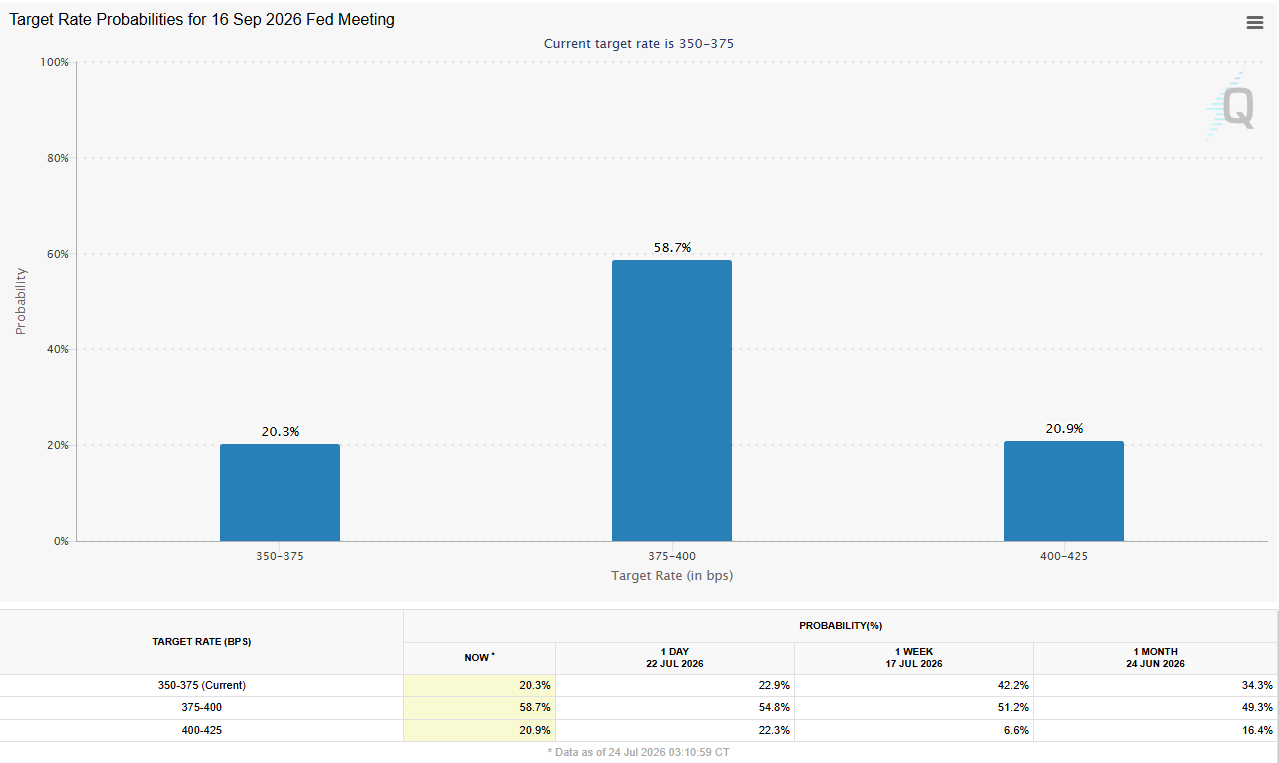
- •Markets are pricing an almost 80% chance of at least a 25 basis point Federal Reserve rate increase by September, according to the CME FedWatch Tool.
- •Rabobank analysts warned that the preliminary PMI survey may not fully reflect the latest Middle East escalation or the recent oil-price increase.
S&P Global is scheduled to release the July flash Purchasing Managers' Indices (PMIs) for the United States on Friday. These surveys, conducted among top private-sector executives, are widely regarded as an early gauge of the country's economic health. The flash readings are based on partial survey responses and typically precede final PMI figures by roughly a week, making them a timelier but less complete snapshot of private-sector conditions.
Market participants anticipate the S&P Global Services PMI to dip slightly to 51.0 from 51.2 in June, while the S&P Global Manufacturing PMI is expected to edge higher to 54.5 from 53.9. Both readings would remain in expansionary territory above the 50 threshold. The Composite PMI, a weighted blend of the manufacturing and services outputs that provides a holistic view of private-sector performance, will also be published alongside the sector-specific reports. Beyond the headline figures, the surveys also capture data on employment and input inflation, both of which could influence the US Dollar's (USD) valuation.
Input Costs and Oil Prices in Focus
While PMI surveys are forecast to reaffirm healthy business conditions in the private sector, details surrounding input costs could amplify market volatility. Although softer-than-expected June inflation data from the US eased bets on a Federal Reserve (Fed) interest rate hike in July, the recent surge in oil prices has led investors to refrain from pricing in a prolonged policy hold.
With the US and Iran ramping up military aggression in the Middle East, West Texas Intermediate (WTI) crude has risen nearly 30% in July. Meanwhile, the CME FedWatch Tool indicates that markets are pricing in a nearly 80% probability of at least a 25 basis points (bps) Fed rate hike by September.
Analyst Expectations
Previewing the PMI data, TD Securities analysts stated: "We expect both the S&P manufacturing and services PMIs to improve in July. Manufacturing is likely to rebound to 54.5, in line with strong regional surveys in the month (Empire and Philly Fed)."
"Meanwhile, services is likely to continue improving to 51.5. NY Fed services improved in July, and we expect S&P to begin catching up to ISM," they added. The reference to S&P catching up to ISM reflects that the Institute for Supply Management (ISM), a separate and closely watched US PMI series, has at times diverged from S&P Global's readings in recent months.
Release Schedule and EUR/USD Implications
The S&P Global Global Manufacturing, Services, and Composite PMI reports will be released at 13:45 GMT on Friday. As noted, they are expected to show that US business activity continued to expand in July.
If the publication suggests that business owners face rising input costs and are considering passing those costs on to consumers through price increases, markets could interpret this as a sign of inflationary pressures resurfacing. In that scenario, the USD could continue to strengthen heading into the weekend, weighing on EUR/USD.
Conversely, an unexpected drop into contraction territory below 50 in either the headline Manufacturing or Services PMI could weaken the USD in the immediate reaction and help EUR/USD hold its ground.
Middle East Tensions May Be Underrepresented
Analysts at Rabobank caution that the initial July PMI signals may not fully capture the latest geopolitical and commodity-market developments. They argue that "this preliminary reading may understate the impact of the escalation in the Middle East," noting that "the July poll was probably conducted in the past two weeks, so the results may be skewed if many respondents replied early – and therefore could not fully factor in the current situation in the Middle East, or this week's increase in oil prices."
Eren Sengezer, European Session Lead Analyst, provided a technical outlook for EUR/USD:
"EUR/USD trades below the 20-day Simple Moving Average (SMA) following multiple failed attempts to clear that level earlier in the week. Additionally, the Relative Strength Index (RSI) indicator on the daily chart stays near 40, reaffirming the bearish stance."
"On the downside, 1.1370-1.1350 (Bollinger Band lower arm, static level) aligns as the first support area ahead of 1.1270 (static level) and 1.1160 (static level). Looking north, the immediate resistance level could be spotted at 1.1420 (20-day SMA), followed by 1.1470 (Bollinger Band upper arm) and 1.1570 (100-day SMA)."

