'Wow, wow, wow!': CNBC's Rick Santelli Stunned as US Economy Adds 162,000 Jobs — Triple Expectations
Key Takeaways
- •The U.S. added 162,000 nonfarm payroll jobs in August 2026, more than three times the 53,000 jobs economists had forecast.
- •Revisions raised June's gain to 31,000 and turned July's reported 23,000-job loss into a 21,000-job gain, together adding 55,000 jobs versus prior estimates.
- •Manufacturing employment rose by 16,000 in August, its best month since late 2023, bringing cumulative gains since December 2025 to 58,000 jobs.
- •The unemployment rate stayed at 4.1% while labor force participation increased to 61.6%, and the average private-sector workweek edged up to 34.4 hours.
- •Warren Buffett has repeatedly advised most investors to own an S&P 500 index fund and has identified income-generating real estate, such as apartments, as a productive asset.
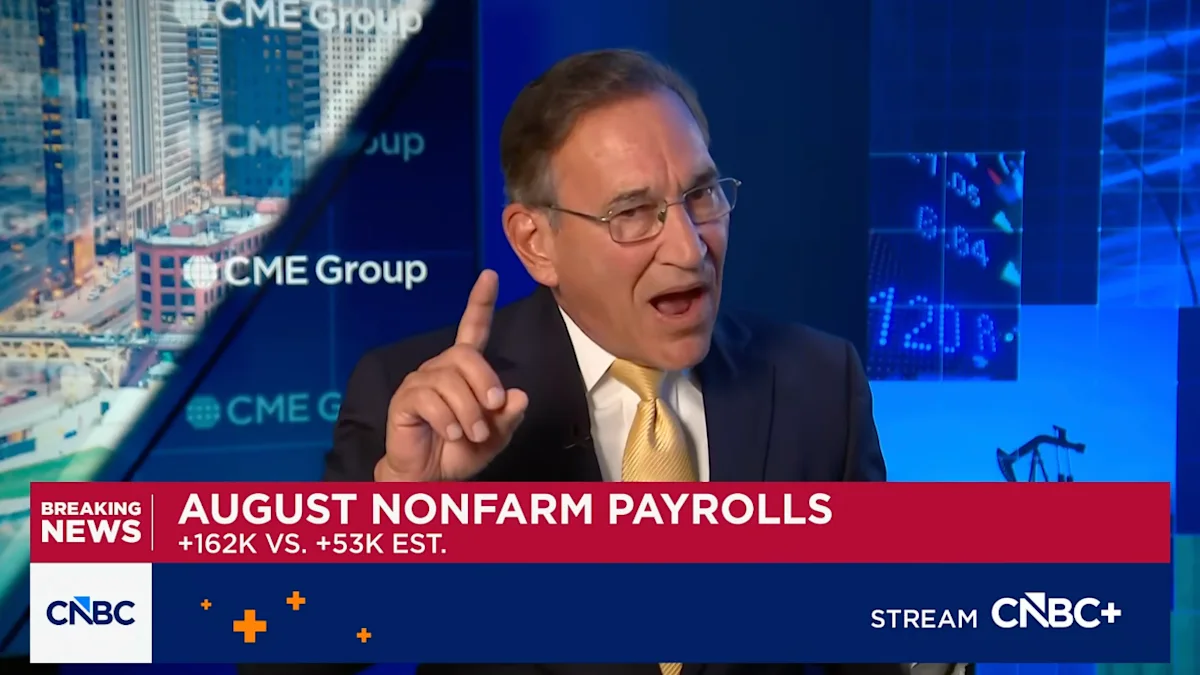
CNBC's Rick Santelli has analyzed countless economic releases over his decades at the network, but the veteran market commentator could barely contain his surprise when the latest U.S. jobs numbers crossed the screen during live coverage on the morning of Sept. 4.
"Hold on to your seats, folks," Santelli said during CNBC's live coverage. "Nonfarm payrolls for the month of August: up 162,000. That's basically three times what expectations are."
The monthly employment report is among the most closely watched economic indicators in the world, because the Federal Reserve, Congress, businesses and investors all use it to gauge the health of the labor market — and it carries outsized weight in debates over the direction of interest-rate policy.
The official figures confirmed the magnitude of the surprise. The U.S. economy added 162,000 nonfarm payroll jobs in August, according to the U.S. Bureau of Labor Statistics — more than three times the 53,000 jobs economists had expected.
Major Revisions Added to the Surprise
The payroll gain was not the only positive development. The government revised June's gain upward from 20,000 to 31,000 jobs, while July's initially reported loss of 23,000 was transformed into a gain of 21,000. Together, the revisions made employment growth across the two months stronger than previously reported by 55,000 jobs.
Revisions are a regular feature of the jobs report — the BLS updates its estimates in each of the two months after an initial release as more complete payroll data arrives — and August's upward revisions made the underlying trend look firmer than the earlier prints had suggested. Investors will be watching whether September's report confirms that strength or whether August itself gets revised.
"We're cooking in grease on this report," Santelli declared. "162,000 would be the best level going back to March of this year, which was the high-water mark at 214,000."
Manufacturing Renaissance Continues
Santelli was especially encouraged by manufacturing, which added 16,000 jobs in August — its strongest showing since late 2023. Manufacturing employment has now increased by 58,000 since December 2025.
"If you look at manufacturing jobs, the renaissance continues," he said.
The unemployment rate held steady at 4.1%, even as the labor force participation rate edged up to 61.6%. Ordinarily, an influx of people entering or reentering the workforce can push the unemployment rate higher because more Americans are actively looking for jobs. That did not happen this time.
"I thought that moving higher would make the unemployment rate move up, but it did not," Santelli said of the participation rate. "That's a whopping two-tenths better than our last look."
The average workweek in the private sector ticked up from 34.3 to 34.4 hours, another development Santelli called "solid."
After the economy had averaged just 31,000 new jobs per month over the preceding 12 months, the August surge delivered an unmistakable upside shock. Santelli's reaction summed it up: "Wow, wow, wow!"
Betting on America
A stronger job market can support consumer spending, corporate earnings and the broader economy. Rising manufacturing employment could also benefit companies positioned to gain from increased domestic investment and production.
Taken together, the numbers offer a reminder that even amid inflation concerns, policy uncertainty and market volatility, the U.S. economy retains powerful engines of growth — a point investing legend Warren Buffett has repeatedly emphasized.
"For 240 years it's been a terrible mistake to bet against America, and now is no time to start," Buffett wrote in his 2015 shareholder letter. "America's golden goose of commerce and innovation will continue to lay more and larger eggs."
Buffett has also offered a clear, simple piece of guidance for everyday Americans — no stock-picking skills required.
"In my view, for most people, the best thing to do is own the S&P 500 index fund," Buffett has famously stated. This approach provides exposure to 500 of America's largest companies across a wide range of industries, offering instant diversification without the need for constant monitoring or active trading.
According to S&P Global, as of August 2026 the S&P 500 is up 13% year-to-date and roughly 70% over the past five years.
Real Estate as a Productive Asset
Beyond stocks, real estate has long been another cornerstone of building wealth in America. Buffett has pointed to real estate when explaining what a productive, income-generating asset looks like.
In 2022, Buffett stated that if you offered him "1% of all the apartment houses in the country" for $25 billion, he would "write you a check this afternoon." His reasoning: regardless of what is happening in the broader economy, people still need a place to live, and apartments can consistently produce rental income, even during a stock market downturn.
Real estate also offers a built-in hedge against inflation. When inflation rises, property values often increase as well, reflecting the higher costs of materials, labor and land. At the same time, rental income tends to rise, providing landlords with a revenue stream that adjusts with inflation.
In a report prepared by JPMorgan, Al Brooks — the firm's vice chair of Commercial Banking — said, "I think multifamily housing is absolutely where you want to be as an investor."
Sources
YouTube; U.S. Bureau of Labor Statistics; CNBC; Berkshire Hathaway; S&P Global; JPMorgan Chase
This article provides information only and should not be construed as advice.
