Twelve-Factor App Guidelines Remain a Cloud-Native Software Checklist
Key Takeaways
- •The Twelve-Factor App methodology was developed in 2011 by Heroku co-founder Adam Wiggins after observing application patterns on the Heroku platform.
- •The framework promotes repeatable cloud deployments through a single codebase, explicit dependency management, and configuration supplied through the environment.
- •The methodology treats databases, queues, caches, and other backing services as replaceable attached resources.
- •It recommends immutable build-release-run pipelines, stateless processes, port binding, process-based scaling, and graceful startup and shutdown behavior.
- •The article says the original Twelve-Factor list remains useful but does not fully address modern observability, secrets management, security, or API concerns.
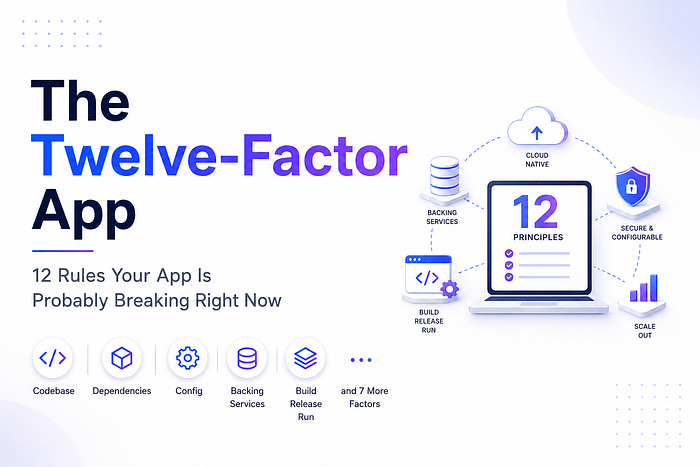
Towards AI published an article titled “The Twelve-Factor App: 12 Rules Your App Is Probably Breaking Right Now,” last updated on July 27, 2026 by the Editorial Team and originally published on Towards AI.
The article revisits the Twelve-Factor App methodology, a set of software design guidelines written in 2011, before Docker became widely used. The piece frames the methodology as a checklist that continues to influence how cloud-native applications are evaluated and built.
According to the article, Adam Wiggins, co-founder of Heroku, developed the guidelines after observing patterns while running thousands of applications on the Heroku platform. The Twelve-Factor App approach is presented as a practical framework for building software that can be deployed reliably across modern cloud environments.
The article explains that a cloud-native application should use a single codebase that can be deployed across multiple environments. It also stresses that dependencies should be declared explicitly and isolated, rather than assumed to be present on the underlying system. Together, these rules support repeatable deployments by reducing hidden differences between environments.
Configuration is another core principle. The methodology recommends supplying configuration through the environment instead of embedding it directly in application code. This separation is intended to make applications easier to move between development, staging, and production environments without changing the codebase.
The guidelines also treat backing services as attached resources. Databases, queues, caches, and other external services should be considered replaceable resources that can be swapped without requiring major application changes.
The article further highlights the importance of a strict build, release, and run pipeline. Under this model, the build stage creates an executable artifact, the release stage combines that artifact with configuration, and the run stage executes the application. Releases are treated as immutable.
For scaling and reliability, the Twelve-Factor App methodology calls for stateless processes. Application processes should not depend on local state, allowing horizontal scaling and replacement of instances. Port binding is also emphasized so that the application is self-contained and can expose services directly through a port.
The piece also discusses concurrency through process scaling. Rather than relying on a single large process, applications should scale by running multiple processes. Disposability is another requirement, with applications expected to start quickly and shut down gracefully. These principles are central to applications that need to be replaced, restarted, or scaled without preserving state on an individual instance.
Dev/prod parity is described as a way to reduce “works locally” problems. The article says development, staging, and production environments should remain as similar as possible to avoid unexpected behavior during deployment.
Logs are addressed as event streams. Instead of managing log files internally, applications should write logs as streams that can be collected and processed by an observability system. Administrative and maintenance tasks should run as one-off processes in the same environment as the application.
The article concludes by noting how software practices have evolved since 2011. It says observability now extends beyond logs, configuration and secrets management have become more sophisticated, and security and API concerns are not explicitly covered in the original Twelve-Factor App list. That framing makes the methodology a baseline checklist rather than a complete modern architecture model.
Published via Towards AI.
Note: Article content contains the views of the contributing authors and not Towards AI.

