HSC Conference Ho Chi Minh: From Rails to Reality in the ‘Tokenization Era’
Key Takeaways
- •Panelists argued that with tokenization rails largely in place, the industry's next challenge is proving clear value through adoption, distribution, and real-world utility rather than building more infrastructure.
- •Institutional-grade tokenized products already run on public blockchains: Franklin Templeton has operated an on-chain money market fund since 2021, BlackRock launched BUIDL in March 2024, and tokenized US Treasury products total in the billions of dollars.
- •Vietnam combines top-ranked grassroots crypto adoption and a deep pool of blockchain engineers, yet the lack of detailed rules for tokenized securities has kept securities-related projects from moving forward.
- •Vietnam's National Assembly passed its first digital technology law in June 2025, effective January 2026, which introduces initial legal definitions for digital assets and crypto assets.
- •Vietnamese authorities are prioritizing physical assets such as commodities and infrastructure in early phases instead of immediately allowing tokenized securities, reflecting a safety-first regulatory stance.
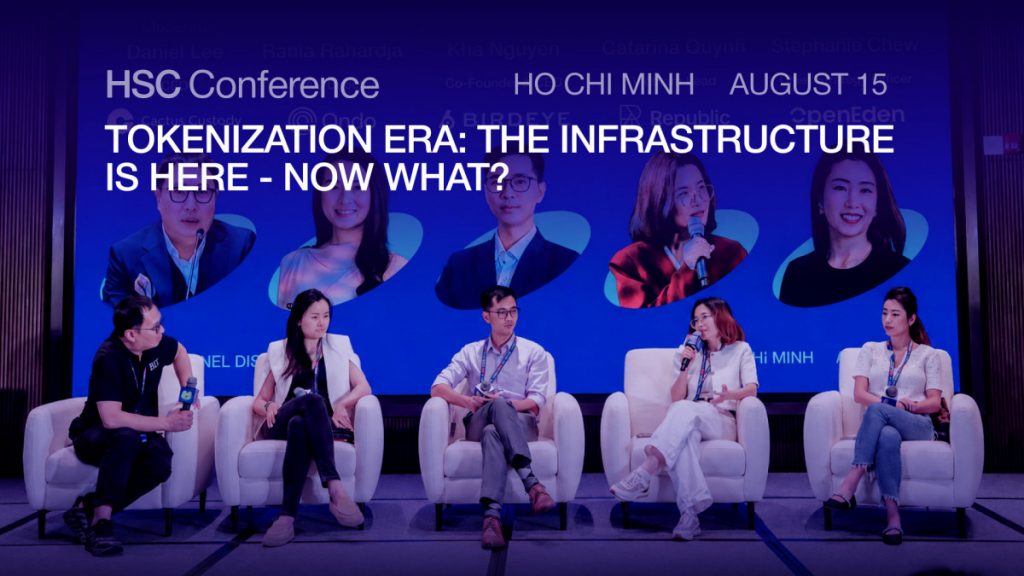
At the HSC Conference in Ho Chi Minh City, senior leaders from tokenization platforms, crypto data providers, and advisory firms gathered to examine how real-world asset tokenization is moving from theory to practical financial infrastructure.
The featured session, “Tokenization Era: The Infrastructure Is Here – Now What?”, was moderated by Daniel Lee, CEO of Cactus Custody, and included Rania Rahardja, APAC Director at Ondo Finance; Kha Nguyen, Co-founder and CEO of Birdeye; Catarina Quynh, Vietnam Lead at Republic Advisory; and Stephanie Chew, Chief Strategy Officer at OpenEden.
Rather than treating tokenization’s technical foundation as the end point, the panel focused on adoption, distribution, and real-world utility. The speakers discussed where tokenized assets are gaining traction, why markets such as Vietnam are taking a cautious approach to regulation, and what will be required for the sector to scale beyond infrastructure.
From Rails to Rationale
The panel quickly shifted from technical capability to practical purpose. With tokenization rails now largely in place, the participants said the industry’s next challenge is to prove clear value. They focused on the problems that tokenization is intended to solve and the conditions needed for wider adoption.
That starting point reflects how far the sector has already moved. Franklin Templeton has operated an on-chain money market fund since 2021, BlackRock launched its tokenized money market fund BUIDL in March 2024, and industry trackers put the total value of tokenized US Treasury products in the billions of dollars — institutional-grade products are already running on public blockchains.
The Case for Tokenization
The conversation began with a basic question: what does tokenization solve?
Rania Rahardja of Ondo Finance identified three main benefits. First is accessibility. Blockchain makes it possible for global investors to access assets that were once limited to U.S. high-net-worth individuals or institutions. Second is operational and capital efficiency. As stablecoins changed payment flows, tokenized assets can enable 24/7 instant settlement. Third is composability. Rahardja said tokenized assets can be used as collateral across decentralized finance protocols and perpetual trading platforms, allowing capital to be used more efficiently than in traditional brokerage accounts.
Vietnam’s Cautious but Promising Path
The discussion then turned to Vietnam. Kha Nguyen of Birdeye said the country has the technical capacity for tokenization, but the lack of a comprehensive regulatory framework has kept securities-related projects from moving forward.
The gap stands out against Vietnam’s grassroots adoption: the country has repeatedly ranked at or near the top of Chainalysis’ Global Crypto Adoption Index in recent years, even though a comprehensive legal framework has yet to take effect. Vietnam’s National Assembly passed its first digital technology law in June 2025, which takes effect in January 2026 and introduces initial legal definitions for digital assets and crypto assets, but detailed rules for tokenized securities have yet to be spelled out.
Catarina Quynh of Republic Advisory, who also serves as a board member of the Global Onchain Economy in Vietnam, offered a government-focused perspective. She said Vietnamese authorities are taking a cautious approach and are prioritizing physical assets such as commodities and infrastructure rather than immediately allowing tokenized securities.
“They try to allow for the Vietnam enterprise to do the RWA,” she said, “but at the first phase is more safety for them.”
Quynh said this approach reflects regulators’ recognition of both the opportunity and the risks associated with digital assets.
The sequencing also differs from regional financial hubs. Singapore’s central bank has run the Project Guardian tokenization pilots with major banks since 2022, and Hong Kong’s securities regulator set out rules in 2023 that allow tokenized funds to be distributed to retail investors under conditions.
Talent and Infrastructure
The panel also discussed Vietnam’s talent base. Nguyen said the country’s strong mathematics education and long history in IT outsourcing have created a deep pool of blockchain engineers. Stephanie Chew confirmed that OpenEden’s entire development team is based in Vietnam.
At the same time, the speakers said the market lacks professionals with advanced financial expertise. Quynh said many Vietnamese companies interested in tokenization struggle to find business leaders who understand custody structures, issuance models, and revenue frameworks.
“We have many talents in the developing technology side,” she said, “but few in the business side.”
Bridging Traditional and Decentralized Finance
The panel also looked at how tokenization is bringing traditional finance into the crypto ecosystem. Chew, drawing on her background in private banking, said tokenized money market funds meet institutional needs that conventional brokerages cannot address.
For example, she said a traditional investor may hold Treasury bills directly, while tokenized versions can be used as collateral for options trading, perpetual contracts, and off-exchange margin. She said that this composability is what makes tokenization meaningfully different.
Rahardja added that major asset managers are increasingly exploring distribution partnerships, supported by regulatory developments such as the GENIUS Act in the United States. The GENIUS Act, signed into law in July 2025, created the first federal regulatory framework for payment stablecoins in the United States.
Looking Ahead
As the session ended, each panelist offered a forward-looking view.
Rahardja summarized Ondo Finance’s goal by saying, “What stablecoins did for the US dollar, Ondo will do for public equities.” Chew said OpenEden remains focused on building infrastructure for more efficient capital markets. Quynh urged Vietnamese enterprises to identify global buyers before designing tokens.
Together, their comments presented tokenization as an industry where technical development, regulatory caution, and market demand are increasingly converging.
