Cardano Whales Buy the Dip as ADA Reclaims $0.211
Key Takeaways
- •Wallets holding between 10 million and 100 million ADA accumulated about 160 million tokens since Sunday, according to Santiment data.
- •ADA’s derivatives market remains cautious, with the long-to-short ratio near 0.90 and bearish positions still dominant.
- •The token’s open interest-weighted funding rate turned positive on Thursday and rose to 0.0013% on Friday, indicating some improvement in bullish sentiment.
- •ADA is still trading above its 50-day and 100-day exponential moving averages at $0.190 and $0.197, respectively.
- •Key short-term levels include support near $0.195 and resistance at $0.213, with a break above or below those levels likely to guide the next move.
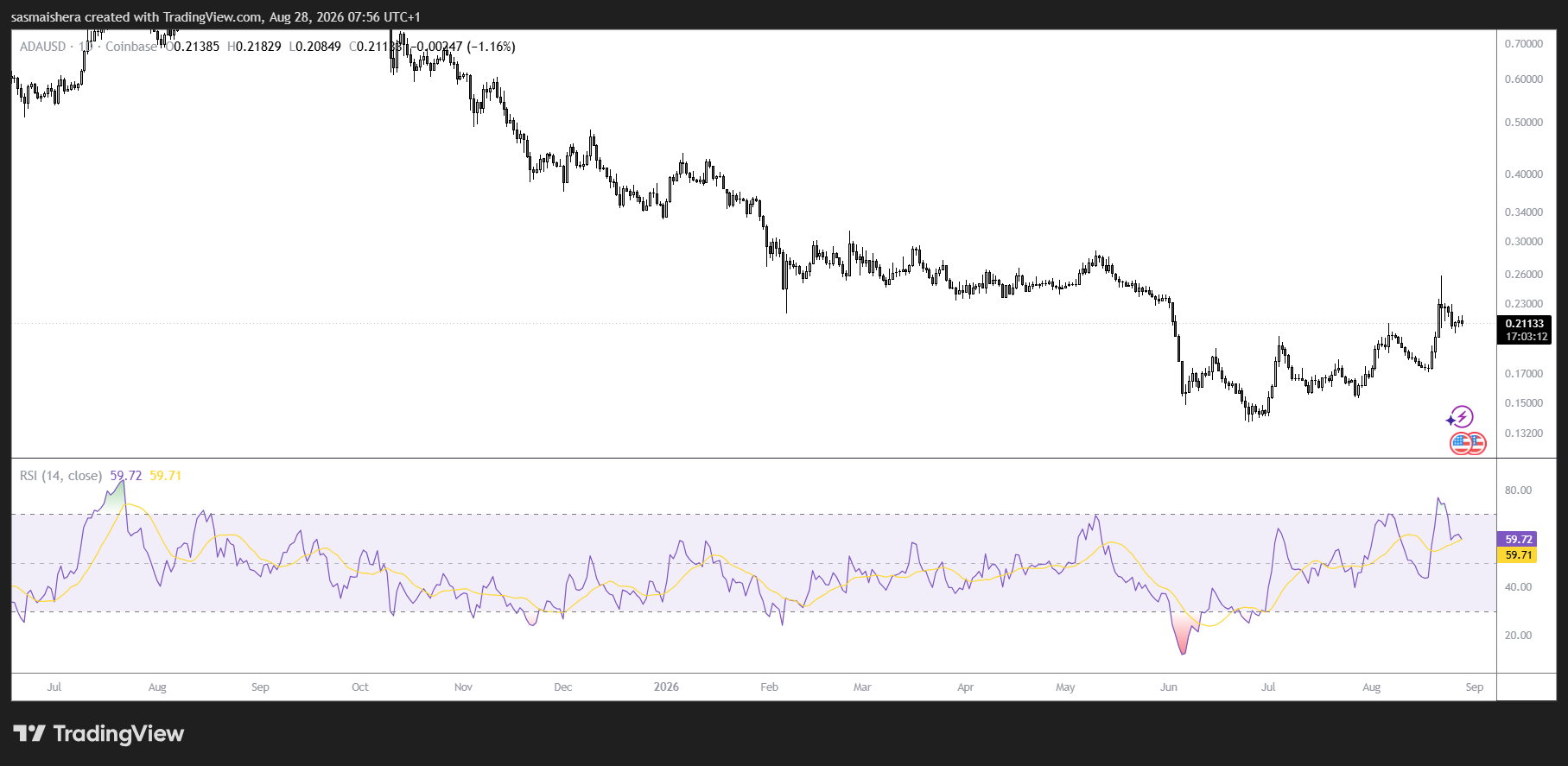
Cardano's ADA, the native token of the proof-of-stake blockchain network of the same name, is trading around $0.210 on Friday after shedding more than 7% since the beginning of the week. Despite the pullback, on-chain data shows that some large investors have been accumulating the token, while conflicting derivatives and on-chain signals leave traders uncertain about whether the cryptocurrency can recover or extend its decline.
ADA's long-to-short ratio has fallen to 0.74, a level indicating that bearish positions dominate the derivatives market. At the same time, wallets holding between 10 million and 100 million ADA have accumulated roughly 160 million tokens since Sunday.
Whales accumulate 160 million ADA
Santiment's Supply Distribution data shows that large Cardano holders have been buying ADA during the latest price correction. Wallets holding between 10 million and 100 million ADA accumulated approximately 160 million tokens since Sunday—worth roughly $34 million at current prices near $0.21—indicating that some whales continue to view the lower prices as a long-term buying opportunity.
The accumulation has yet to generate enough demand to reverse ADA's short-term decline. Whale buying during a pullback can support a positive longer-term outlook, but it does not guarantee an immediate recovery—particularly when broader market sentiment remains cautious.
Mixed derivatives signals
Cardano's derivatives indicators present a mixed picture. CoinGlass data shows that ADA's long-to-short ratio stood at 0.90 on Friday, approaching its lowest level in more than a month. A ratio below one indicates that more traders hold short positions than long positions, reflecting expectations of further price declines. The reading suggests that bearish traders continue to dominate the derivatives market despite the recent accumulation by whales.
ADA's funding rate paints a slightly more optimistic picture. According to CoinGlass, the token's open interest-weighted funding rate turned positive on Thursday and reached 0.0013% on Friday. A positive funding rate means traders holding long positions are paying those with short positions, which typically indicates that bullish positions are becoming more prominent even though the long-to-short ratio continues to favor sellers. The divergence between the two indicators highlights the uncertainty surrounding Cardano's near-term direction.
CryptoQuant's summary data supports this cautious view. Although the futures market has recorded large whale orders, selling activity remains dominant, while several other indicators are neutral. Together, the metrics point to indecision rather than a clear bullish or bearish trend.
Cardano holds above key moving averages
Despite losing more than 7% during the week, Cardano remains above its 50-day and 100-day Exponential Moving Averages at $0.190 and $0.197, respectively. Holding above these averages gives ADA a slightly bullish short-term bias, although the token continues to trade below significant overhead resistance.
Momentum indicators are also cooling. The Relative Strength Index has retreated toward the upper-50 region, while the Moving Average Convergence Divergence histogram is contracting. These readings suggest that the buying momentum behind Cardano's recent rebound is weakening.
Cardano's first major resistance sits at $0.213, corresponding with the 50% Fibonacci retracement level of its latest decline. A close above this level could allow ADA to target the 61.8% Fibonacci retracement at $0.231, followed by horizontal resistance at $0.236. Beyond those levels, ADA faces a significant supply zone between the $0.245 horizontal resistance and the 200-day EMA at $0.246. A decisive break above this area would strengthen the bullish outlook and potentially clear the way for further gains.
On the downside, immediate support sits near the 38.2% Fibonacci retracement level at $0.195. This region is reinforced by the 50-day and 100-day EMAs, making it an important support cluster for Cardano bulls. A sustained close below it could expose the 23.6% Fibonacci retracement level at $0.173. If selling pressure intensifies and ADA loses $0.173, the token could retreat toward its stronger structural support around $0.150.
For now, whale accumulation offers some encouragement, but mixed derivatives data and weakening momentum leave Cardano's short-term recovery uncertain. The clearest signals from here are observable ones: whether the 10–100 million ADA cohort continues to add to its holdings, whether the funding rate stays positive, and how price behaves at the $0.195 support cluster and the $0.213 Fibonacci resistance that frame the current range.
Source: CoinJournal
