Strategic Bitcoin Reserve Bill Heads to House Markup on Sept. 16
Key Takeaways
- •The House Financial Services Committee will hold a markup of H.R. 8957 at 10:00 a.m. on Wednesday, September 16, representing the bill's first procedural step toward a full House vote.
- •The legislation would write the Strategic Bitcoin Reserve into federal statute under the Treasury Department, strengthening the framework created by President Trump's March 2025 executive order with stricter custody, reporting, and sale rules.
- •Under the bill, forfeited Bitcoin would form the reserve, holdings would be locked up for 20 years, and subsequent Treasury sales would be capped at 10% of the reserve during any two-year period with congressional approval.
- •The measure would bar borrowing, new taxes, or deficit spending for Bitcoin purchases and direct the Treasury and Commerce departments to study budget-neutral ways to expand the reserve over five years.
- •White House adviser Patrick Witt said in May 2026 that the government held about 328,372 BTC, though other trackers estimate federal holdings between roughly 198,000 and 328,000 BTC.
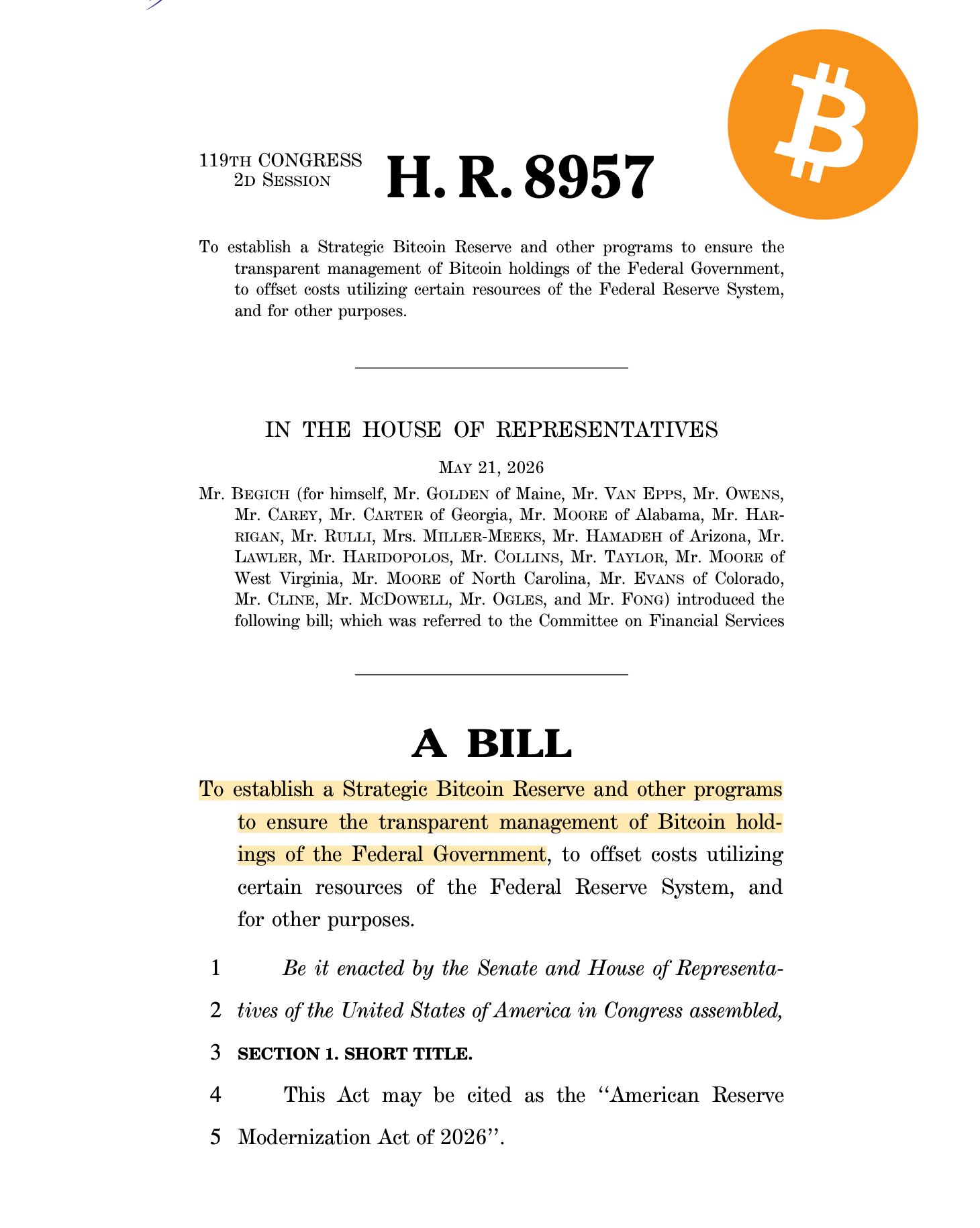
The U.S. Strategic Bitcoin Reserve bill will reach a key House committee stage this week. The House Financial Services Committee has scheduled H.R. 8957, the American Reserve Modernization Act of 2026, for a 10:00 a.m. markup on Wednesday, September 16, in Washington.
The bill would establish the Strategic Bitcoin Reserve in federal law under the Treasury Department and create a separate stockpile for federally held non-Bitcoin digital assets. The proposal builds on President Donald Trump's March 2025 executive order, but H.R. 8957 would put the reserve framework into statute and impose stricter rules on custody, reporting, and future sales.
House Committee Set to Consider H.R. 8957
On Wednesday, September 16, the House Financial Services Committee is set to consider H.R. 8957. The measure would write the Strategic Bitcoin Reserve into law under the Treasury Department, make forfeited Bitcoin part of the reserve, and create a separate stockpile for other seized digital assets.
A markup is a committee session in which members review a bill's text, offer amendments, and vote on whether to report the measure to the full House. Committee approval is a standard prerequisite for a bill to reach the floor, so Wednesday's session is the first procedural hurdle for the proposal, and any changes adopted would carry forward into the version later taken up by the chamber.
Under the bill, non-Bitcoin assets could be sold to acquire additional BTC or reduce government debt. The Treasury and Commerce departments would also study budget-neutral ways to expand the reserve over five years. The legislation would prohibit using borrowing, new taxes, or deficit spending to fund Bitcoin purchases.
Following the bill's passage, the Bitcoin holdings would be locked up for 20 years. After that period, the Treasury could recommend selling no more than 10% of the reserve during any two-year period, subject to congressional approval. The bill would also require quarterly proof-of-reserves, third-party audits, and oversight from the Government Accountability Office, the independent agency often called the congressional watchdog for its audits of federal programs and spending.
In addition, U.S. states could store their own BTC in segregated Treasury accounts under the bill, while the legislation would not authorize the seizure of privately held Bitcoin.
The Sept. 16 vote is an early step in the legislative process. The bill would still need from the full House and the Senate before being sent to the President for his signature. If ultimately enacted, the measure would move the reserve framework from executive action into standing federal law. That distinction carries weight: an executive order can be revised or rescinded by a later administration, while a statute would remain on the books unless Congress passed new legislation to amend or repeal it.
Trump's Push for a U.S. Strategic Bitcoin Reserve
The United States already has a Strategic Bitcoin Reserve, but it was established through executive action rather than legislation. President Trump signed Executive Order 14233 on March 6, 2025, creating the Strategic Bitcoin Reserve and a separate U.S. Digital Asset Stockpile.
Under the executive order, the Treasury was directed to retain forfeited government Bitcoin, and its sale was generally prohibited. However, the order did not authorize open-market purchases using taxpayer funds.
In May 2026, White House adviser Patrick Witt said the government held about 328,372 BTC. Other trackers, however, estimate holdings anywhere from roughly 198,000 to 328,000 BTC.
The proposed legislation is separate from Senator Cynthia Lummis' BITCOIN Act, which was first introduced in 2024 and reintroduced in March 2025. That bill would require the Treasury to purchase 1 million BTC over five years, but it has not passed. Its purchasing mandate differs from H.R. 8957, which would build the reserve from Bitcoin forfeited to the government.
The Broader U.S. Crypto Legislative Landscape
Crypto legislation has been in the spotlight recently in the United States. The GENIUS Act, which regulates payment stablecoins, is the main crypto measure to have become law so far. It was signed on July 18, 2025, after passing the Senate 68-30 and the House 308-122, though full implementation remains subject to agency rules.
The CLARITY Act has not become law. The Senate is scheduled to hold a cloture vote on the measure on Tuesday. Cloture is the Senate's procedure for ending debate ahead of a final vote and generally requires the support of 60 senators, so Tuesday's result will indicate whether the chamber can move the bill toward a floor decision.
Wednesday's event is a committee markup, not a House floor vote or the enactment of the Strategic Bitcoin Reserve bill.
This article is for informational purposes only and does not constitute legal, financial, or investment advice. Legislative proposals can be amended during the congressional process and may not become law in their current form.
Source: The Market Periodical

