Bars Anchor South Korea's Social Life More Than Anywhere Else, AB InBev-Commissioned Reports Find
Key Takeaways
- •Korea recorded the survey's highest reliance on bars, with 54 percent of respondents naming them their primary social outlet, more than double the 21 percent average across the five countries polled.
- •Bars also play a professional role in Korea, where 34 percent of respondents visited one with colleagues in the past year and 26 percent formed a business connection over drinks, both the highest levels recorded.
- •The research estimates that bars generate $189.2 million in annual social value for Korea and contribute $9.3 billion in gross value added, equivalent to 0.5 percent of GDP.
- •Social occasions are the leading global motivation for drinking, cited by 35 percent of respondents, with moderation, experience-seeking, willingness to pay for worthwhile drinks, flavor exploration and brand loyalty identified as key behavioral forces.
- •Beer and malt-based drinks, including ready-to-drink canned cocktails, hard seltzers and flavored malt beverages, grew from about 46 percent of total alcohol servings in 2019 to more than 50 percent in 2026.
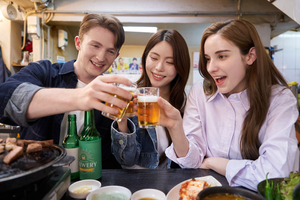
Two studies commissioned by AB InBev, the parent company of Oriental Brewery, show that South Koreans depend on bars for socializing to a greater degree than drinkers elsewhere surveyed — even as global alcohol volumes remain more than 30 percent above early-2000s levels while per-capita consumption declines.
An Oxford Economics survey of 5,311 legal-drinking-age adults across five countries — Korea, Brazil, Mexico, the UK and the US — found that 93 percent of Koreans regard bars as either their go-to or an occasional place for socializing. Korea posted the highest share of the group, with 54 percent naming bars as their main way to socialize, more than double the 21 percent average across the five markets.
Bars in Korea also extend into professional territory. Some 34 percent of respondents said they had visited a bar with colleagues over the past year, and 26 percent said they had made a business connection over drinks — both the highest levels recorded. That makes bars not just a leisure venue but part of how social and business relationships are maintained in the market.
The study put the estimated annual social value of bars in Korea at $189.2 million. Bars contributed $9.3 billion in gross value added to the economy, equivalent to 0.5 percent of GDP.
A separate report from Ipsos and IWSR helps explain why bars carry such weight in a market like Korea's. Social connection remains a leading reason people drink globally, with 35 percent citing social occasions as their main motivation, and on-trade consumption has held steady even as digital life expands.
"Consumers are becoming more deliberate about what they drink, when they drink, and how alcohol fits into daily life," the report said.
The report identified five forces shaping consumer behavior: moderation around alcohol content, an experience economy that favors worthwhile social occasions, a willingness to pay for drinks that feel genuinely worth it, a search for new flavors and formats, and loyalty to familiar brands.
Beer and related malt-based drinks — including ready-to-drink canned cocktails, hard seltzers and flavored malt beverages — grew from about 46 percent of total alcohol servings in 2019 to more than 50 percent in 2026.
"Consumers are making more intentional decisions about how alcohol fits into their lives, creating a more nuanced consumption landscape," the report stated.

