Mortgage Rates Hit 6.71% as Treasury-Mortgage Spread Sticks at 2 Points Despite Fannie and Freddie MBS Buybacks
Key Takeaways
- •The average 30-year fixed mortgage rate reached 6.71%, its highest level since July of last year, per Freddie Mac's weekly survey.
- •The spread between the 30-year mortgage rate and the 10-year Treasury yield stands at about 1.97 percentage points, essentially unchanged since before the Fannie and Freddie buyback program was announced in January 2026.
- •The Fed has shed $827 billion, or 30%, of the MBS it accumulated during quantitative easing, and continues runoff of roughly $15-18 billion per month.
- •Fannie and Freddie are funding MBS buybacks by diverting cash from Treasury purchases and selling Treasuries, turning them into Treasury sellers and pushing Treasury yields higher.
- •The 30-year mortgage rate could breach 7% if the 10-year Treasury yield moves above 5% and stays there, given a spread near 2 percentage points.
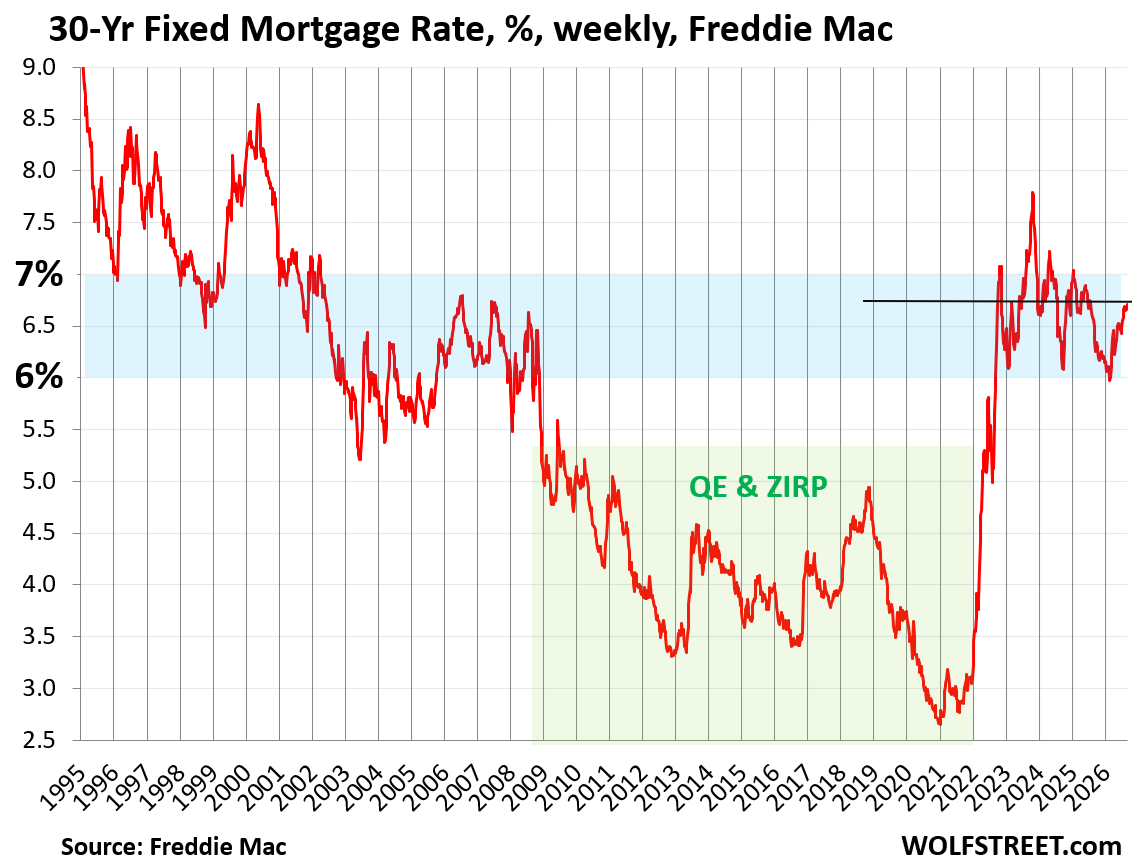
The average 30-year fixed mortgage rate climbed to 6.71%, its highest level since July of last year, according to Freddie Mac's weekly survey released today covering the week through Wednesday, September 2. Apart from a few spikes to the upside, the rate has traded in a 6.0% to 7.0% band since September 2022.
By historical standards, mortgage rates in the 6-7% range are not high. They only appear elevated against the backdrop of the 14 years of financial repression between 2008 and 2022, when the Federal Reserve cut short-term interest rates to nearly zero and pushed mortgage rates down through trillions of dollars of purchases of mortgage-backed securities (MBS) and Treasury securities, funded by money creation.
For prospective homebuyers and homeowners weighing a refinance, the practical effect is that monthly payments on a given loan amount remain far higher than they were during the sub-3% era, which is one reason housing affordability has become a persistent political and economic talking point even as rates sit within their recent historical band.
The spread between Treasury yields and mortgage rates
The 30-year fixed mortgage rate tracks the 10-year Treasury yield but sits above it. Because homes are sold or refinanced, the average 30-year mortgage is paid off in roughly 12 years. The gap between the two rates — the spread — varies over time.
In 2022 and 2023 the spread widened to more than 3 percentage points, the widest since the early 1980s, meaning mortgage rates were unusually high relative to 10-year Treasury yields. The spread then began narrowing and stood at 2 percentage points by the end of 2025.
Seeking to narrow the spread further and pull mortgage rates down, Fannie Mae and Freddie Mac — both under government conservatorship since the 2008 financial crisis, when they were taken over by the federal government — announced with great fanfare on January 8, 2026, that they would substantially accelerate buybacks of MBS they had previously issued.
To fund these buybacks, the two enterprises are using operating cash flow that would otherwise have gone toward purchasing Treasuries, and they are shedding Treasury securities already on their balance sheets — in effect replacing Treasuries with their own MBS. This has turned Fannie and Freddie, formerly large buyers and holders of Treasuries, into sellers of Treasuries, which helps push Treasury yields higher. The result is a narrower spread achieved partly through higher Treasury yields.
The 10-year Treasury yield, after rising earlier in the week, dipped today to 4.77%, in the upper portion of the 4-5% range that has prevailed since mid-2023. Before the Fed's financial repression began in 2008, that 4-5% range was viewed as the low end of the preceding four-decade spectrum.
The spread itself deserves attention: the 10-year Treasury yield is essentially unchanged compared with October 2023, yet the 30-year fixed mortgage rate has fallen by a full percentage point over the same period, and the spread has narrowed by the same amount.
Where the spread stands now
The weekly average 30-year mortgage rate through Wednesday was 6.71% (Freddie Mac's measure), while the weekly average 10-year Treasury yield as of Wednesday was 4.74%, putting the spread at 1.97 percentage points. That is almost exactly where the spread stood at the end of December 2025 and the beginning of January 2026, before Fannie and Freddie — and Trump — announced the large-scale MBS buyback program. All of these readings, however, remain about 1 percentage point narrower than in mid- to late 2023, when the spread hovered around 3 percentage points at times.
Many factors move the spread, including:
- MBS market dynamics: Buyers and sellers in the roughly $12-trillion market for MBS, the second-largest bond market after the Treasury market.
- The Fed: By shedding MBS, the Fed contributes to a wider spread. Under quantitative tightening (QT), the spread widened in late 2022 and through 2023 to about 3 percentage points. Although QT ended in December 2025, the runoff of MBS has continued.
- Fannie and Freddie: Since late 2025, their buybacks of their own MBS have contributed to a narrower spread.
The average 30-year fixed mortgage rate stood at 6.21% before Fannie and Freddie — and Trump — announced the expanded buyback program on January 8. By the end of February, mortgage rates had dropped to 6.01%. They then began rising again as the 10-year yield surged, and now sit at 6.71%, the highest in over a year, with the spread stuck at about 2 percentage points despite the buybacks. The question is where mortgage rates would be without the buybacks — over 7%?
For readers tracking what comes next, the variables to watch are the trajectory of the 10-year Treasury yield, the pace of the Fed's ongoing MBS runoff, and the scale and duration of the Fannie and Freddie buyback program — each of which feeds directly into the spread and, through it, into the mortgage rate homeowners actually pay.
The Fed's impact on the spread
During quantitative easing (QE), the Fed bought MBS to narrow the spread between Treasury yields and mortgage rates and to push down long-term yields generally, repressing mortgage rates in two ways. The spread narrowed to less than 1.5 percentage points, and as Treasury yields also fell, mortgage rates dropped below 3% — even as inflation surged toward 9%.
That period of financial repression, in the author's framing, produced the worst inflation in 40 years and the largest home price surge on record, giving rise to what is now called the "affordability crisis."
QE ended in early 2022, and QT began in the second half of 2022, when the Fed started allowing MBS to roll off. It continues to shed MBS at a pace of roughly $15-18 billion per month, a rate determined by the passthrough principal payments MBS holders receive when the underlying mortgages are paid off or paid down through monthly principal payments. After QT ended last December, the Fed began purchasing T-bills to replace the MBS runoff.
To date, the Fed has shed $827 billion, or 30%, of the MBS it accumulated during QE, including $190 billion over the past 12 months and $17 billion over the past four weeks.
The end of QE in early 2022 — beginning with expectations of its end beforehand — followed by QT and the shedding of MBS were major factors in the spread's earlier widening. The slowdown of QT in 2024 and its end in 2025 relieved much of that pressure, and the spread narrowed by 1 percentage point through the end of 2025. The ongoing MBS runoff, however, continues to weigh on the spread.
That looming 7% mortgage rate
At 6.71%, mortgage rates are not far from the 7% line they already breached in 2023, when the spread was 3 percentage points. The Fannie and Freddie buybacks appear to counteract the Fed's MBS runoff in terms of the spread, even though they may push Treasury yields higher by pulling the two enterprises out of the Treasury market.
The buybacks may be the only factor keeping mortgage rates below 7% by holding the spread near 2 percentage points rather than letting it drift wider. Under that scenario, the 30-year fixed mortgage rate would breach 7% once the 10-year Treasury yield moves above 5% and stays there — rather than briefly touching 5% and retreating, as it did spectacularly in October 2023.
Source: Wolf Street
