LGEL (373220) Is Listed on edgeX: Battery Economics, ESS Growth, and the LGEL Trading Thesis
Key Takeaways
- •LG Energy Solution manufactures lithium-ion batteries for electric vehicles and energy storage systems and was separated from LG Chem, debuting on the KOSPI in January 2022 under ticker 373220 in one of South Korea's largest IPOs.
- •The company's Ultium Cells joint venture with General Motors operates battery plants in North America, including sites in Ohio and Tennessee.
- •Q2 updates emphasized the company's ability to protect profit amid a choppy EV backdrop, while management has become more vocal about grid storage opportunities and AI-related energy demand.
- •The LGEL/USDC perpetual on edgeX is a derivative contract offering 24/7 trading access, but it does not grant ownership, dividends, or voting rights in LG Energy Solution shares.
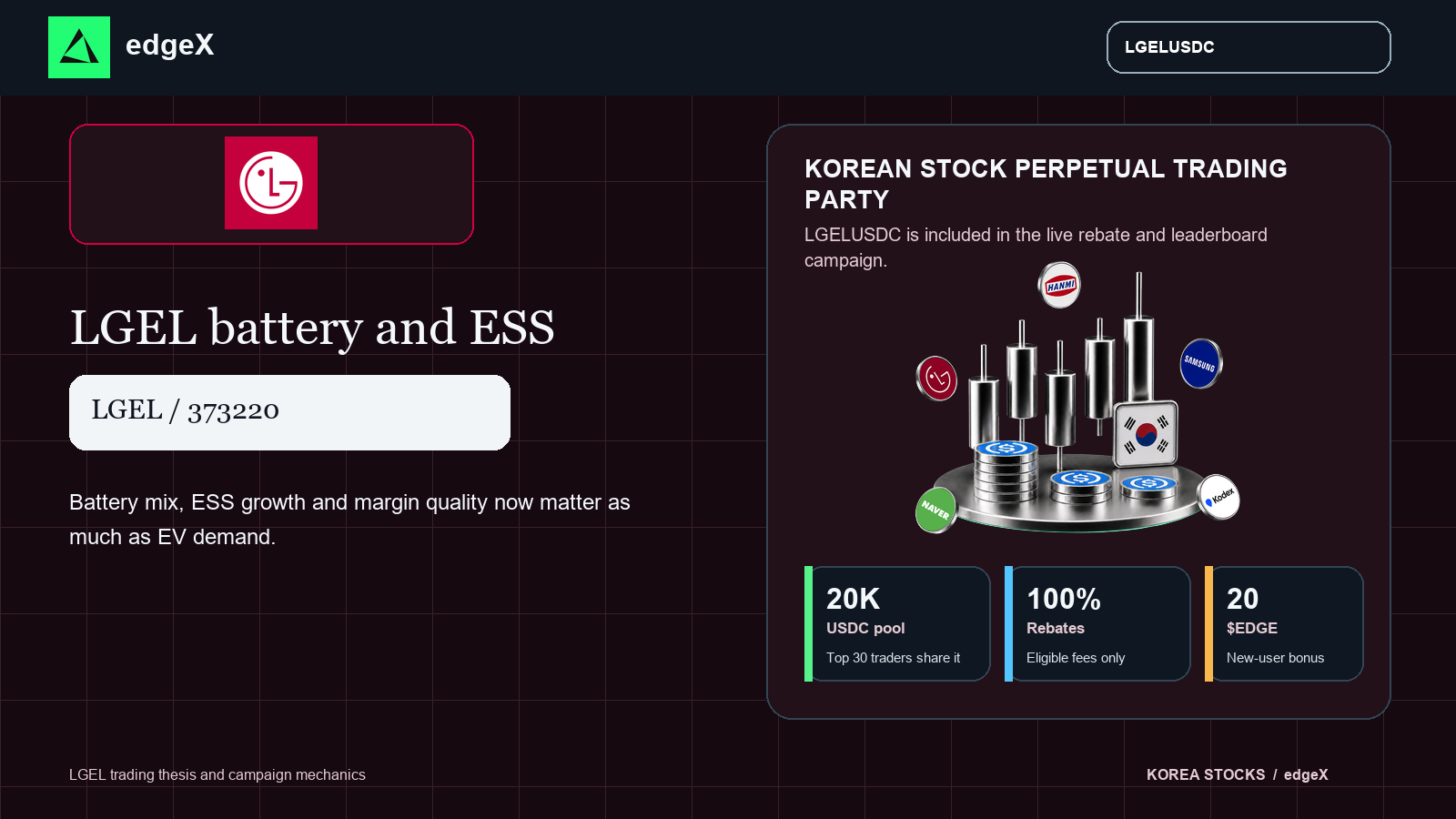
- •The edgeX Korean Stock Perpetual Trading Party provides fee rebates, a leaderboard prize pool of up to 20,000 USDC, and a new-user reward path.
Quick Answer
LGEL is LG Energy Solution, a core Korean battery name with exposure to EV cells, ESS and manufacturing scale. The LGEL/USDC perpetual on edgeX lets traders position around battery economics, margin recovery and the shift toward stationary storage. The stock matters now because the market is watching whether ESS can reduce the company's dependence on a single EV cycle.
https://x.com/edgeX_exchange/status/2088223391904092299
LGEL Arrives on edgeX as Battery Cycles Give Way to Mix Discipline
LG Energy Solution is one of the most important names in Korea's battery stack because it sits directly in the path of electric-vehicle demand, stationary storage demand and manufacturing scale economics. That makes the stock more than a simple EV beta trade. It is a test of whether one of the world's largest battery producers can improve mix and margins while the industry stays brutally competitive.
That is why the LGEL/USDC perpetual belongs on edgeX. The stock can react to EV adoption, raw-material prices, joint-venture news and order visibility all at once. Traders are not just betting on vehicle sales. They are betting on whether battery economics can improve faster than the market expects.
What LG Energy Solution Actually Sells
LGEL makes lithium-ion batteries for electric vehicles and energy storage systems, plus related components and manufacturing services. Its business is capital intensive, cyclical and highly sensitive to utilization. When demand is strong and plants are full, the company can leverage scale. When demand slows or mix deteriorates, fixed costs can pressure profit quickly.
The mix matters as much as the volume
The most important detail in a battery business is not only how many cells are shipped, but what kind of cells they are and what customers are using them for. EV cells tend to be the headline product, but ESS can become a more attractive structural market if grid demand rises, integration improves and customer adoption broadens. That is why the market keeps asking whether LGEL can diversify beyond the pure auto cycle.
The company has to manage that transition carefully. If it pushes too hard for volume, margins can suffer. If it stays too cautious, it can miss share in a market that rewards scale. The best outcome is a product mix that lets the company grow without sacrificing economics.
| Driver | Bullish signal | Risk signal |
|---|---|---|
| EV demand | Clearer North American and global battery orders | Automaker demand softens or delays continue |
| ESS | Grid storage gains share and repeat orders grow | ESS remains small or low-margin |
| Manufacturing | Better utilization and cleaner mix | Fixed costs stay heavy versus demand |
| Pricing | Stable contract structure and better margins | Raw materials or competition compress pricing |
| Stock setup | Battery recovery with 24/7 edgeX access | Sector de-rating or weaker macro tape |
The Latest Official Updates Point to a Broader Battery Story
LG Energy Solution's Q2 updates showed that the market still cares about the company's ability to protect profit while navigating a choppy EV backdrop. At the same time, the company has been more vocal about grid storage opportunities and AI-related energy demand, which gives the stock a second narrative line beyond vehicle batteries.
That matters because the market has become less willing to pay for broad battery optimism. Investors want evidence that the company can convert engineering strength into durable margin. A business that can win both EV cells and ESS projects has a better chance of reducing the volatility that usually comes with the battery cycle.
Why ESS is more than a side story
Energy storage can sound like a niche next to EVs, but the economics are important. Grid and commercial storage can provide more diversified demand than a single automaker schedule, and in some cases they can support steadier planning and better utilization. If LGEL can make ESS a meaningful part of the mix, the company could look less like a one-cycle manufacturer and more like a broader energy platform.
That does not mean ESS is a magic fix. It still needs disciplined capital allocation, strong counterparties and good product economics. But it does give the stock a healthier debate than the old question of whether EV demand is simply strong or weak.
What the Market Is Really Pricing In
The market is pricing whether LG Energy Solution can make battery economics look less like a commodity cycle and more like a scaled industrial franchise. That requires better mix, better utilization and enough customer demand that every new factory does not become a future drag. The company does not need perfect conditions. It needs enough pricing and operating discipline to stop the business from looking purely cyclical.
If EV demand accelerates and ESS grows at the same time, the market can reward the stock for leverage. If EV demand softens while ESS is still too small to matter, the stock may remain trapped in the "good company, bad cycle" bucket. That is the debate that matters most to traders.
The biggest risk is paying for recovery before recovery shows up
Battery names often rally when investors expect the cycle to turn. The danger is that the turn takes longer than the market expects, or that it arrives with weaker pricing than hoped. LGEL can therefore look expensive or cheap depending on whether traders focus on the next quarter or the next few years.
For that reason, the stock works best when the evidence is concrete: utilization improves, product mix gets better and the company proves that ESS can carry more weight without destroying returns.
A Scenario Framework for LGEL
In a bullish scenario, EV demand stabilizes, ESS keeps growing and the company shows that higher-quality mix can support better margins even before the broad battery market feels easy again. That is the setup in which investors stop treating LGEL as a pure cyclical recovery trade and start treating it as a scaled energy-platform company with more than one growth engine.
In a base scenario, EV remains mixed but not broken, ESS grows steadily and profitability improves only gradually. That would still leave room for the stock to work, but mostly through selective re-rating rather than a dramatic shift in how investors classify the company. The market would continue rewarding discipline more than headline volume.
In a bearish scenario, EV softness persists, ESS stays too small to matter and manufacturing scale continues to look like a cost burden rather than an advantage. In that environment, even a technically strong company can struggle to earn a better multiple because the market sees too much capital intensity and not enough near-term proof of better returns.
What Would Make the Battery Mix More Believable
The most convincing evidence for LGEL is not a generic statement about future EV adoption. It is proof that the company is creating a healthier revenue mix right now. Traders should watch for signals that ESS is gaining real weight, that utilization is improving and that any margin progress is driven by product quality and customer mix rather than by one-off help.
This is also why the stock can be more interesting than a simple EV sentiment trade. Battery companies are often judged too quickly by top-line direction and not carefully enough by what is inside the top line. LGEL deserves a closer read because the gap between volume and value can be unusually large in a business where chemistry, customer profile and end-market use all matter.
That is the core LGEL debate: whether the company can use ESS and better mix to make its next quarter feel less cyclical and more strategic.
Why LGEL Still Has a Scale Advantage
LG Energy Solution remains important because scale still matters in batteries even when the cycle turns rough. Large factories, supply contracts, customer relationships and engineering depth all take time to build. That does not guarantee profits, but it does make the company harder to dislodge than a smaller competitor. In a market that often overreacts to one quarter, that structural advantage can be easy to miss.
The key question is how much that scale is worth when the industry is still sorting through EV pacing, pricing and demand normalization. If the company can use its scale to keep utilization high while moving more volume into better-quality products, the market can start to see it as a more resilient energy platform. If scale only produces more capacity without stronger returns, then the advantage becomes less visible in the stock.
What Traders Should Watch in the Next Quarter
The next LGEL readout should focus on whether ESS is truly broadening the story and whether EV demand is becoming less disruptive. Traders should watch mix, pricing discipline and utilization first. If those improve together, the company can begin to look less like a cyclical manufacturer waiting on a turn and more like a business that is actively shaping its own earnings profile.
That is why the stock can reward patience when the signals line up. Battery names often move before the earnings story feels fully obvious, but the move tends to last only when the underlying economics improve. For LGEL, the most valuable proof will be a quarter where the company shows it can grow without making the balance between volume and value worse.
What the Next LGEL Quarter Has to Show
The next meaningful LGEL signal is not just a revenue number. It is whether management can show that profitability is improving for reasons that traders can trust. That means better plant utilization, stronger product mix, firmer demand visibility and cleaner evidence that ESS is becoming a real second leg rather than a talking point attached to the broader battery story.
If those signals arrive together, the market can begin to treat LGEL as a company with more than one way to win. If they do not, the stock may continue to trade as a large, respected manufacturer waiting for the cycle to turn more decisively. For traders, that distinction matters because one setup deserves patience and the other deserves caution.
edgeX Korean Stock Perpetual Trading Party
The edgeX Korean Stock Perpetual Trading Party is useful for LGEL because battery names can gap on macro and industry headlines. The campaign gives traders fee rebates, a leaderboard prize pool of up to 20,000 USDC and a new-user reward path, which lowers the friction of expressing a view on a name that can move with EV headlines, raw-material swings and Korea market sentiment.
Why this campaign fits an active battery-cycle trade
LGEL often reacts to sector read-throughs rather than a single company-only event. That means traders may want a venue that stays open when headlines land. A perpetual market can help, but only if the trader respects funding, liquidation and the possibility that a Korea-session move gets repriced again when the underlying market reopens.
The campaign also matters because battery traders tend to be active when the narrative changes. If users are expecting a margin recovery, an ESS win or a sector re-rating, the fee rebates and leaderboard incentives can make the execution of that view more efficient. The campaign does not change the thesis. It changes the trading cost of expressing it.
What Could Strengthen or Weaken the LGEL Thesis
The bullish case strengthens if EV demand stabilizes, ESS grows faster, and LGEL shows that it can improve margin through mix rather than just through volume. A strong signal would be more visible pricing discipline or better utilization without a need for aggressive discounting.
The thesis weakens if EV demand remains uneven, ESS fails to scale, or capacity keeps expanding faster than profits. LGEL is a powerful company, but power alone is not enough. The market wants battery economics, not just battery size.
Trade LGEL Perpetuals on edgeX
TradFi access no longer has to stop when traditional exchanges close. edgeX gives traders around-the-clock access to selected stock perpetuals through a self-custodial venue. Users retain control of their assets while the platform is built for fast execution and transparent on-chain settlement.
The LGEL/USDC perpetual lets eligible traders express a long or short view without waiting for the next Korean session open. A perpetual is a derivative, not ownership of LG Energy Solution shares, so traders should verify current leverage, funding, fees, liquidity, index methodology, contract specifications and regional availability before acting.
Frequently Asked Questions
What is LG Energy Solution's main business?
LG Energy Solution makes batteries for EVs and energy storage systems and is one of Korea's most important industrial battery names.
Why does ESS matter for the stock?
ESS can diversify demand away from pure auto-cycle dependence and potentially support steadier utilization and better mix.
Is the edgeX perpetual the same as owning LGEL stock?
No. It is a derivative contract and does not grant shareholder rights, dividends or voting power.
What is the biggest risk for LGEL traders?
The biggest risk is that battery demand improves too slowly or margins stay weak while the company keeps investing heavily in capacity.

