KODEX200 Is Listed on edgeX: Korea Beta, Index Liquidity, and the KODEX200 Trading Thesis
Key Takeaways
- •edgeX has launched a KODEX200/USDC perpetual that trades continuously, addressing the gap created by the Korea Exchange's limited weekday cash session that runs from 9:00 to 15:30 local time.
- •The KODEX 200 ETF is managed by Samsung Asset Management and tracks the KOSPI 200, a market-cap-weighted benchmark of roughly 200 of the largest Korea Exchange-listed companies that historically covers the majority of the broader KOSPI's market capitalization.
- •The KODEX200/USDC perpetual is a derivative quoted against a dollar-linked stablecoin, has no fixed expiry, relies on periodic funding payments, and does not provide ownership of or shareholder rights in the ETF.
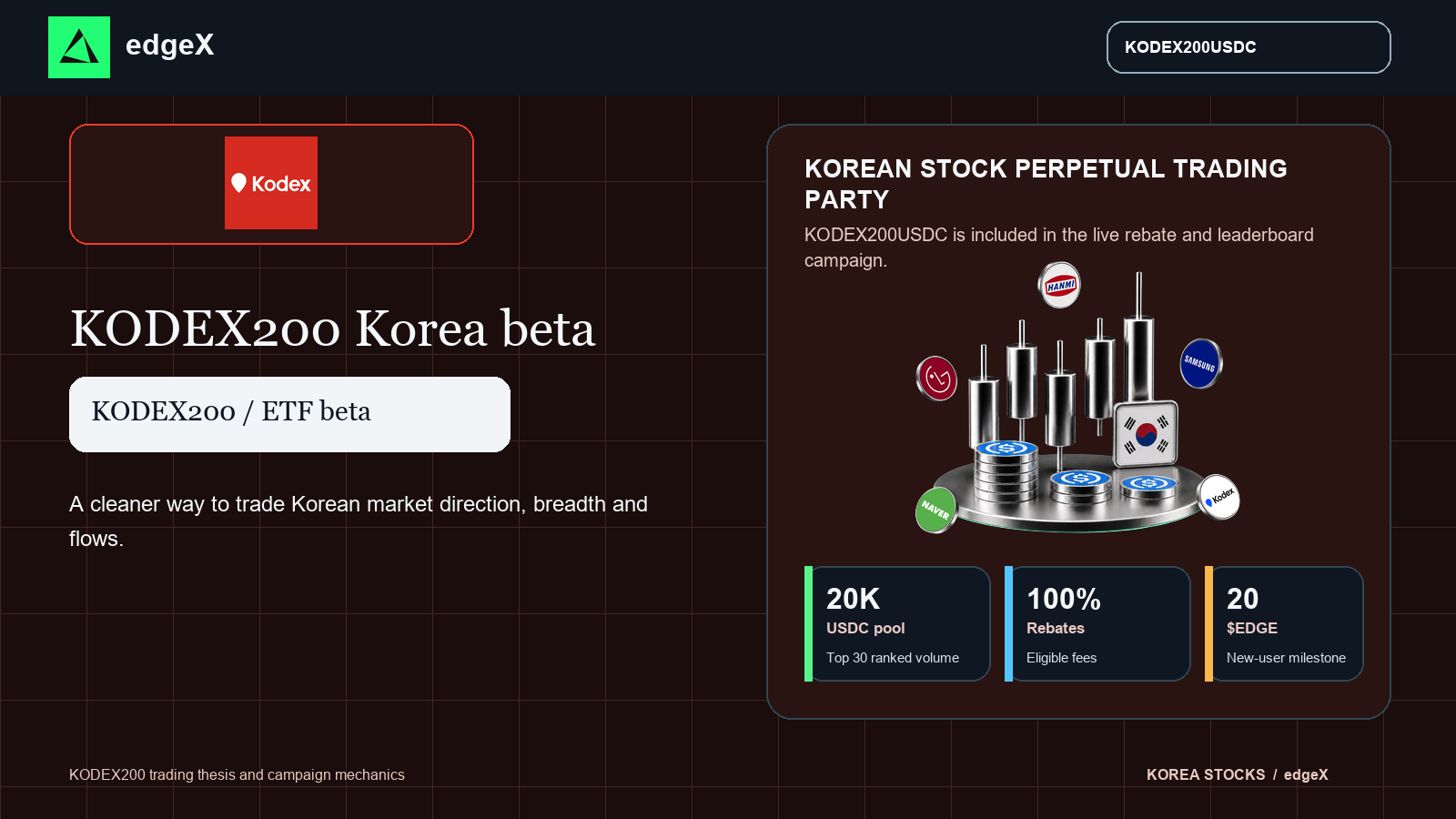
- •KODEX200USDC is a selected contract in the edgeX Korean Stock Perpetual Trading Party, which provides fee rebates, a leaderboard prize pool of up to 20,000 USDC, and $EDGE milestones for new perpetual users.
- •Samsung Electronics and SK Hynix sit at or near the top of the benchmark's weighting, meaning the diversified-looking index still carries pronounced semiconductor concentration risk.
Quick Answer
KODEX200 is the KODEX 200 ETF, a widely used product tied to Korea's large-cap equity benchmark. The KODEX200/USDC perpetual on edgeX lets traders express a view on Korean market direction rather than on a single company. It matters now because Korea's tape can be driven by semiconductors, foreign flows and risk appetite all at once, and an index instrument can capture that more cleanly than a stock-specific trade.
https://x.com/edgeX_exchange/status/2088223391904092299
KODEX200 Arrives on edgeX as Korea Market Direction Becomes Its Own Trade
Sometimes the best trade is not a single story stock. It is the market that those stories live inside. That is what makes KODEX200 interesting on edgeX. Instead of betting on whether one company beats earnings or launches the right product, traders can focus on whether Korea's large-cap equity market is attracting flows, holding breadth and keeping leadership.
That is why the KODEX200/USDC perpetual matters. The product is a cleaner instrument when the view is macro, sector-led or flow-driven. If semiconductors, foreign buying and risk appetite are all pushing Korea in one direction, an index expression can be more efficient than trying to pick the exact single-name winner.
What KODEX200 Actually Represents
KODEX 200 is an ETF tied to the KOSPI 200 benchmark, which means it is essentially a liquid vehicle for Korea's large-cap market. That gives traders a way to position around the country's broad equity tape rather than around one internet, battery or semiconductor name. The benchmark matters because Korea can move as a block when global investors change their view on AI demand, exports, rates or Asia risk.
Index exposure is useful when stock picking becomes too narrow
Single-name trades are powerful when the catalyst is company specific. They are less useful when the real question is whether the whole market is repricing. KODEX200 becomes valuable in those moments because it captures the tape, the leadership and the breadth together. It can also help traders express a Korea view without overcommitting to one theme.
That does not make it risk free. An index can still be concentrated through leadership sectors, and Korea's benchmark can still be highly sensitive to semiconductors and foreign flows. But it does change the kind of risk a trader is taking.
| Driver | Bullish signal | Risk signal |
|---|---|---|
| Market breadth | More sectors participate in the advance | Gains stay too narrow and fragile |
| Flows | Foreign buying supports the tape | Risk appetite fades or reverses |
| Macro backdrop | Export, rates and growth expectations stabilize | Macro disappointment hits cyclicals |
| Leadership | Semis and heavyweights hold up without losing breadth | Leadership cracks and drags the index |
| Stock setup | Clean Korea beta with 24/7 access on edgeX | One-sector dependence distorts the signal |
Why the Index Matters More Right Now
Korea's market has been sensitive to AI-related leadership, global rate expectations and swings in risk appetite. In that environment, many traders do not actually need a more complicated instrument. They need a simpler one that tracks whether the whole market is being rewarded or punished. That is the role KODEX200 can play.
The ETF format also matters because KODEX 200 is already familiar to local traders as a benchmark expression. Translating that into a perpetual market on edgeX gives users a way to stay involved even when the underlying local session is closed. That can be useful when macro headlines or overseas sessions are driving sentiment before Korea gets its next cash open.
The index trade is often cleaner than the single-name trade
A single stock can beat estimates and still fall if the market wants less risk. A weak company can rise if the whole market is being chased. That is why an index product can be the better expression when the view is on flows, macro or sector leadership. It removes one layer of company execution risk and keeps the position closer to the actual question being asked.
For traders, that can mean a cleaner setup when the goal is to capture Korea beta, not to outguess one management team.
What the Market Is Really Pricing In
The market is pricing whether Korea can sustain broad enough participation to keep the tape attractive. When leadership is healthy and risk appetite stays constructive, KODEX200 can serve as a compact expression of that view. When leadership narrows too much or macro conditions worsen, the same product can transmit the downside quickly.
That is what makes the product different from the single-name articles in this batch. With KODEX200, the trader is not asking whether one company is doing the right thing. The trader is asking whether the market environment is rewarding Korea at all.
The risk is concentration hidden inside diversification
Index exposure can feel safer because it is diversified, but that can be misleading if a few heavy sectors dominate direction. Korea's benchmark can still behave like a concentrated macro trade if semiconductors or other heavyweights are doing most of the work. Traders should respect that dynamic instead of assuming the index eliminates volatility.
In practice, the product works best when the trader knows whether the bet is on breadth, on leadership or on pure market direction. Those are related ideas, but they are not identical.
A Scenario Framework for KODEX200
In a bullish scenario, Korea's market keeps attracting flows, leadership remains intact and breadth improves enough that the advance feels durable rather than fragile. That is the environment in which an index product can outperform the temptation to overtrade single names, because the real story is that the market itself is earning a higher price.
In a base scenario, leadership remains decent but participation is mixed. The tape still works, but only because a few major groups are doing most of the lifting. KODEX200 can still be useful there, but traders need to recognize that the product may be carrying more concentration risk than the word "index" implies. It becomes a more tactical instrument than a broad, comfortable proxy.
In a bearish scenario, risk appetite softens, flows reverse or leadership cracks. In that setup, index exposure can punish traders quickly because it captures the market-wide disappointment more efficiently than a stock-specific trade. The advantage of broad exposure then becomes its danger: there is nowhere to hide inside a product designed to reflect the tape.
What Traders Should Monitor Inside the Index
The most important question for KODEX200 traders is not whether one company is exciting. It is whether the market's internal structure still looks healthy. Are more sectors participating, or is the move resting on a narrow handful of names? Are foreign flows supporting risk appetite, or are they fading? Is macro news helping the tape broaden, or only helping one leadership pocket?
Those are the signals that make index trading more serious than it first appears. A broad-market product is not a low-thought product. It simply asks a different kind of question. For traders who want to express a Korea view rather than a single-stock view, that can be exactly the right instrument, but only if they read the tape as a whole and not as a bundle of unrelated headlines.
What the Next Korea Tape Has to Prove
The next meaningful KODEX200 signal is whether the market can hold direction without becoming too narrow. Traders should watch whether leadership broadens, whether flows remain supportive and whether macro headlines are reinforcing the advance rather than merely keeping one group of heavyweights elevated. An index product becomes more attractive when the underlying market starts looking healthier across multiple sectors.
If the tape cannot do that, KODEX200 may still move, but it will move with a more fragile quality. That distinction matters because broad exposure is only as strong as the market structure beneath it. A durable index trade needs participation, not just momentum.
Why Index Exposure Can Be the Cleaner Trade
When market conditions are being driven by macro, flows and overall risk appetite, single-name conviction can become less useful than traders expect. A good company can fall in a weak tape, and a mediocre company can rise in a strong one. KODEX200 matters because it reduces the need to pretend that a broad market move is really a company-specific insight. It lets traders express the view they actually have.
That does not make the product simpler in an intellectual sense. It makes it cleaner. The trader still needs to understand what is powering Korea's market, whether the advance is broad enough to trust and how concentrated the leadership has become. But when the real story is the market rather than the stock, an index expression is often the more honest instrument.
Why the Index Trade Needs Breadth, Not Just Leadership
One of the biggest mistakes in index trading is assuming that a strong headline move automatically means a healthy market. Sometimes a handful of giants can pull the index up while the rest of the market lags badly behind. KODEX200 is still useful in that situation, but the trade is more fragile than it appears because the benchmark is being powered by a narrow group of names.
That is why breadth matters so much. Breadth tells traders whether the market is genuinely participating or merely being dragged higher. A broader market tends to support a more durable index trade. A narrow market can still be profitable, but it demands more timing discipline and a better understanding of who is actually carrying the tape.
What Traders Should Watch in the Next Quarter
The next KODEX200 readout is really a question about whether Korea can sustain a healthier market structure. Traders should watch breadth, foreign flows and whether leadership remains broad enough to support a calmer trend. If those pieces improve, index exposure becomes cleaner and more attractive. If they do not, the product can still be a useful trading vehicle, but only as a more tactical expression of risk appetite rather than a stable market call.
That is the real value of KODEX200. It gives traders a way to express a Korea view honestly, without forcing the market call into a single-company narrative that may not fit the moment.
edgeX Korean Stock Perpetual Trading Party
The edgeX Korean Stock Perpetual Trading Party matters for KODEX200 because index products are often traded actively around macro events and broad sector rotation. KODEX200USDC is one of the selected contracts, which means traders can qualify for fee rebates, pursue the leaderboard pool of up to 20,000 USDC and, if they are new perpetual users, work toward the $EDGE milestones.
Why this campaign fits an active Korea-beta trade
A trader who wants to express a market-direction view may rebalance more often than a trader holding one thematic stock. In that context, rebates matter. So does continuous access. The campaign therefore fits the product naturally: it reduces friction on a market that people often use to react to broad tape changes rather than to hold one static conviction.
The campaign is not the reason to trade Korea beta. It is the reason the execution of that beta can feel more efficient during an active market window.
What Could Strengthen or Weaken the KODEX200 Thesis
The bullish case strengthens if Korea keeps attracting flows, sector leadership stays healthy and more than one corner of the market participates in the move. A stronger tape is a better argument for index exposure than a very narrow, brittle rally.
The thesis weakens if breadth deteriorates, macro pressure rises or the market becomes too dependent on one leadership pocket. An index expression is powerful precisely because it captures the whole market. That can become a weakness if the whole market is what starts to break.
Trade KODEX200 Perpetuals on edgeX
TradFi access no longer has to stop when traditional exchanges close. edgeX gives traders around-the-clock access to selected stock perpetuals through a self-custodial venue. Users retain control of their assets while the platform is built for fast execution and transparent on-chain settlement.
The KODEX200/USDC perpetual lets eligible traders express a long or short view without waiting for the next Korean session open. A perpetual is a derivative, not ownership of the ETF itself, so traders should verify current leverage, funding, fees, liquidity, index methodology, contract specifications and regional availability before acting.
Frequently Asked Questions
What does KODEX200 track?
KODEX 200 is tied to Korea's large-cap benchmark and is widely used as a broad expression of the KOSPI 200 market.
Why use KODEX200 instead of a single Korean stock?
Because sometimes the real view is on market direction, flows and breadth rather than on one company.
Is the edgeX perpetual the same as owning the ETF?
No. It is a derivative contract and does not provide fund ownership or shareholder rights.
What is the biggest risk for KODEX200 traders?
The biggest risk is hidden concentration inside the index, where a broad-market product can still behave like a narrow leadership trade if a few sectors dominate.

