Iran and Oman Report Progress on Deal to Reopen Strait of Hormuz
Key Takeaways
- •The Strait of Hormuz, which previously carried approximately one-fifth of the world's traded oil and gas, has been largely closed by Iranian attacks on shipping, driving up global commodity prices and forcing major shipping companies to reroute around the Cape of Good Hope.
- •Under the emerging agreement, ships would enter the Persian Gulf through an Iranian-controlled route and exit through an Omani-controlled route, with service fees charged for security and environmental preservation.
- •U.S. Secretary of State Marco Rubio confirmed progress but noted no finality yet, while Treasury Secretary Scott Bessent suggested a deal could be reached within one to two days.
- •Any agreement to reopen the strait is contingent on the lifting of the U.S. blockade on Iran's ports, a condition that could prompt Washington to block the deal given the strategic implications of formalizing Iranian control.
- •A cargo ship reported being struck by an unknown projectile in the strait off Oman's coast, underscoring the persistent security risks even as diplomatic efforts continue.
Iran and Oman have made progress toward an agreement to reopen the Strait of Hormuz, a development that could mark a step toward winding down the war in the Middle East, regional officials said Tuesday.
The Strait of Hormuz, a narrow chokepoint at the mouth of the Persian Gulf roughly 21 miles wide at its narrowest point, is one of the most critical energy transit corridors in the world. Major producers including Saudi Arabia, Kuwait, Iraq, and the United Arab Emirates depend on it for the bulk of their oil and gas exports.
Under the emerging agreement, ships would enter the Persian Gulf through an Iranian-controlled route and exit through a route controlled by Oman, with service fees charged for providing security and preserving the maritime environment, two regional officials told The Associated Press on condition of anonymity.
The officials cautioned that negotiations remain underway and that the final agreement could take a different form. They also noted that any deal would be linked to the lifting of the U.S. blockade on Iran's ports.
Any agreement formalizing Iran's control of the strait would represent a significant strategic gain for Tehran. For that reason, the United States could seek to block the deal by refusing to lift the blockade. The strait was an open international waterway before the U.S. and Israel attacked Iran on Feb. 28.
Oman's role as a co-negotiator is consistent with its longstanding position as a neutral intermediary between Iran and Western governments. Muscat has previously facilitated back-channel talks between Tehran and Washington, including during negotiations that led to the 2015 Iran nuclear agreement.
U.S. President Donald Trump faces mounting pressure to end an increasingly unpopular war that has driven up gas prices ahead of midterm elections and depleted U.S. supplies of certain munitions. In recent days, he has alternated between threatening large-scale strikes and expressing support for diplomatic efforts.
U.S. Officials Confirm Progress
U.S. Secretary of State Marco Rubio, speaking to reporters at the State Department, said: "There's been progress made in those talks, but not finality yet. We're hoping that will happen very shortly."
Rubio previously ruled out any deal that would grant Iran control over the strait, stating last month that it would create a "very dangerous precedent" for other parts of the world.
Treasury Secretary Scott Bessent told CNBC: "There is a chance we may have a deal today or tomorrow to open the strait and move towards a more normalized position in this conflict."
Asked whether tolls would be imposed for passage through the strait, Bessent said: "I think it would be freedom of movement, and even though things are still a little dicey there over the past few days, we saw quite a few ships coming out even now."
The potential agreement between Iran and Oman was first reported by The New York Times.
Trump Calls It Iran's 'Last Chance'
Before the war, approximately one-fifth of the world's traded oil and gas transited through the waterway. Iranian attacks on shipping have largely shut the strait down, causing a spike in fuel, fertilizer, and other commodity prices and destabilizing economies well beyond the Middle East. Insurance premiums for vessels transiting the region have surged, and several major shipping companies have rerouted cargo around the Cape of Good Hope, adding weeks to voyage times.
Trump said Monday that the U.S. was in talks with Iran, calling it Tehran's "last chance" to reach a deal and avoid further U.S. military escalation.
"The first phase is the opening of the straits. The second phase will be the denuclearization," Trump said. "And that will take a little while."
Iran has denied that it is negotiating with the United States, maintaining that the discussions are solely with Oman.
The two sides reached an interim agreement in June to reopen the strait and launch 60 days of negotiations aimed at ending the war and resolving the longstanding dispute over Iran's nuclear program. That agreement collapsed amid escalating hostilities centered on the strait, and the deadline is now approximately two weeks away.
Cargo Ship Reports Strike in the Strait
Meanwhile, a cargo ship reported being "hit by an unknown projectile" in the strait off the coast of Oman, according to the United Kingdom Maritime Trade Operations Center, which did not provide further details about the vessel, including its flag state or whether it was carrying cargo.
The ship sustained damage, according to British maritime security firm Ambrey, which did not elaborate further.
In recent weeks, Iran has repeatedly attacked ships using a route running close to Oman that is overseen by the U.S. military and was designed to bypass Tehran's control.
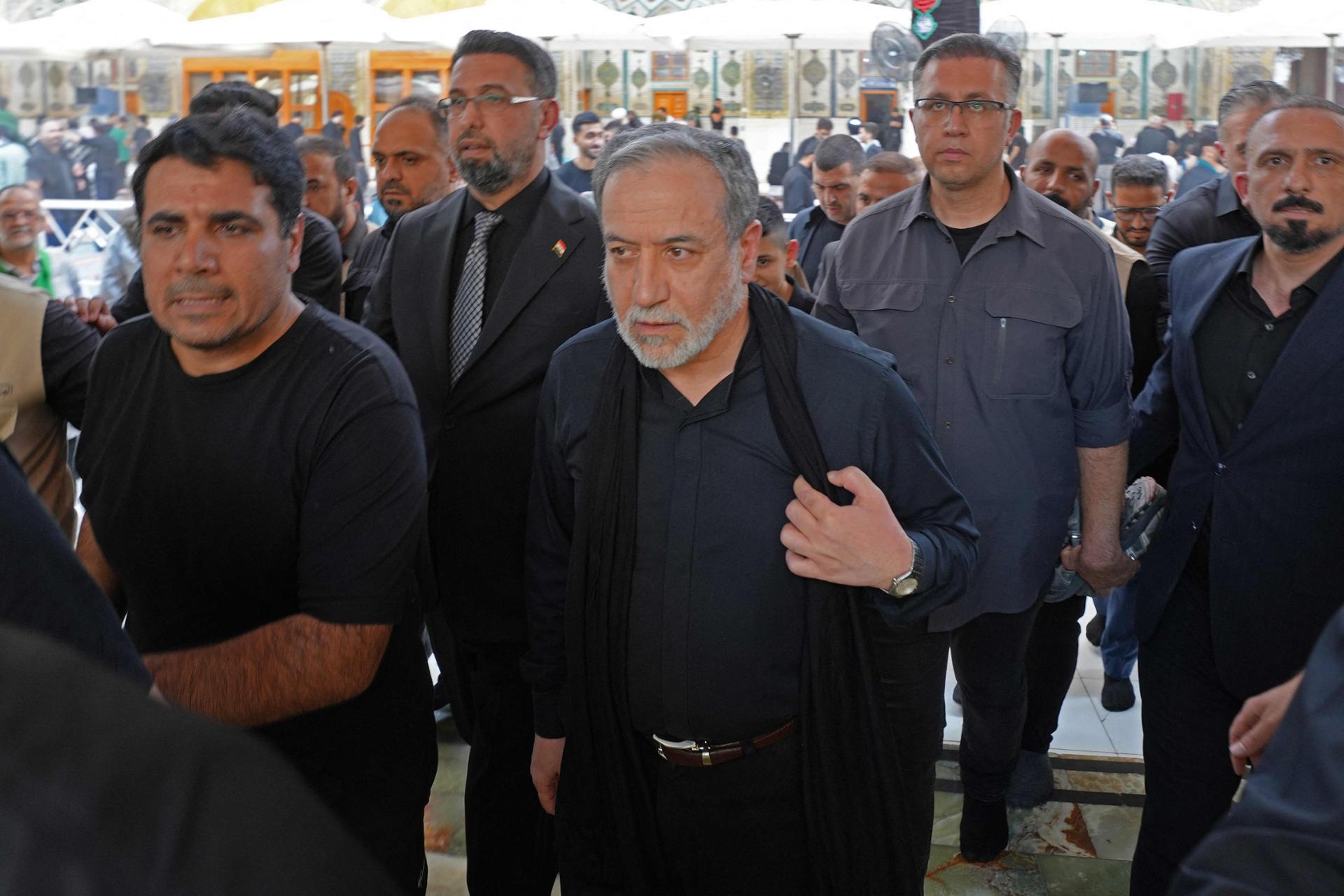
Iran's Foreign Minister Abbas Araghchi visited the Imam Ali shrine in Iraq's holy city of Najaf on Aug. 3. On the same day, Iran's foreign ministry said there were currently no negotiations with the United States, but that talks were taking place with Oman on management of the strategic Strait of Hormuz.

