Ikeja Electric Apologises to Band A Customers as Reduced Grid Allocation Fuels Lagos Power Outages
Key Takeaways
- •Ikeja Electric apologised to Band A customers for failing to provide the promised minimum of 20 hours of daily electricity on November 3 and 4, without citing specific reasons for the shortfall.
- •The company had announced on October 19 that reduced supply stemmed from a shortfall in its power allocation from the national grid, and the recent apology indicates the allocation problems continue.
- •The Federal Government attributed ongoing outages in Lagos, Abuja, Ogun, Kwara and Oyo to inadequate gas supply to thermal plants, maintenance problems and reduced hydropower output, with the Nigerian Independent System Operator confirming gas shortages and low reservoir levels are limiting generation.
- •Grid allocation data from November 5 shows Ikeja Electric receiving 249 megawatts while Eko Electricity Distribution Company received 256 megawatts, volumes that do not necessarily reflect what reaches households.
- •Public frustration has escalated, with protests by mainland and Lagos Island residents, higher petrol spending on generators, and rising costs for businesses, prompting scrutiny of the premium Band A tariff tied to the 20-hour supply promise.
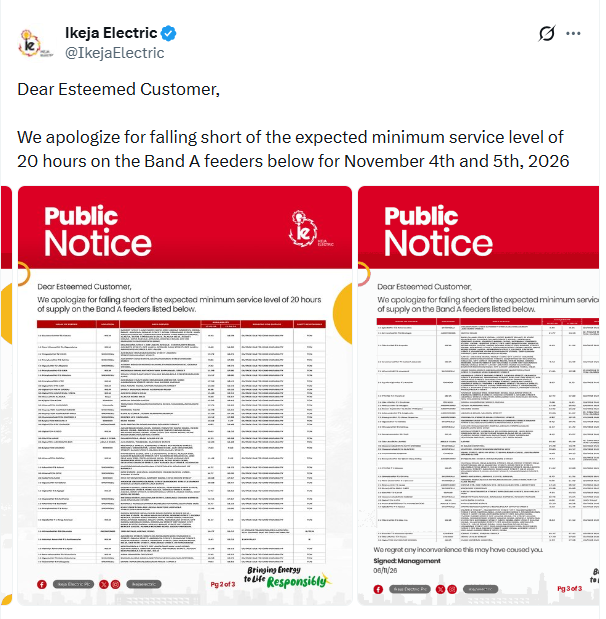
Ikeja Electric has apologised to customers on some of its Band A feeders after failing to deliver the promised minimum of 20 hours of daily electricity supply, an admission that highlights continuing power supply challenges in parts of Lagos.
In a notice dated November 5, published on the company's official X (Twitter) account, Ikeja Electric acknowledged that it fell short of the expected service level on November 3 and 4. The company did not provide specific reasons for the shortfall.
The apology follows an earlier announcement on October 19, in which Ikeja Electric explained that reduced electricity supply was the result of a shortfall in its power allocation from the national grid. At the time, the company said it was working with stakeholders to improve the situation and ensure fair distribution of the available electricity. The latest apology, however, indicates that the allocation problems persist and continue to undermine service commitments to Band A customers.
The disruption is not limited to Ikeja Electric. On November 6, the Federal Government attributed ongoing outages in regions including Lagos, Abuja, Ogun, Kwara and Oyo to several factors: inadequate gas supply to thermal power plants, maintenance problems and reduced output from hydropower stations.
The Nigerian Independent System Operator confirmed that gas shortages and lower water levels in hydroelectric reservoirs are limiting electricity generation, leaving distribution companies to share the little power they receive among their customers. Because distribution companies can only deliver the volumes assigned to them, service commitments such as the Band A guarantee are directly exposed to nationwide generation constraints.
Allocation figures illustrate the squeeze. On November 5, Ikeja Electric received 249 megawatts from the national grid, while Eko Electricity Distribution Company received 256 megawatts. These figures reflect the volumes allocated to the companies, not the amount of electricity that ultimately reaches individual households.
The reduced supply has fuelled frustration among residents. In recent days, some mainland residents protested against the sustained outages, while residents of Lagos Island held demonstrations earlier in the week. Many households are spending more on petrol for generators, and businesses that depend on consistent power are facing higher costs and disruptions.
For Band A customers, repeated shortfalls are raising serious questions about the value of paying higher tariffs for a promise of at least 20 hours of electricity each day. Band A is the top service classification in Nigeria's tariff framework, with premium rates tied to the 20-hour supply expectation. While national supply constraints explain the reduced allocations to distribution companies, customers expect the companies to communicate clearly whenever they cannot meet promised service levels.
As of now, Ikeja Electric has not provided any update on when power supply will be restored to expected levels in the affected areas. Further notices from Ikeja Electric, alongside changes in grid allocations and the gas and hydro conditions cited by the authorities, will indicate how supply in the affected areas develops.
Source: TechNext24

