Despite Fatal Incident, Seoul Unable to Prevent Swimming in Han River
Key Takeaways
- •A man in his 30s died on August 2 after being caught in a whirlpool and pulled into a sluice gate near Jamsil Bridge on the Han River.
- •The popular swimming area is located only about 100 meters from five sluice gates that can produce dangerous currents and vortices when opened.
- •Current Korean law does not give authorities the power to ban or penalize swimming in the river, as the Water Leisure Safety Act regulates only activities involving equipment or vessels.
- •The Seoul Metropolitan Government is exploring legal and institutional measures to restrict public access to hazardous waters near submerged weirs and other dangerous areas.
- •In 2018, two firefighters were killed by strong currents near the Singok submerged weir beneath Gimpo Bridge, illustrating the lethal force of such structures even for trained professionals.
Published Aug. 14, 2026, 12:00 a.m. KST
A short distance from where swimmers enjoyed a Sunday morning dip in the Han River, a man had died just one week earlier — caught in a whirlpool generated by a submerged weir.
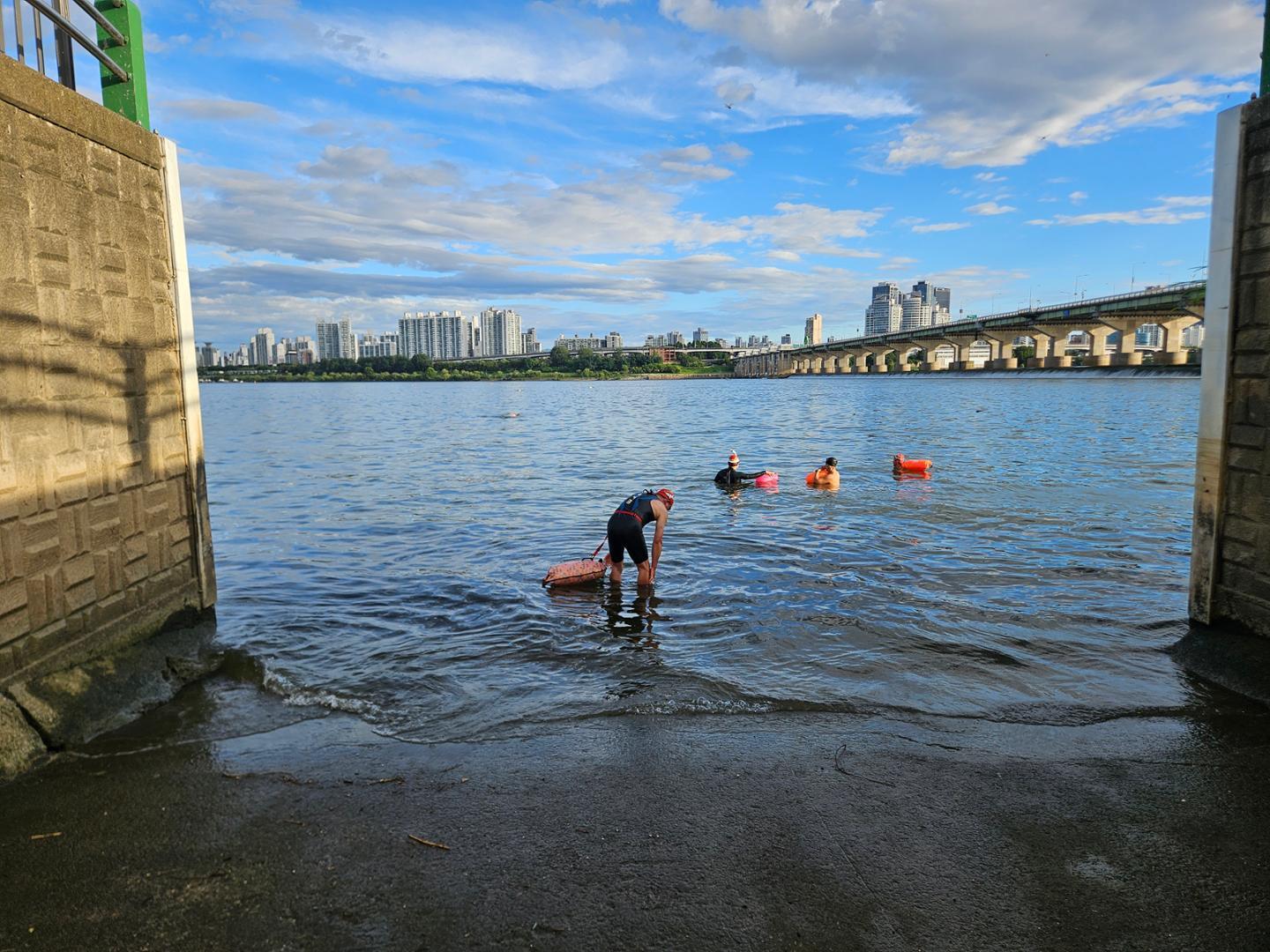
"Even the day before the incident, a couple of young people were swimming dangerously close to the sluice gates at the submerged weir," said Sohn, 63, as he emerged from the river after swimming underneath Jamsil Bridge in Seoul. Even as he spoke, dozens of people could be seen swimming on the southern side of the bridge.
"This is one of the few places where people can swim in open water," Sohn said. "The number of people coming here to swim has risen sharply since triathlons began gaining popularity last year."
As open-water swimming grows in popularity as a hobby, however, serious safety concerns are intensifying along the Han River, one of Seoul's most heavily used recreational waterways, where millions of residents and visitors gather annually across dozens of riverside parks.
The area near Jamsil Bridge was the site of a fatal accident on Aug. 2, when a man in his 30s was caught in a whirlpool and pulled into a sluice gate. Beneath the bridge, close to the swimming area, sits a submerged weir that regulates water flow downstream from the upper reaches of the river. Five sluice gates are installed at the northern end of the bridge, near where the accident took place. The man reportedly swam too close to the gates while some were open. The straight-line distance between the sluice gates and the swimming area is only about 100 meters.
A barricade stands at the entrance to the path leading down to the river, but it appeared to do little to deter swimmers. Many were seen entering the water without safety gear, despite a notice stating that life jackets are mandatory. A few even ventured dangerously close to where the fatal accident had occurred.
Despite the tragedy, swimming remains permissible in parts of the river. Under current law, there is no clear legal basis for banning swimming in the river, except within designated water-source protection zones.
Although the Water Leisure Safety Act allows authorities to designate prohibited or hazardous areas, its provisions apply only to "water leisure activities" involving equipment or vessels. Consequently, authorities cannot impose fines or other administrative penalties on individuals simply for entering the water or swimming without equipment. The gap highlights a broader regulatory challenge: as urban waterway recreation expands faster than the legal frameworks designed to manage it, activities that fall outside traditional categories of regulated water sport can slip through enforcement structures entirely.
Calls are growing to clearly mark hazardous areas near sluice gates and restrict them for swimming, as the gates can generate powerful currents and vortices. In 2018, two firefighters were swept away by strong currents and killed while conducting a boat rescue operation near the Singok submerged weir beneath Gimpo Bridge — a case that underscored the lethal force of weir-generated hydraulics even for trained professionals.
"When sluice gates are opened, powerful currents form, making it difficult to guarantee people's safety even if they are wearing life jackets," said Gong Ha-seong, a professor in the Department of Fire and Disaster Prevention at Woosuk University. "Urgent measures are needed, such as installing safety barriers to prevent people from approaching the gates and significantly improving warning signs."
The Seoul Metropolitan Government says its ability to directly restrict swimming is currently limited because it lacks the legal authority to enforce such a ban.
"We are exploring legal and institutional measures to effectively restrict people from entering hazardous waters near submerged weirs and other dangerous areas," an official from the city's Future Hangang Headquarters said. "This includes seeking advice from legal experts and consulting with relevant agencies."
This article from the Hankook Ilbo, the sister publication of The Korea Times, is translated by a generative AI system and edited by The Korea Times.
