The Great Wealth Transfer Will Deliver Far Less Than Expected, Visa Report Finds
Key Takeaways
- •Visa estimates that baby boomers will pass on approximately $36 trillion of their $93 trillion in total wealth, or about $515,000 per inheriting household, after subtracting debts, retirement spending, taxes, charitable donations, and fees.
- •The bottom 90% of boomer households collectively hold just $16 trillion in wealth, while the top 1% alone controls roughly one-third of the total.
- •Nearly 75% of inheritance recipients fall within the top 2% to 10% income bracket, meaning the transfer is unlikely to narrow the wealth gap between generations.
- •Visa projects that only $8 trillion of inherited wealth will be spent on consumption, increasing average annual real consumer spending growth by just 0.1 percentage point over the next two decades.
- •Approximately one-quarter of millennial homeowners received parental assistance for their down payment and could not have purchased their homes without it, reflecting a broader trend of boomers providing financial support during their lifetimes.
Baby boomers have accumulated unprecedented wealth over decades of economic expansion, but their heirs may face a reality check. The anticipated handoff — widely described as the largest intergenerational wealth transfer in U.S. history — has been a focal point for financial advisors, wealth managers, and economists tracking its potential to reshape consumer spending, housing demand, and asset markets. According to a report from Visa Business and Economic Insights, the so-called Great Wealth Transfer will likely pass on only a fraction of the headline figures that have circulated in recent years.
Estimates for the transfer vary, with some projections reaching as high as $124 trillion. Visa's analysis, published last month, puts the figure at a more modest $93 trillion — still roughly three times U.S. GDP.
Visa compared the gap between advertised totals and actual take-home amounts to lottery winnings. "You hit the jackpot, but you immediately lose half by—smartly—taking the lump sum," the report stated. "Next, you lose another 30–40% through taxes and fees. The advertised jackpot is enormous, but after the lump-sum haircut, taxes and fees, the take-home number is much lower. A similar dynamic applies to the great wealth transfer."
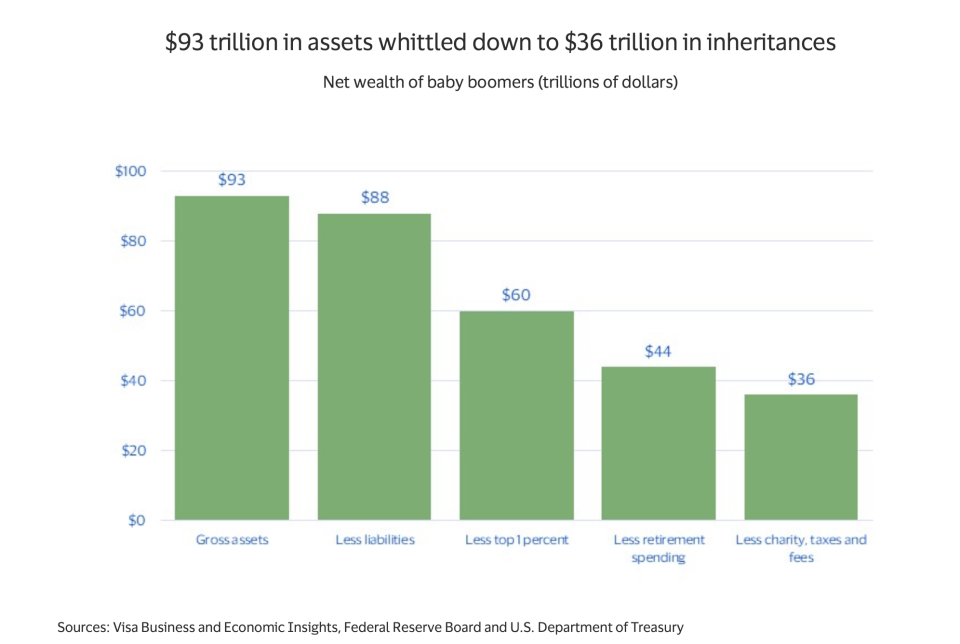
After accounting for debts, retirement spending, charitable donations, taxes, and fees — and excluding the top 1% of households — Visa calculated that boomers will pass on approximately $36 trillion of their $93 trillion in wealth, or about $515,000 per inheriting household.
Despite being the wealthiest generation on record, many boomers carry substantial liabilities. According to Visa, 41% of homeowners aged 65 to 79 and 31% of those 80 and older still hold mortgage debt. Additional obligations include credit card balances, auto loans, borrowing against brokerage accounts, and personal or business loans.
"Taken together, the high share of cost-burdened older homeowners and substantial non-mortgage debt indicate that many baby boomers have far less financial flexibility—and potentially less wealth to pass on—than headline figures might suggest," the report said.
Once debt is subtracted, roughly $88 trillion remains. One-third belongs to the top 1%, leaving $60 trillion. The top 2% to 10% controls $44 trillion, meaning the bottom 90% of boomer households hold just $16 trillion.
Boomers are also expected to spend approximately $16 trillion during retirement on housing, food, healthcare, prescription drugs, and other essentials. Taxes further reduce the pool. That is how Visa arrived at its $36 trillion inheritance estimate.
The wide disparity between affluent and typical boomer households means the $515,000 average overstates what most millennials and Gen Xers will actually receive. Nearly 75% of inheritance recipients fall within the top 2% to 10% income bracket. The top 10% to 50% account for about a quarter, while the bottom 50% represent only a marginal share. The findings suggest the transfer is unlikely to meaningfully narrow the wealth gap between older and younger generations, since the bulk of assets already concentrated among higher-income households will largely remain there.
Because most transferred wealth flows to already-affluent households, a relatively small portion will be spent. Visa estimated that $28 trillion will likely be saved or invested, with only $8 trillion directed toward consumption. Given the scale of the U.S. economy, this spending is projected to raise average annual real consumer spending growth by just 0.1 percentage point to 2.1% over the next two decades. That modest uplift challenges assumptions that the transfer would deliver a significant consumer spending windfall for the broader economy.
There are some bright spots for younger generations. Boomers are increasingly providing financial support during their lifetimes. The popularity of "skip-generation trips," where grandparents travel with grandchildren without the parents, reflects this trend: 28% of grandparents have taken such a trip, and 35% plan to within the next three years.
Additionally, roughly one-quarter of millennial homeowners received parental assistance for their down payment and would not have been able to purchase their current home without it.
"For many, this support made it possible to qualify for a mortgage, lower their monthly payments or afford a more expensive home. It also reflects a broader shift among older generations toward giving while living," Visa said. "Rather than waiting to pass down inheritances later, many boomers are using their wealth to help their children clear major financial hurdles now, when the support will have the greatest impact."
Source: Fortune

