European Markets Slide as Brent Crude Nears $100; Novartis Posts Record One-Day Drop
Key Takeaways
- •Novartis fell more than 10% — its steepest single-day drop ever — after its myotonic dystrophy drug del-desiran and cholesterol therapy pelacarsen both failed late-stage trials.
- •Brent crude hovered around $98.50 per barrel after Iran threatened retaliatory strikes against Gulf and American energy installations.
- •The STOXX 600 declined 0.6% to about 646 points, with the DAX, CAC 40, and FTSE 100 all losing between 0.4% and 0.6%.
- •Markets broadly expect the European Central Bank to raise rates by 25 basis points at Thursday's meeting, while strong U.S. jobs data has reinforced expectations of another Fed hike this month.
- •Sandoz gained 4.5% after projecting net sales growth of more than 100% over 2025-2035, and Telecom Italia rose 2.5% on Poste Italiane's improved acquisition offer.
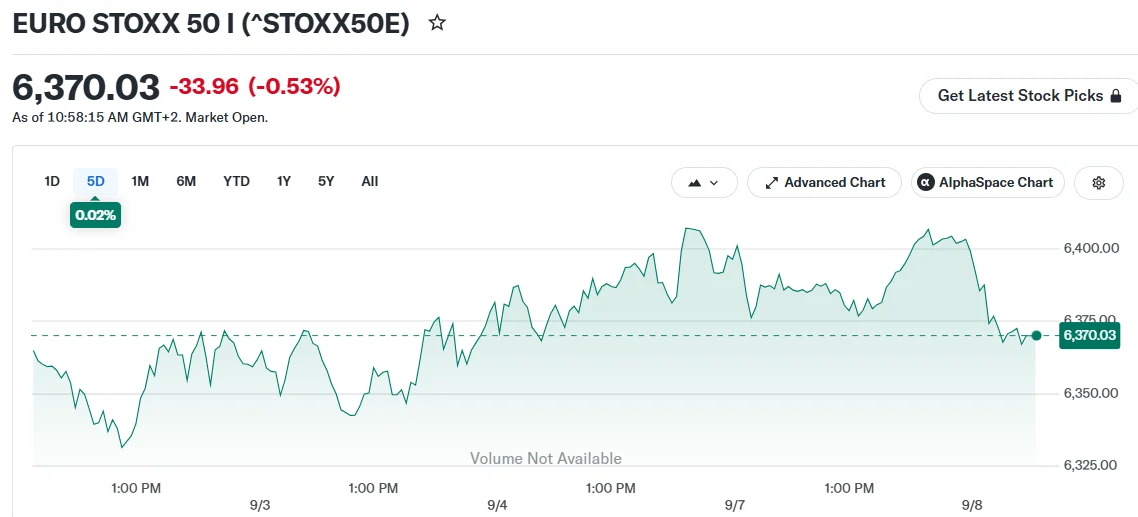
European equity markets fell on Tuesday as surging oil prices intensified inflation concerns, while Novartis suffered its worst trading session in company history. Europe's benchmark STOXX 600 index declined 0.6% to approximately 646 points during morning trading. Major indices, including Germany's DAX, France's CAC 40, and Britain's FTSE 100, all posted losses ranging from 0.4% to 0.6%.
Novartis Records Historic Decline After Consecutive Trial Setbacks
Novartis was the STOXX 600's biggest decliner, shedding more than 10% of its value — the steepest single-day drop in the company's history. The Basel-based pharmaceutical company disclosed that del-desiran, its advanced-stage candidate for treating myotonic dystrophy, failed to achieve its primary clinical endpoint.
The announcement came shortly after Monday's revelation that pelacarsen, the company's investigational cholesterol therapy, had also fallen short in late-phase clinical testing. The dual disappointments within 48 hours triggered a mass exodus among shareholders. Late-stage pipeline candidates typically represent years of research investment and are a key driver of pharmaceutical companies' long-term growth outlook, which is why trial failures of this magnitude tend to prompt sharp market repricings — a dynamic on full display in Novartis shares on Tuesday.
StoneX senior market analyst Fiona Cincotta observed that despite these recent setbacks, Novartis had accumulated substantial year-to-date gains prior to this week's developments.
Elsewhere in the sector, Sandoz advanced 4.5% after the Swiss pharmaceutical manufacturer announced ambitious growth targets, projecting that net sales will increase by more than 100% over the 2025–2035 period.
Poste Italiane enhanced its acquisition proposal for Telecom Italia. The announcement lifted Telecom Italia shares by 2.5%, while Poste Italiane remained unchanged.
Crude Prices Surge Toward $100 on Middle East Geopolitical Risks
Brent crude futures hovered around $98.50 per barrel after Iran threatened retaliatory strikes against Gulf energy infrastructure, including American oil and natural gas installations, should attacks occur. A move above the $100 threshold would mark a psychologically significant level for markets, given oil's outsized role in shaping inflation expectations and consumer spending across import-dependent Europe. The energy sector bucked the broader market trend, gaining 0.6% despite widespread declines elsewhere.
Elevated crude prices are amplifying inflationary pressures across Europe and worldwide. Fixed-income markets saw significant selling activity last week, prompting expectations that central banks will keep interest rates elevated for an extended period. The oil rally complicates that picture further, since higher energy costs feed directly into consumer prices just as policymakers debate how much more tightening is needed.
Market participants broadly anticipate the European Central Bank will raise rates by 25 basis points at Thursday's policy meeting. Attention is also focused on U.S. inflation data due later this week, which follows unexpectedly strong American employment figures that have reinforced expectations for an additional Federal Reserve rate hike this month.
European banking sector equities declined 1.3%. Market observers note that financial institutions typically serve as early indicators of economic deceleration concerns, with rising energy costs amplifying recession anxieties within the eurozone.
The euro held steady near $1.16. UK 10-year government bond yields rose 2 basis points to 5.19%, while Germany's equivalent maturity yield advanced to 3.39%.
Germany reported a trade surplus of €21.27 billion, whereas France's trade deficit widened to €6.7 billion in July.
The downward pressure on European markets follows a subdued Monday session, when American exchanges were closed for the Labor Day holiday.
