European Stocks Fall as Brent Crude Approaches $100 a Barrel and Novartis Slumps on Drug Trial Failures
Key Takeaways
- •Novartis fell more than 10%, on track for its worst day on record, after its del-desiran trial for myotonic dystrophy failed, following a failed pelacarsen cholesterol drug trial a day earlier.
- •Brent crude rose nearly 2% to around $98.50 a barrel after Iran threatened to strike energy infrastructure across the Gulf if attacked.
- •The pan-European STOXX 600 dropped 0.6% to about 646 points, with the DAX, CAC 40, and FTSE 100 each down between 0.4% and 0.6%.
- •The European Central Bank is widely expected to raise interest rates by 25 basis points at its Thursday meeting.
- •Germany posted a €21.27 billion trade surplus in July, while France's trade deficit widened to €6.7 billion.
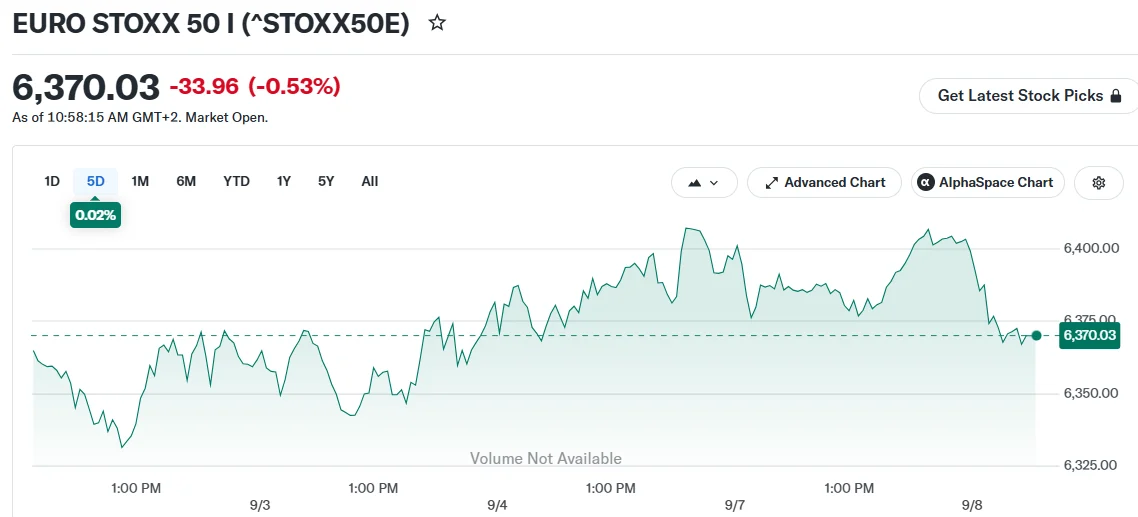
European stocks fell on Tuesday as rising oil prices stoked inflation fears and Novartis suffered one of the worst single-day crashes in its history.
The pan-European STOXX 600 dropped 0.6% to around 646 points by mid-morning. Germany's DAX, France's CAC 40, and London's FTSE 100 each fell between 0.4% and 0.6%. The broad decline extends a choppy stretch for European equities, which have had to absorb a bond market selloff and shifting central bank expectations in recent sessions.
Novartis Hit by Back-to-Back Drug Trial Failures
Novartis was the biggest loser on the STOXX 600, falling more than 10% and on track for its worst day on record. The Swiss drugmaker announced that its late-stage trial for del-desiran, a treatment for myotonic dystrophy, failed to meet its primary endpoint. Myotonic dystrophy is a rare, inherited neuromuscular disorder with no currently approved treatment targeting its underlying cause, which is why late-stage programs in the disease attract significant investor attention.
The news came just one day after Novartis revealed that pelacarsen, its experimental cholesterol drug, had also failed in a late-stage trial. Two setbacks in two days sent investors heading for the exit. The double blow highlights a broader reality for large pharmaceutical companies: pipeline candidates in expensive late-stage trials can represent billions in potential future revenue, and a single failed readout can wipe out years of development spending and expected sales in a single trading session.
Fiona Cincotta, senior market analyst at Stone-X, noted that Novartis had still posted solid gains earlier in the year before these setbacks.
Sandoz, by contrast, gained 4.5% after the Swiss pharmaceutical company said it aims to more than double net sales between 2025 and 2035. Sandoz, Novartis's former generics and biosimilars arm, was spun off as a separate listed company in 2023.
Elsewhere, Poste Italiane sweetened its takeover offer for Telecom Italia. Telecom Italia shares rose 2.5% on the news, while Poste Italiane traded flat. The bid is the latest step in the long-running consolidation of Italy's telecom sector.
Oil Prices Near $100 as Middle East Tensions Rise
Brent crude futures traded around $98.50 a barrel, up nearly 2%, after Iran threatened to strike energy infrastructure across the Gulf, including U.S. oil and gas assets, if attacked. The move pushed energy shares up 0.6% even as the rest of the market fell. A sustained move above $100 would take crude back to levels last seen during the supply shocks of 2022, a threshold that has historically weighed on consumer-facing economies dependent on imported energy, as most of Europe is.
Higher oil prices are adding to inflation pressure across Europe and globally. Bond markets saw a selloff last week, and central banks are now expected to hold rates higher for longer. The European Central Bank is widely expected to raise interest rates by 25 basis points at its meeting on Thursday. The decision will be followed closely for any signal on the path beyond this week's move.
Investors are also watching U.S. inflation data due later this week. That report follows a stronger-than-expected U.S. jobs reading, which raised bets on another Federal Reserve rate hike this month.
Banking shares in Europe dropped 1.3%. Analysts say banks tend to reflect concerns about a slowing economy first, and higher oil prices are fueling worries about a possible recession in the eurozone.
The euro held steady around $1.16. UK 10-year bond yields rose 2 basis points to 5.19%, while Germany's 10-year yield edged up to 3.39%.
On the trade front, Germany reported a surplus of €21.27 billion, while France's trade deficit widened to €6.7 billion in July. The figures underscore the persistent divergence between Europe's largest economy, powered by export manufacturing, and its second-largest, which relies heavily on energy imports.
The pressure on European markets comes after a quiet Monday, when U.S. markets were closed for the Labor Day holiday.
