Hyosung Bets on AI Power Boom with US Grid Expansion
Key Takeaways
- •Hyosung has invested $300 million to expand its ultra-high-voltage transformer plant in Memphis, Tennessee, which is expected to rank among the largest production facilities of its kind in the US.
- •In 2022, Hyosung developed a 22.9-kilovolt, 1.05-megavolt-ampere solid-state transformer capable of connecting directly to urban distribution networks.
- •The global solid-state transformer market is projected to grow more than 40 percent annually as power infrastructure is modernized, though high-capacity SSTs for data centers remain at an early commercialization stage.
- •Hyosung formed a joint venture with Quanta Services to produce circuit breakers from 72.5 kV to 800 kV in Pennsylvania, giving it local manufacturing for both transformers and circuit breakers.
- •Hyosung Group Chair Cho Hyun-joon described power infrastructure as a core industry linked to national security and pledged to establish the company as a long-term partner in stabilizing the US grid.
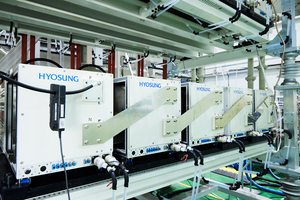
Hyosung Heavy Industries is scaling up its US power infrastructure business as demand from artificial intelligence and data centers continues to climb. The South Korean company is pairing its local manufacturing base in the United States with its expertise in power equipment and grid technologies, positioning itself amid rising electricity demand and an aging American grid that is driving major investment in the country's power network. The push comes as grid equipment has become a recognized bottleneck for data center construction, with US domestic manufacturing of large transformers and related hardware attracting policy support aimed at strengthening supply chains.
At the heart of Hyosung's technology strategy is the solid-state transformer, or SST, which the company regards as a key component of power systems in the AI era. In 2022, Hyosung developed a 22.9-kilovolt, 1.05-megavolt-ampere SST capable of connecting directly to urban distribution networks. Unlike conventional transformers, SSTs use power semiconductors to control voltage and current while simultaneously providing electrical insulation. That controllability is what makes SSTs relevant to data centers, which require flexible, high-density power delivery that conventional copper-and-iron transformers were not designed to provide.
According to market research firms, the global SST market is projected to grow by more than 40 percent annually as power infrastructure is modernized. The segment for high-capacity SSTs serving data centers at 22.9 kV and above is still at an early stage, with only a handful of companies pursuing demonstrations and commercialization. Hyosung aims to secure an early foothold as data centers demand larger, more flexible and more efficient power systems.
To support its US expansion, Hyosung has invested $300 million in enlarging its ultra-high-voltage transformer plant in Memphis, Tennessee. Once completed, the expanded facility is expected to have one of the largest production capacities of its kind in the United States. Domestic production also positions the company favorably as US utilities and regulators increasingly weigh where critical grid equipment is made.
The company has also formed a joint venture with US infrastructure firm Quanta Services to manufacture circuit breakers ranging from 72.5 kV to 800 kV in Pennsylvania, giving Hyosung local manufacturing capabilities for both transformers and circuit breakers. Quanta's nationwide operations and customer network are expected to help Hyosung reach major power users and broaden its access to the US infrastructure market.
Hyosung plans to combine this local production base with its portfolio of SSTs, energy storage systems, static synchronous compensators and high-voltage direct-current transmission technologies to target the growing data center power market. How quickly high-capacity SSTs move from demonstration to commercial deployment at data centers, and how the Memphis expansion ramps up, will be key markers of the company's progress in this segment.
"Driven by the expansion of AI and data centers, power infrastructure has become a core industry directly linked to national security," Hyosung Group Chair Cho Hyun-joon said. "Building on our US manufacturing facilities and technological capabilities, we must establish ourselves as an irreplaceable, long-term partner in stabilizing the American power grid."
