ECB Pushes to Widen MiCA Stablecoin Yield Ban as Circle, Aave and EU Users Resist
Key Takeaways
- •The European System of Central Banks asked the European Commission to broaden MiCA's ban on paying stablecoin holders so it covers lending, borrowing, staking, rewards, fee reductions and loyalty benefits.
- •ESMA instead proposed a regulated service for firms providing access to DeFi protocols, along with proportionate disclosure rules for staking, lending and borrowing, rather than an outright ban.
- •Circle and Aave Labs pushed back against expansion, with Circle noting only three of the 25 largest stablecoins currently meet MiCA standards and Aave Labs warning a wider ban would favor dollar stablecoins in on-chain markets.
- •The Stand With Crypto EU group reported more than 50,000 emails to the Commission and a petition exceeding 126,600 signatures calling for the yield ban to be dropped.
- •The ESCB also proposed scrapping the rule requiring issuers to hold 30-60% of reserves in bank deposits, replacing it with a system where a set share of reserves matures within one to five working days.
Circle, Aave Labs and more than 50,000 European Union citizens are set to face off against Europe's central banks, which are urging Brussels to extend the MiCA ban that currently prohibits paying stablecoin holders, so that it also covers activities such as crypto lending, borrowing and staking.
The clash between those who want the restriction tightened and those who want it loosened was set up during the European Commission's MiCA review public comment window, which closed on September 30. Because MiCA — the EU's Markets in Crypto-Assets regulation — sets the common rulebook for stablecoins across the bloc, the review's outcome will shape what EU holders can legally earn on the tokens they use, putting lending, staking and rewards programs across the region on the line.
What European central banks want from the MiCA consultation
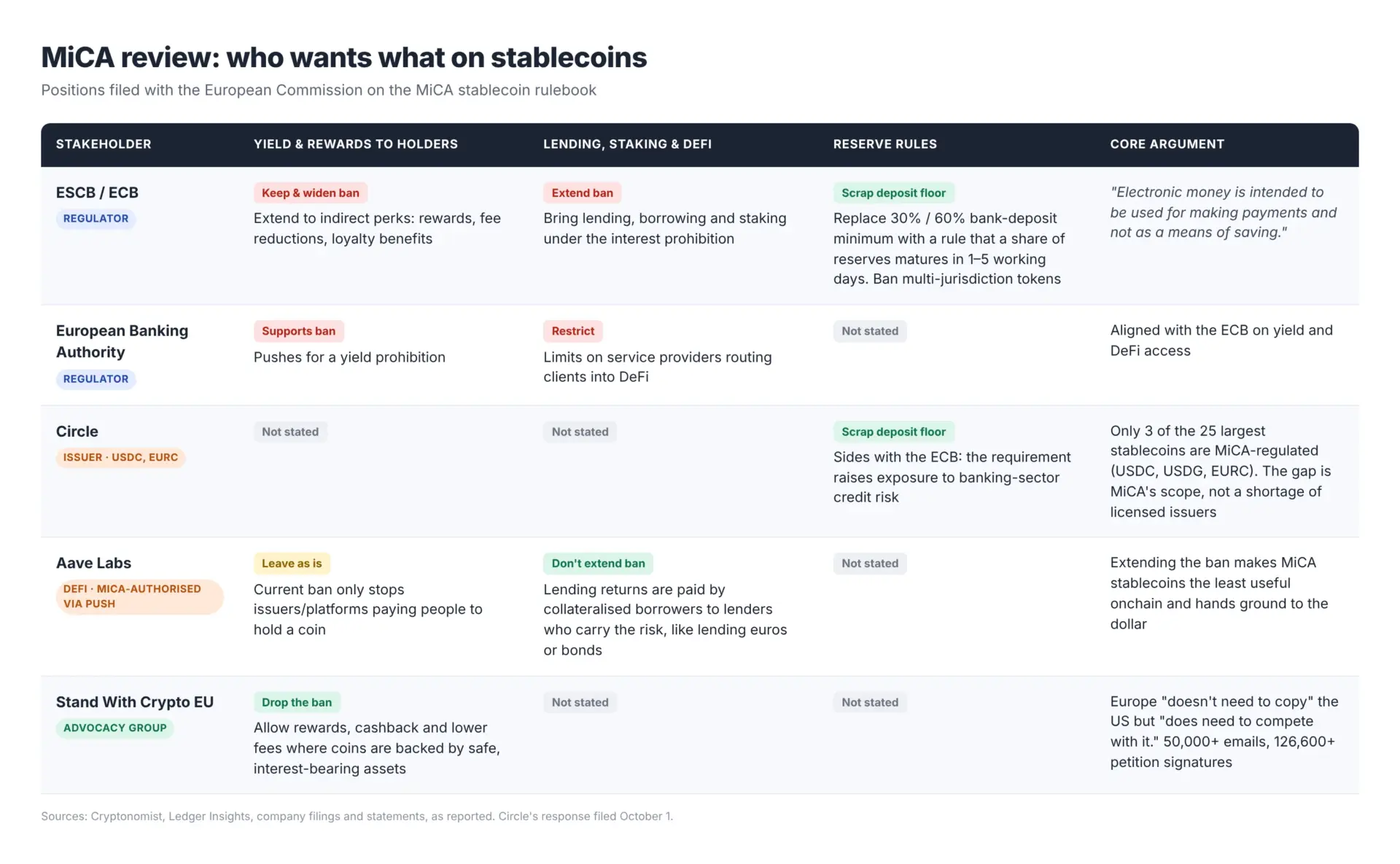
The European System of Central Banks (ESCB), a body that includes the European Central Bank (ECB), wrote in its response to the European Commission's MiCA consultation that it supports keeping the prohibition on paying interest on stablecoins in the rulebook.
The ESCB pushed regulators to expand the interest payment ban to activities such as lending, borrowing and staking. It also asked that prohibitions on other forms of perks — including rewards, fee reductions and loyalty benefits — be added to the rulebook. In its current state, MiCA does not expressly ban these alternatives.
Explaining its position, the ESCB wrote that “Electronic money is intended to be used for making payments and not as a means of saving.” When people are paid for simply holding a token, the body argued, the arrangement starts to align with its definition of a deposit account, which is governed by different rules.
The central banks also asked that stablecoins issued in other jurisdictions not be considered viable or acceptable in the EU. For example, a US-issued USDC token should not be treated separately from a euro-issued USDC.
Not every suggestion from the body pushed for more restrictive measures, however. The ESCB asked regulators to scrap a rule that requires stablecoin issuers to hold between 30% and 60% of their reserves in bank deposits. In its place, the body representing Europe's central banks proposed an alternative system in which a set share of reserves would mature within one to five working days.
The central banks are not the only regulators in the file. In its September 30 response, the European Securities and Markets Authority (ESMA) proposed a new regulated service for firms that give users access to DeFi protocols, along with proportionate disclosure rules for staking, lending and borrowing, rather than an outright ban. In doing so, ESMA staked out a middle position between the central banks' ban-first approach and the industry's push to keep lending and staking outside the prohibition.
Industry stakeholders disagree with Europe's central banks
In its October 1 response to the regulator, Circle argued that the regulator should focus on the perimeter of a framework that clears only three of the 25 largest stablecoins by market cap — USDC, USDG and EURC — as MiCA-compliant today, not on a shortage of licensed issuers.
Circle did, however, side with the ECB on reserves, writing that the mandatory deposit floor requirement raises exposure to banking-sector credit risk.
Aave Labs, the DeFi firm that operates Push — a MiCA-authorized service provider subsidiary supervised by the Central Bank of Ireland — asked the Commission in its consultation response not to extend the interest ban to lending or staking.
The company grounded its argument in a distinction between lending returns and simply paying people to hold a coin. Lending returns are paid by borrowers who post collateral and are taken on by a lender who bears the risk, much like lending euros or bonds, while the current ban only stops issuers and platforms from paying people to hold a coin.
Expanding the ban beyond its current scope, Aave Labs argued, would dollar stablecoins the advantage in on-chain markets, while MiCA stablecoins lose a key use case in that sector.
Stani Kulechov, the founder of Aave, said on X that he was “disappointed” by the responses from the ECB and the European Banking Authority.
More than 50,000 respondents oppose expanding MiCA's scope
The loudest pushback came from outside the companies. The Stand With Crypto EU advocacy group said more than 50,000 people across the bloc asked the Commission via email to let regulated stablecoins offer rewards, cashback and lower fees. One petition gathered over 126,600 signatures calling for the yield ban to be dropped entirely, as long as the coin is backed by safe, interest-bearing assets.
The group, whose partners include Boerse Stuttgart Digital, 50 Partners, IOTA and Morpho, said the email volume ran more than six times the 8,221 responses to the ECB's digital euro consultation.
Harry Pearce Gould, the group's general manager, framed it as a competitiveness fight, saying Europe “doesn't need to copy” the US but “does need to compete with it.” Under the GENIUS Act of 2025, US issuers cannot pay interest directly, but exchanges there can still offer rewards. Supporters of keeping the rules within their current scope argue that EU platforms will lose business if regulators move forward with the restrictive suggestions.
The Commission now has to reconcile those competing submissions as it decides what a revised MiCA looks like. How it weighs the ESCB's push to extend the ban against ESMA's disclosure-based alternative and the industry's arguments for keeping lending and staking outside the prohibition will shape how much of that activity remains available to EU users under the revised framework.

