Pi Coin Price Stalls Near $0.09 as Protocol 28 Mainnet Switch Nears
Key Takeaways
- •PI traded at $0.0903 on OKX on October 2, 2026, with a market capitalization near $1.01 billion against only $5.41 million of 24-hour volume.
- •The Pi Core Team announced that node operators must upgrade to Protocol 28 by October 13, with the mainnet switch scheduled for October 16.
- •Pi said it will work with Open Standard, whose partner-governed Open USD stablecoin counts more than 200 partners including Visa, Google and Stripe, though details remain undisclosed.
- •Liquidity is thin, with OKX showing about $102,500 in resting orders within 2% above price, and Binance, Coinbase, Bybit and KuCoin do not list PI spot.
- •PI trades below its falling 100-day and 200-day moving averages, with a daily close above $0.0948 required to activate the bullish case and a close under $0.0849 to activate the bearish case.
Pi (PI) did very little on Friday. As of 15:10 UTC on October 2, the token sat at $0.0903 on OKX spot, with the session's range so far running from $0.08965 to $0.09183. Two pieces of project news landed during the past week; the price ended the stretch about where it began.
Quiet is a relative term. CoinMarketCap lists a market capitalization near $1.01 billion against only $5.41 million of 24-hour volume. PI's peak of $2.98, set on February 26, 2025, remains 97% above the current price.
How Pi Got to Nine Cents
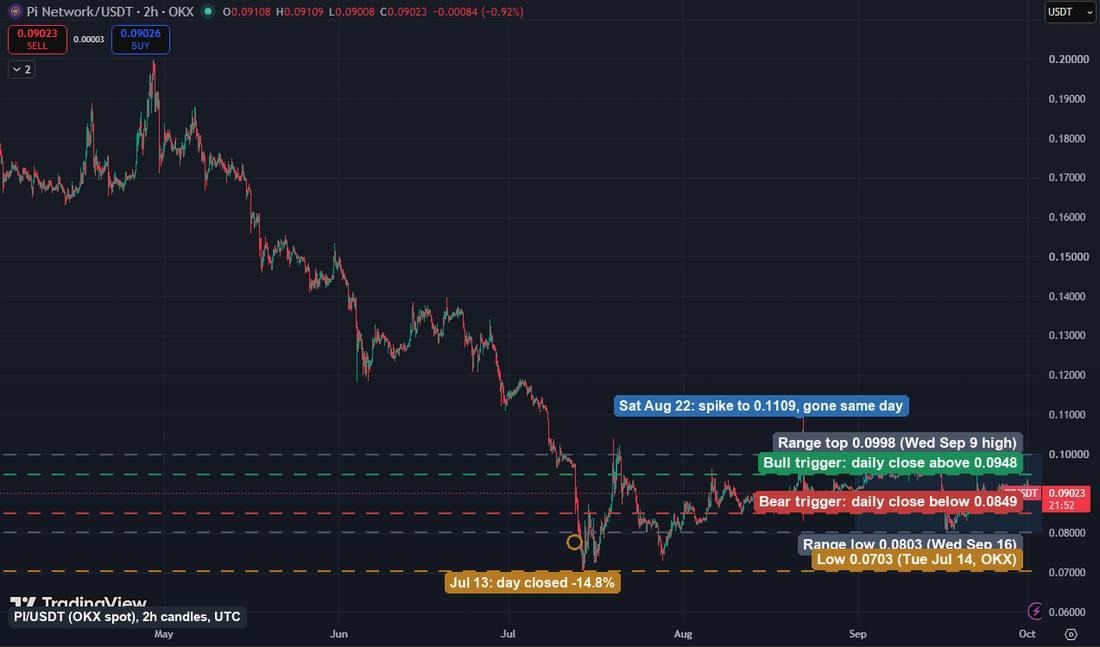
The decline arrived in lumps. On Monday, July 13, PI closed 14.8% lower on OKX, and Tuesday, July 14 printed the low at $0.0703. Turnover on the exchange that Monday was about $11.4 million — more than four times the September daily average there.
Why it happened is not settled. Third-party reports blamed holder selling and monthly token unlocks, but nothing Pi has published ties either one to that day. "Possible" is as far as the evidence goes.
Price has never traded back under that low. It probed the zone twice — Thursday, July 16 (0.07232) and Tuesday, July 28 (0.07297) — then climbed into a $0.080 to $0.100 band and stayed there. On Saturday, August 22, PI spiked to $0.1109 and closed at $0.0904, a full round trip inside one day. OKX's PI/USDT 2-hour chart for May through October 2, 2026, on TradingView, shows the pattern.
The latest leg down began on Tuesday, September 15. At 18:00 UTC, PI fell from 0.09457 to 0.0886 inside an hour. The low came at 17:00 UTC on Wednesday at $0.0803, which is 18.7% below the September 14 high of $0.0988.
Timing complicates the macro narrative. The Federal Reserve raised its target range by a quarter point, to 3.75% to 4%, at 18:00 UTC that Wednesday, according to its own statement. PI had bottomed in the hour before and closed that hour higher at 0.08298 — which makes the rate hike a poor explanation for the low. What hit coin at 18:00 UTC on Tuesday is not confirmed anywhere checkable. The 30-minute OKX chart on TradingView, covering September 1 to October 2, 2026, captures the move.
What Liquidity Looks Like Under the Chart
Thin order books matter more to PI's price than any chart pattern. CoinMarketCap's exchange table showed OKX with about $102,500 of resting orders within 2% above price and $236,900 within 2% below as of mid-afternoon UTC on October 2. Kraken's pair showed $1,381 and $6,227.
OKX carried roughly 38% of reported volume, Gate 14% and Bitget 8%. Binance, Coinbase, Bybit and KuCoin do not list PI spot: Binance's API rejected the PIUSDT symbol on October 2, Coinbase returned not found for PI-USD, and the Bybit and KuCoin checks came back empty.
Leveraged positioning is small. Open interest — the total of open leveraged positions — stood at about $2.5 million on OKX, with Bitget at roughly $5.3 million and Gate at $1.3 million. That is around $9 million combined, under 1% of market capitalization. Funding was 0.005% on OKX and Gate and minus 0.0288% on Bitget at 15:10 UTC. These are snapshots, not verdicts.
Token Supply Is the Slow Variable
Per CoinMarketCap, 11.24 billion PI circulate out of a 100 billion maximum, or 11.2%. Fully diluted valuation is $9.02 billion — about nine times the market cap.
Release schedules for locked balances come from third-party trackers rather than Pi's blog. Those trackers put monthly releases near 128 million PI, which at the current price equates to roughly $11.5 million a month, or about $0.38 million a day — approximately 7% of daily volume. PiScan displayed a maintenance page on October 2, and the figure remains unconfirmed. The full weekly record for OKX's PI/USDT pair is available via TradingView.
Protocol 28 and the Open USD Tie-Up
The Pi Core Team posted at 23:24 UTC on Friday, September 25 that its testnet had moved to Protocol 28 after Protocol 27 finished on mainnet. Node operators must upgrade by October 13, and the mainnet switch is set for October 16. Pi describes the upgrade as better handling of transaction-data delays plus safer batch upgrades for smart contracts.
The partnership announcement came five days later. At 17:45 UTC on Wednesday, September 30, Pi's X account said the project is working with Open Standard, the company behind Open USD (OUSD), a partner-governed stablecoin. According to Pi's post, Open Standard counts more than 200 partners, including Visa, Google and Stripe. Pi said it will explore rewards for Pioneers and wider use, with details to follow. That is intent, not a product.
PI traded at 0.09115 when the post went up. It touched 0.09332 early Thursday, then closed Thursday at 0.09002 — below where it started.
Developer Tools and KYC Fixes
Pi's blog shows steady shipping. A September 4 post added local storage for a set of whitelisted apps, a staking-data API and file sharing, plus a unified documentation site. Pi Desktop 0.6.3 followed on September 9 with SoloHost app rankings by active users and a My Apps page. Neither post gives app or user counts — the numbers a price-watcher would want most.
KYC and migration received fixes as well. A September 17 post said 417,000 accounts flagged as possible duplicates can move forward in KYC. It also promised a fix within a week for 497,000 Fast-Track wallets stuck without gas to claim migrated balances. As of October 2, the blog index showed no later post confirming that the fix shipped.
The Price Levels That Decide the Next Leg
Here is where the moving averages sat through Thursday's close. PI is below its 100-day (0.0935, still falling) and 200-day (0.1278, also falling) averages. The 50-day at 0.0910 is a hair overhead, and the 20-day at 0.0897 sits just underneath. Measured from the 20-day high of 0.0988, PI is down 8.6%, and it trades 6.4% above the 10-day low of 0.0849. That is a range, not a breakout.
Bulls need a daily close above $0.0948 — the high from Tuesday, September 22. That would open $0.0988 first, then $0.0998 from the September 9 high. If PI slips back under $0.0937 on a daily close (the September 30 high), the bullish case is off.
Bears need a daily close under $0.0849, Friday, September 25's low. The first stop would be $0.0803, then $0.0703. A daily close back above $0.0881 — the September 23 close — cancels the bearish setup.
Between those lines, neither case is live, and the scenario block is the whole call. Short term, PI is balanced. The trend regime is the one input with tested backing: Bitcoin at $85,394 sat above its rising 100-day average of $70,770, while PI sat below its own. That leans toward the bear case, though only a close under 0.0849 would make it live.
Dates that could move volume in either direction — with the direction itself unknown — are the October 13 node deadline and the October 16 mainnet switch.
Bitcoin and Rates Behind the Pi Chart
PI has not followed the broader market. CoinGecko lists it down 3.8% over 30 days, while the Binance Bitcoin perpetual is up 10.5%. The rate backdrop is the Fed's 375% to 4% range following the September 16 hike.
None of this is financial or investment advice. It is a read of price, liquidity and public project updates as of 15:40 UTC on Friday, October 2, 2026, based on reporting from Live Bitcoin News. Any of it can go stale within hours.

