Philippine DTI Seeks Wider Market for 'Dying' Traditional Crafts via LIKHA Program
Key Takeaways
- •The DTI's LIKHA program, spearheaded by First Lady Liza Araneta-Marcos and operationalized by the agency, exhibits endangered Filipino crafts to build buyer demand and sustain fading traditions.
- •Cebu's Kinarnero, a traditional handwoven loop weave, nearly went extinct because traditional raw materials grew scarce and few weavers passed the skill to younger generations.
- •The sole remaining Lagang shell craft practitioner in Cebu found a market for his work and now trains his community, an approach the DTI encourages other artisans to adopt.
- •More than 100 artisans are taking part in the fifth edition of Likha, a three-day showcase running from Oct. 2 to 4 with an expected attendance of about 9,000.
- •After the showcase, craftsmen may display their pieces for free at the year-round Likhang Filipino Exhibition Halls in Pasay City, where a 10-15% markup covers handling, stocking, and operations.
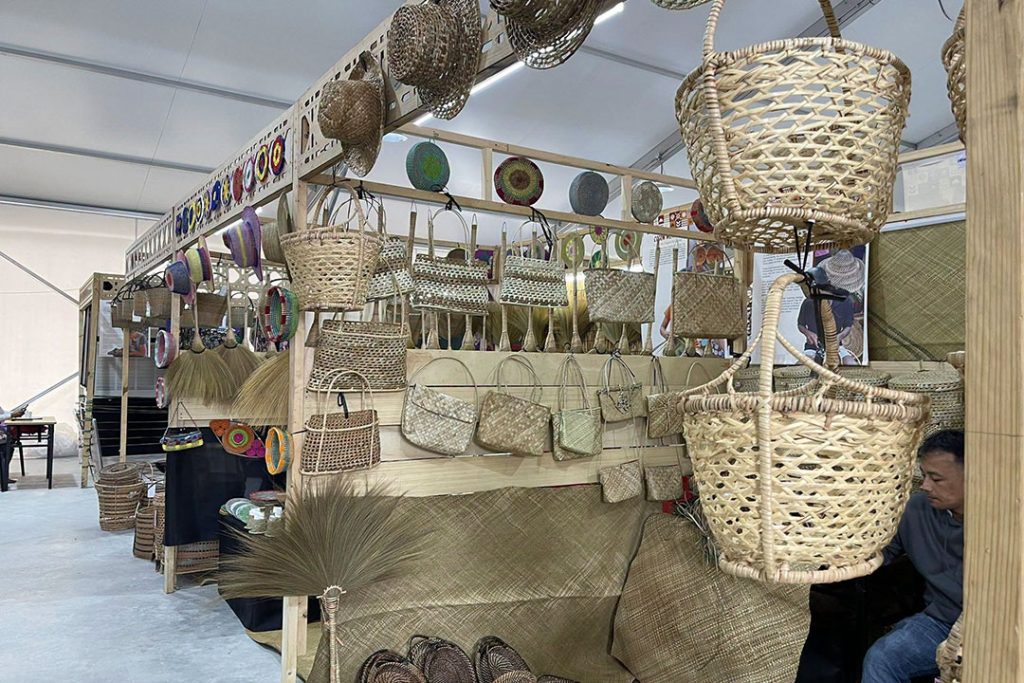
The Philippine Department of Trade and Industry (DTI) said on Thursday that it is working to expand the market reach of "dying" locally made products by helping Filipino artisans present their crafts to a wider audience.
"The more you help us bring out the information that there is such product, the more you create a demand for them," DTI Assistant Secretary Al Modesto Valenciano told BusinessWorld in an interview. "Let's face it, it's economics. For it to go on, there has to be a demand. The more we inform people about it, the more we inform other designers about it, and the more we use the products, the more it can go on."
The initiative falls under the LIKHA program, spearheaded by First Lady Marie Louise "Liza" Araneta-Marcos and operationalized by the DTI. Through the program, artisanal pieces from across the country — particularly those at risk of disappearing — are exhibited to draw potential buyers and, hopefully, resurrect fading craftsmanship.
Among the exhibitors is the Holistic Coalition of the Willing (HoliCOW), which featured Cebu's Kinarnero in partnership with the Cebu Technological University (CTU) Argao Campus. Kinarnero is a traditional handwoven textile and loop weave whose fleece-like texture makes it absorbent. The technique nearly went extinct due to raw material shortages and a failure to pass the tradition down to younger generations.
"It died down because, perhaps, of the material that is actually lacking. So, there are no materials traditionally used for this," Crysali Therese Dayaganon, a professor at CTU Argao, told BusinessWorld in an interview. "Another problem is actually, nowadays, there are only a few who are able to pass down the skill and actually weave."
Mr. Valenciano said the LIKHA program aims to encourage local craftsmen not only to sustain their heritage work but also to bring others into the tradition. He pointed to the case of the last remaining practitioner of Lag shell craft in Cebu, who found new momentum after discovering demand for his work.
"The ones doing the Lagang shell craft in Cebu, he's the only one left, but after a year, he discovered that there's a market. He's now training his community," he said. "That's what we encourage them to do. Train your community, involve the community because they cannot multiply their speed; it's all handmade, but they can multiply the people who work the way they work."
Together, the Cebu examples illustrate the pressures behind LIKHA's mandate: a craft can fade when its raw materials run short or its practitioners dwindle — and, as the Lagang shell craftsman shows, it can find new momentum once demand reappears and skills are passed on to new learners.
More than 100 artisans are taking part in the fifth edition of Likha. After the showcase, craftsmen may display their pieces for free at the year-round Likhang Filipino Exhibition Halls in Pasay City.
"We mark up their products a bit, like 10-15%, which is not really much because it will only [cover] the cost of handling, stocking, and operations — the people we pay for them to sell the stock," Mr. Valenciano said.
Organizers expect about 9,000 attendees at the three-day cultural showcase, which runs from Oct. 2 to 4.
"Last year we had an average of like 2,000 to 3,000 a day. We hope to get the same… I would love to see the youth," the DTI official said.
Whether the three-day run meets the roughly 9,000-attendee target, and whether more artisans follow the community-training path taken by the Lagang shell craftsman, are the near-term markers to watch as LIKHA works to widen the market for the country's at-risk crafts.
— Almira Louise S. Martinez, BusinessWorld

