NYT's Jamelle Bouie: Trump Loyalists' 'Bizarre' Clapping Reveals Fear of the President
Key Takeaways
- •New York Times columnist Jamelle Bouie said the extended applause from Cabinet members and loyalists at Thursday's executive order signing suggests Trump's own allies are afraid of him.
- •Bouie compared the scene to Stalin-era subordinates who feared punishment for being the first to stop clapping, while acknowledging Trump would not send anyone to a gulag.
- •Bouie argued Trump shares personality traits with Mao Zedong, including narcissism, paranoia, endless demands for praise, and holding grudges.
- •Bouie cited generic ballot polling showing Democrats ahead by 15 or more points, a margin that could translate to roughly 260 House seats and 55-56 Senate seats if realized.
- •Bouie warned that a broad electoral repudiation could inflict a narcissistic injury on Trump and raised concerns about unpredictable consequences, such as further escalation of the war on Iran.
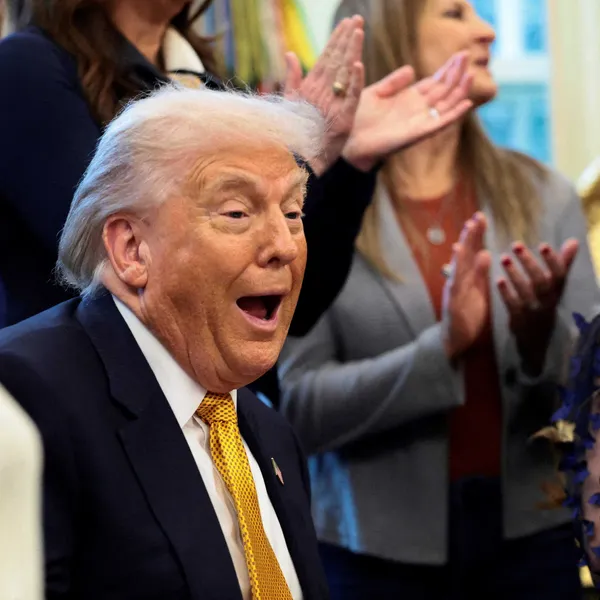
During an executive order signing on Thursday, Cabinet members and other loyalists of President Donald Trump applauded for a "bizarre" length of time — an episode that New York Times columnist Jamelle Bouie suggested reveals something important about the "authoritarian" dynamic within the MAGA movement. In Bouie's assessment, even Trump's allies are "afraid" of him.
Bouie laid out his argument in a video analysis highlighted in an Alternet report. Trump "signs the executive order and then they all start clapping and they keep clapping. They're clapping for a long time. It's as if they're afraid to stop clapping, or someone fears being the first to stop clapping," he said. A clip of the moment bears this out: the applause stretches on far longer than a typical signing ceremony. For Bouie, the scene called to mind a famous parallel from history.
"It involves one Joseph Stalin," Bouie explained, "whose subordinates were afraid to stop clapping at an event for fear of being the first to stop clapping, and thus coming under the suspicion of their notoriously narcissistic, paranoid, and insane boss who might well send them to the gulag or just have them executed that night for being the first to stop clapping. Now, Donald Trump is not going to send any of those people to a gulag. They're not going to be executed. But he does have the psychology of a dictator."
Bouie said he has "recently been reading a lot about Mao Zedong and modern Chinese history, the Chinese revolution, and the events that followed," and finds it striking "the extent to which Mao is a recognizable personality type. Again, extremely narcissistic, very paranoid, self-absorbed, unable to kind of understand the existence of other people. Someone who is indifferent to most details until he becomes monomaniacally focused on a particular set of details and wants to micromanage them. Someone who demands endless praise from everyone around him, holds grudges forever, and constantly lashes out when he is unable to get exactly what he wants."
"Sounds familiar," Bouie asserted. "Trump very much is cut from the same personality cloth. And it makes sense then that his subordinates would be extremely fearful of doing anything to upset him for fear of his wrath or vengeance, even if that's only going to take the form of them being yelled at. But these people are cowards and they don't like to be yelled at."
According to Bouie, that dynamic will face its sternest test if Democrats flip Congress. Polling, he noted, shows Democrats winning generic ballots by 15 or more points. The generic ballot is a recurring survey question asking voters which party's candidates they intend to support for Congress, and it is one of the most closely tracked gauges of the political environment heading into an election — though survey margins do not translate automatically into seat counts. "If you had to translate into seat gains... that would look like a situation where Democrats have won about 260 seats in the House, about 55 or 56 seats in the Senate, and they control 30 governorships. It is kind of a catastrophic collapse for Republicans." Bouie's scenario, in other words, is conditional: the totals he sketches describe what such a result could look like, not an outcome already settled.
Confronted with such a "broad public repudiation" — "and really an early sign that his legacy is going to be quite dismal after he leaves office and certainly after he passes" — Trump would be unable to "sustain that kind of narcissistic injury... so it's a real concern to me what he does to compensate for that," Bouie argued.
The president's personality, the columnist warned, could produce consequences that are difficult to foresee. "Does he escalate the war on Iran even further? Does he look for ways to lash out and destroy further parts of Washington DC? How does he respond to that kind of narcissistic injury? Because that is how you should understand his psychology: someone who is mostly driven by the desire to affirm his own sense of self and his ego and to avoid injury to those things."

