Cinemalaya 2026 Pocket Reviews: Films on Systems That Inflict Pain
Key Takeaways
- •The 22nd Cinemalaya festival is showcasing nine full-length independent films in competition at select Metro Manila malls, with BusinessWorld having reviewed six of them.
- •This year's selection collectively uses creative freedom to depict social, political, and institutional systems that fail to protect or help ordinary Filipinos.
- •2 Valid IDs, directed by Ma-an Asuncion-Dagñalan and starring Pokwang, became the fastest-selling film at the festival by dramatizing a poor woman's struggle to obtain government identification documents.
- •A.NI.MÁL, a political satire shot entirely on an iPhone over four days by Dustin Celestino, examines dynastic political families through the lens of a governor's dog abuse scandal.
- •Tayo Lang Ang Nakakaalam addresses the Philippines' rapidly rising HIV infection rate and the enduring stigma that continues to hinder testing and treatment despite legislative reforms passed in 2018.
By Brontë H. Lacsamana, Reporter
The 22nd edition of Cinemalaya is entering its final days, and BusinessWorld has screened six of the nine full-length films in competition.
Cinemas at select Metro Manila malls — Shangri-La, Gateway, and Ayala Malls (Manila Bay, Market! Market!, Glorietta, Circuit, and Trinoma) — are currently showcasing some of the best that local independent cinema has to offer. Since its founding in 2005 by the Cultural Center of the Philippines and the Cinemalaya Foundation, the festival has served as the country's premier platform for independent filmmaking, launching works that have gone on to international festival circuits and shaped the trajectory of Philippine cinema. Compared to mainstream narratives, this year's selection exercises that creative freedom to depict systems that continue to inflict pain rather than help or protect.
Here are reviews of the six films screened:
2 Valid IDs
Directed by Ma-an Asuncion-Dagñalan
It is a testament to how weary Filipinos have grown of the status quo that the film whose screenings sold out fastest — and drew the loudest audience demand for more — is about a poor woman struggling to secure two valid government IDs.
The premise strikes a national nerve: the Philippines has long required multiple identification documents for even the most basic transactions, a structural problem the Philippine Identification System Act (PhilSys), signed into law in 2018, was meant to solve. Yet enrollment and rollout delays have left millions still navigating the exact bureaucratic maze the film depicts. Anyone who has waited in line for basic government services, submitted ID applications, or advocated for a family member in a public hospital will find 2 Valid IDs painfully authentic. The obstacles depicted are ones the average Filipino can relate to, and ones that writer Abet Padagdagan Raz personally experienced, inspiring him to develop the story into a film alongside director Ma-an Asuncion-Dagñalan.
Marietta Subong (better known as comedian Pokwang) effectively channels the tears and frustration of being subjected to one humiliating scenario after another — long queues, convoluted identification forms, and all. While the premise might seem repetitive on paper, the film reaches beyond a farming family's difficulty proving their identity to illuminate the indifference of a system that was never designed to serve them.
In the shared hospital ward, it is the patients' caretakers who extend warmth and understanding to one another, precisely because the institutions themselves lack the grace to offer empathy. Pokwang delivers a powerful portrayal of a devoted wife slowly cracking under the pressure of a society that continually disregards her, while Zaijian Jaranilla shines as the young man who becomes nearly a son to her — a beacon of kindness even amid his own suffering.
While 2 Valid IDs captures a struggle that resonates deeply — whether through firsthand or secondhand experience with bureaucratic systems — there was room to let more of the anger, sense of community, and resistance boil over, rather than merely punctuating the suffering on display.
A.NI.MÁL
Directed by Dustin Celestino
A.ni.mál is a political satire centering on a mayor's daughter who returns home with footage of her godfather — the governor — abusing his dog.
The premise is unusual, and it is a home run for playwright and filmmaker Dustin Celestino, who tempers his familiar tropes in service of a genuinely entertaining and fascinating study of dynastic political families. Political dynasties remain entrenched across the Philippines, where a significant percentage of elected positions at the local and national level have been held by members of the same families across generations — a reality that gives the satire its bite. The tropes persist — characters serving as direct mouthpieces for ideological monologues, interweaving storylines striving to depict a microcosm of Philippine hypocrisy — but they are less grating here than in his previous work. The humor is incisive, propelled by a phenomenal ensemble, suggesting that the pivot from serious political examinations toward satire may be the most effective direction for his directorial voice.
Stimulating exchanges between characters lay bare the dark comedy at every turn: a delusional, narcissistic heir clinging to wokeness to remain relevant; her vapid, desperate mother secretly paralyzed by her own political inadequacy; and her morally bankrupt mayor father, more than willing to serve as a pawn in the governor's game. Mother-daughter pair Frances Makil-Ignacio and Maxine Ignacio execute their roles flawlessly, generating laughs and pity in equal measure, while Jojit Lorenzo injects microdoses of tragedy into what could have been a straightforward part. Bituin Escalante is the film's standout, playing the dutiful wife and gubernatorial candidate with such power and ferocity that singling out her best scene is nearly impossible.
Whatever one's view of the flaws in Celestino's monologue-heavy writing (this is, notably, a Palanca-winning script), he possesses a genuine talent for constructing emotionally charged arguments that build until they crack open something ugly about realities both political and personal — on raucous campaign stages and in quiet family homes alike. Shot entirely on an iPhone 17 Pro Max over four days, A.ni.mál applies a handheld, indie mockumentary treatment to acting-heavy, theater-like writing, capturing the frenetic atmosphere of a country that fixates on larger-than-life personalities. The camera zooms in and out on politicians' faces, grasping for truth within their thickly woven web of lies.
Above all, it is the lens of dog — and animal — abuse that compels viewers to confront selective morality, with a single heinous act functioning as both distraction and symbol of the systemic corruption entrenched in society. It is fitting that this level of absurdity is required to portray politics as more of a zoo than it already is. Still heavy-handed in parts, but overall thoughtfully executed.
GANGGANG
Directed by JL Burgos
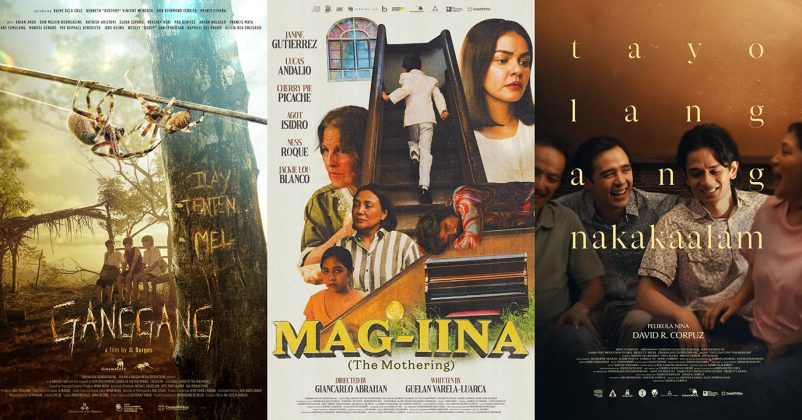
Ganggang follows three boys: Ilay, whose parents were disappeared; Ten-ten, a farmer's son; and Mel, a soldier's son. Together they seek out the best fighting spider to rival that of the school bully, and through their adventures they uncover far bigger bullies lurking in their village.
The film is a resounding cry from those who have lost loved ones in militarized communities — a fitting follow-up to director JL Burgos' incisive documentary Alipato at Muog, about his own brother who was "disappeared" by the state. Enforced disappearance has a long and unresolved history in the Philippines, spanning the martial law era under Ferdinand Marcos Sr. through subsequent administrations. The Anti-Enforced or Involuntary Disappearance Act was signed into law only in 2012, and cases like that of Jonas Burgos — abducted in 2007 and still missing — remain unresolved. That personal experience clearly informs this story of three boys confronting the truths about bullying: at school, where a classmate torments them; among the wild spiders they provoke into fighting to the death; and within the very society they inhabit. The provincial town of Sidhaya serves as a microcosm of all that is wrong with how unionized farmers and teachers are treated in remote areas.
While Ganggang lacks technical polish — its dialogue can be on-the-nose, with characters voicing every act of oppression and every imperative to resist — its stridence is powered by genuine conviction. The realities of state violence, desaparecidos, and red tagging are essential to understand, if difficult to watch, but the way the children, their families, and their community unite against these atrocities is portrayed with genuine warmth. One could argue there is little reason for gentleness or subtlety when those in power are blunt about their abuses.
What the director told unflinchingly through documentary in his previous film is now bravely channeled through a fictional coming-of-age narrative. While documentary clearly remains the stronger medium for such a loaded message, this too is a powerful vehicle for telling it.
Hand of God
Directed by Mark Duane Angos
Hand of God follows a young lieutenant who sets out to introduce football to children in a Basilan village. The film has him grapple with his guilt as a member of the army, attempting to heal wounds through something as innocent and idealistic as coaching a sport.
Basilan sits at the heart of one of Asia's longest-running armed conflicts, where Moro separatist insurgencies and military operations have displaced communities for decades. The film hits the expected beats of an uplifting sports drama, positioning football as a path for underprivileged children to play and pursue a brighter future. However, there are glaring weaknesses in its premise of a community caught between the evils of the Philippine army and the evils of Moro militant groups, and the attempt to balance both sides falls flat. A scene toward the end feels ham-fisted in its rush to acknowledge that the army does indeed commit atrocities.
The tonal shifts can be jarring. The highlights are the engaging sports sequences in which the children learn and gradually embrace football. By contrast, the political context surrounding their village — caught in the crossfire of war — comes across as shaky, painting a one-dimensional picture of the Mindanao conflict. Even accounting for its basis in a true story, the film feels heavily fictionalized, in stark contrast to Ganggang, the other child-centered film in the lineup, which is firmly grounded in the lived reality of remote communities.
Still, Hand of God is beautifully shot and mixed, bolstered by a strong cast. KD Omalin is a gifted child actor, and his scenes with Iza Calzado as his loving mother rank among the film's best. Ruru Madrid brings a solid screen presence and voice; his sincerity as a guilt-ridden soldier seeking atonement through football shines through, regardless of how the narrative resolves. What the film makes clear is that children are the victims of war, and at least its conclusion allows the village to stand up for itself.
Mag-iina
Directed by Giancarlo Abrahan
Mag-iina, based on a script by playwright Guelan Vareal-Luarca, is a chamber piece following Anj, a woman who returns to her family's ancestral home around the 40th day after her estranged father's death. Played capably by Janine Gutierrez, Anj uncovers the dark truths of the Abreu family as she reconnects with her unstable mother (Agot Isidro), her headstrong aunt (Cherry Pie Picache), and her domineering grandmother (Jackie Lou Blanco).
While it is satisfying to watch a ensemble of accomplished actresses portray the depths of inescapable generational trauma and madness, the slow burn of their escalating fever dreams and insanities requires patience. The film begins as a conventional horror movie, with the house assuming a malevolent presence and the boy Ygo (played convincingly by Lucas Andalio) serving as its unwitting victim. Each family member's denial of their own crimes and hypocrisies — lurking in the shadow of the man they all mourn — and the gradual transformation of the boy named after him unfold through paintings and sketches in a manner that evokes the deceptive myths surrounding cultural and familial legacy in the Philippines.
As expected, a Guelan Vareal-Luarca script rendered through Giancarlo Abrahan's direction yields rich character dynamics, calibrated with enough restraint to sustain intrigue. There is also something visceral about the mix of Tagalog, Spanish, and English that these high-society women deploy within the walls of their old provincial home — at times clunky in its intensity, yet effective in the torturous dissection of one another's insecurities. The house itself nearly becomes a character in its own right (evoking a warped version of Mike De Leon's Kisapmata, a landmark 1981 psychological thriller based on Nick Joaquin's The Summer Solstice), with events instead assuming a visually and sonically surreal quality that brings to life a suffocating, vaguely allegorical psychological thriller that quietly consumes the viewer.
Why a gothic horror about an old-money family with a reputation in Philippine arts and culture, hidden skeletons, and a legacy of generational trauma? It is a thought-provoking exploration of how a matriarchal system can be detrimental to its own women — particularly the working-class maid — when it becomes a vehicle for perpetuating masculine evil, like a Cronenbergian Inang Bayan. What happens when the Motherland itself is so deeply compromised?
Tayo Lang Ang Nakakaalam
Directed by David R. Corpuz
Tayo Lang Ang Nakakaalam is a quietly heartbreaking portrait of an HIV-positive man's declining health, observed through the eyes of the loving partner, devoted mother, and regretful father who care for him in his worst days. It is a study of love held in silence, brought to life beautifully by Martin Del Rosario and Miguel Odron as the central couple.
The film arrives at a critical moment for public health awareness: the Philippines has recorded one of the fastest-growing HIV infection rates in the Asia-Pacific region, and advocates have long cited persistent stigma and inadequate sex education as key barriers to testing and treatment. The film is largely about how concealing the truth of one's identity and illness corrodes a person from within, under the crushing weight of the stigmas that have historically kept a marginalized group in the shadows. The HIV and AIDS Policy Act, passed in 2018, was intended to strengthen the legal framework for prevention and care, yet social attitudes have lagged behind legislative reform. The film asks: what becomes of the loved ones and family members who must navigate the consequences of secrecy? This film seeks answers.
Given the painful subject matter, director David R. Corpuz handles it with tenderness, drawing muted and nuanced performances from the parents, played by Yayo Aguila and Epy Quizon. Their quiet acceptance and support of their dying son and his boyfriend create a poignant portrait without excess melodrama. Yet for all its claustrophobic atmospherics — characters confined within cramped hospitals, offices, hallways, and rooms — no single person is fully fleshed out.
Ultimately, as the title suggests, the film advances the idea that knowledge of oneself — one's preferences, loves, pains, and illnesses — is itself empowering. The back half slows considerably to dwell on this theme, with an ending that attempts to balance messages about grief and getting tested, a challenge that could likely have been addressed by reordering certain scenes. While it does not entirely stick the landing, there is much to be drawn from the emotional impact achieved even without knowing every detail.

