CFTC Warns Consumers About Crypto ATM Scams Linked to $388 Million in Losses
Key Takeaways
- •The CFTC issued a consumer advisory warning that crypto ATM scams have been tied to $388 million in reported losses.
- •Scammers typically contact victims by phone, text, or email and create urgency by claiming account problems or money owed.
- •Victims are instructed to withdraw cash and deposit it into a crypto ATM, often by scanning a QR code provided by the scammer.
- •The agency says crypto ATM transactions are usually immediate and irreversible once the cash is converted to cryptocurrency.
- •Arizona and Hawaii have taken steps on crypto ATM rules, and Congress has seen a bill aimed at limiting kiosk fraud.
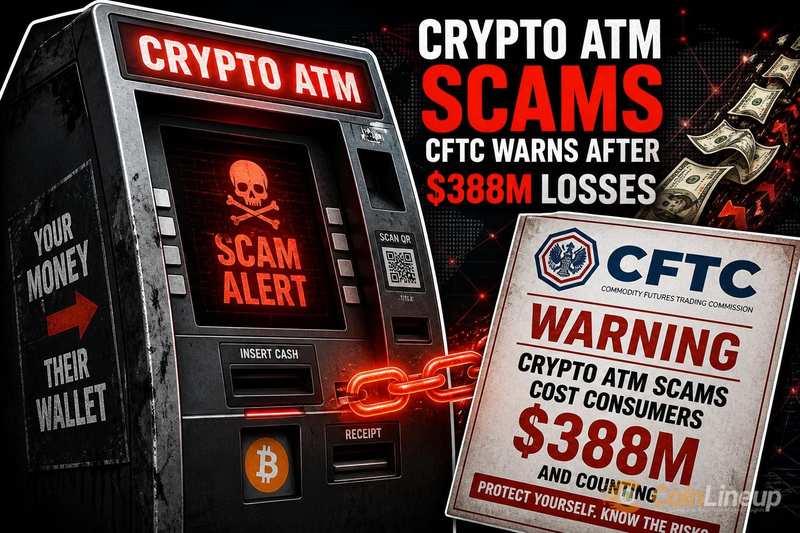
The U.S. Commodity Futures Trading Commission (CFTC) has issued a consumer warning about crypto ATM scams, a fraud pattern tied to $388 million in reported losses. The agency's core message is simple: scammers pressure people to turn cash into cryptocurrency at these machines because those payments are fast and nearly impossible to reverse.
What the CFTC advisory says
The CFTC is a federal regulator that oversees derivatives and commodity markets in the United States. It has now published a consumer advisory focused on crypto ATMs, also called kiosks, and on how criminals use them to collect stolen money. The advisory explains both how the machines work and why they have become a favored channel for moving fraud proceeds.
A crypto ATM looks like a regular cash machine. Instead of dispensing bills, it converts cash into cryptocurrency and sends it to a digital wallet. These kiosks are no longer niche: tens of thousands of them now operate across the United States — more than in any other country — often placed in convenience stores, gas stations, and supermarkets, and they generally charge far higher fees than regulated online exchanges. The agency's advisory warns that scammers exploit this process to move victims' funds quickly.
The reason is straightforward: once cash becomes crypto and leaves the machine, the transaction is typically immediate and irreversible — a point the CFTC has already stressed in earlier guidance noting that crypto ATM transactions are final.
How these scams typically work
The pattern usually starts with unexpected contact. Someone calls, texts, or emails claiming to be from a bank, a government agency, or a company the target trusts.
Next comes urgency. The scammer says the victim's account is compromised, that money is owed, or that they must act right away to avoid trouble. That pressure is designed to stop the target from thinking clearly.
Then comes the demand: withdraw cash and deposit it into a specific crypto ATM, often by scanning a QR code the scammer provides. The Federal Trade Commission has described the same kiosk-based cash scheme in its own consumer alerts, and the FBI's Internet Crime Complaint Center has also flagged crypto kiosks in public warnings about fraud losses.
That kiosk guidance sits within a larger problem. The FTC has put reported cryptocurrency-related fraud losses at $5.6 billion for 2024, so the ATM scam figures regulators keep flagging represent one slice of a much broader fraud landscape.
These scams often target older adults and people new to crypto, who may not know that no legitimate agency asks for payment this way.
What consumers should do before using a crypto ATM
The single most useful rule: no real bank, government office, or business will ever tell a customer to fix an urgent problem by feeding cash into a crypto ATM.
Anyone who receives that kind of request should stop and avoid acting on the phone number or link the caller provided. Instead, they should look up the official contact details themselves and verify the claim directly. Slowing down is the strongest defense, because these transfers cannot be clawed back once they are completed.
Some states are adding legal protections as well. Arizona has adopted crypto ATM rules that have helped scam victims recover funds, and Hawaii has moved to ban cash deposits at crypto ATMs. The issue has also reached Congress, where members have introduced the Crypto ATM Fraud Prevention Act, a bill that would cap kiosk transaction amounts and require the machines to display fraud warnings.
For anyone considering a first cryptocurrency purchase, the safest path is a well-known, regulated exchange rather than a kiosk recommended by a stranger. Protecting one's own wallet also matters, since weak security has been linked to real crypto losses. And if a payment ever feels rushed, that feeling should be treated as the warning sign it is.
