Burnham Bounce: Prime Minister Sees Popularity Surge as Farage's Ratings Slide
Key Takeaways
- •Andy Burnham's approval rating rose 12 points in July, with 42 per cent of voters viewing him favourably compared to 30 per cent unfavourably.
- •Nigel Farage's approval rating fell by 12 points to a net score of -20, marking a notable reversal for the Reform UK leader.
- •Reform UK remains the most popular party at 26 per cent voter share, while Labour and the Conservatives are tied at 23 per cent each.
- •Under Burnham, Labour has regained voter trust on reducing inflation, improving health, and tackling crime from Reform UK.
- •Conservative leader Kemi Badenoch maintained a net positive favourability score of four despite Burnham's rising popularity.
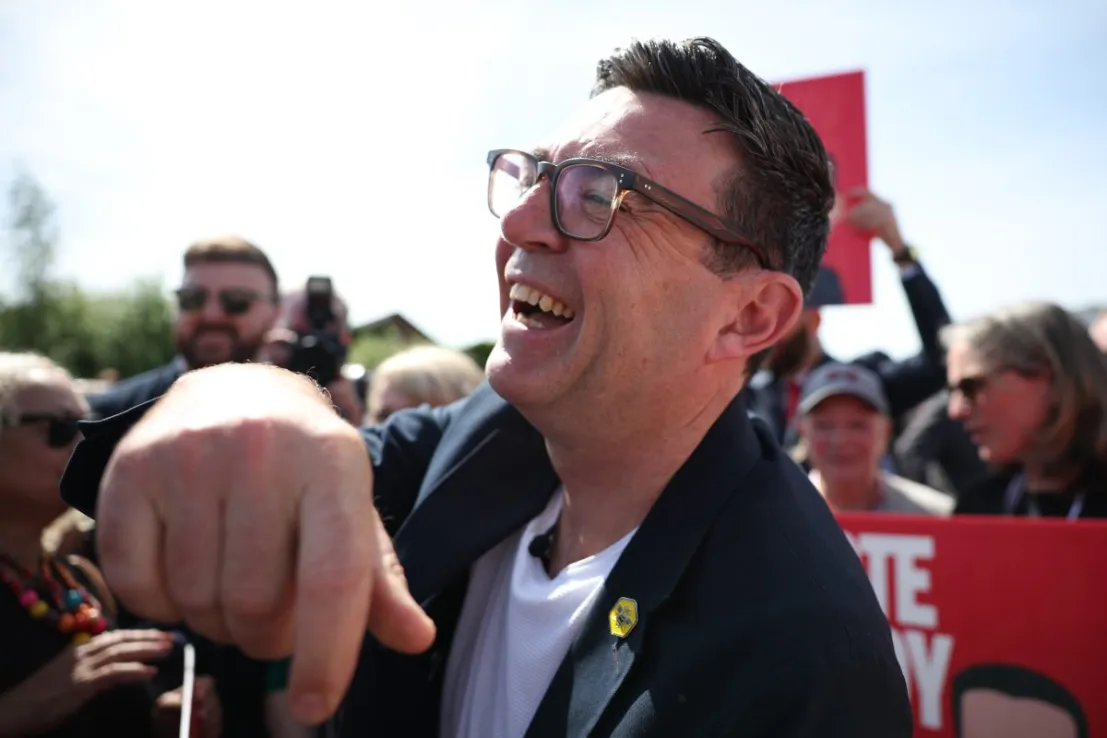
Andy Burnham has secured a sharp rise in his approval ratings, emerging as the most positively received figure in British politics, while Nigel Farage's numbers have dropped significantly, according to the latest City AM / Freshwater Strategy poll of UK voters.
Burnham's approval rating climbed 12 points in July from a net score of zero, making him the only political leader whose favourability materially exceeds his unfavourability — with 42 per cent of voters viewing him favourably compared to 30 per cent unfavourable. Farage's rating fell by the same margin, dropping to -20. The contrast marks a notable reversal for Farage, who had previously capitalised on voter disillusionment with the Conservative government and positioned Reform UK as the primary vehicle of anti-establishment sentiment.
The polling data contextualises what has been dubbed the "Burnham bounce," with the Prime Minister's gains coinciding with increased scrutiny of Farage's financial dealings.
Party Standings Largely Unchanged
Despite the shift in personal ratings, party-level polling has moved less dramatically. Reform UK remains the most popular party with 26 per cent of voter share, down three points on the month. Labour and the Conservatives are tied at 23 per cent each.
The Liberal Democrats have fallen behind the Green Party, which secured 10 per cent of voter share in July polling compared to the Lib Dems' nine per cent. The Green advance underscores the degree to which smaller parties are contesting the political space beyond the traditional two-party framework, even as the larger parties remain locked in a tight three-way battle.
"Clear Divergence" in Indicators
Freshwater Strategy polling guru Dr Michal Turner identified a "clear divergence" in the leading indicators, noting that Burnham's popularity jump has not yet translated into broader gains for Labour.
"That's actually the normal sequence of events; permission to be heard from voters comes first; then vote intentions follow or they don't, once voters take a better look," Turner said.
"The question for Burnham and Labour is whether they can convert the goodwill into votes before the novelty of a new leader wears off. On the evidence of the last decade in Britain, that window can be probably measured in weeks, rather than months and years."
Burnham Trusted on Inflation and Crime
Turner also noted that under Burnham, Labour has regained voter trust on key issues including reducing inflation, improving health, and tackling crime — areas that had previously been strong for Reform.
The pollster suggested that an early election could become an "increasingly attractive option" for Burnham, given his pledges to overhaul the UK's political culture and introduce radical reforms.
The Prime Minister has ruled out calling an early election but indicated he would need to secure "people's consent" for proposed social care reforms requiring "difficult decisions." Since social care did not feature prominently in Labour's 2024 election manifesto, strategists have interpreted his remarks as a signal that a new election could occur before the scheduled date of 2029.
Badenoch Maintains Positive Rating
City AM / Freshwater Strategy polling also found that Conservative leader Kemi Badenoch maintained net positive favourability despite Burnham's return to Westminster, with a score of four.
In a three-way "preferred Prime Minister" contest, Burnham leads both rival party leaders. Badenoch is preferred over Farage by 23 points in a head-to-head matchup, while the gap between Burnham and the Reform leader is marginally wider at 25 points. The distance between Burnham and Badenoch is the narrowest at 18 points.
Badenoch's Conservatives are more trusted than Reform on issues including reducing government spending, improving wages, and lowering the cost of living.
Method note: Freshwater Strategy interviewed n=1,248 eligible voters in the UK, aged 18+, online, between 7–10 August 2026. Margin of error +/- 2.8%. Data are weighted to be representative of UK voters. Freshwater Strategy are members of the British Polling Council and abide by their rules.

