Bitcoin (BTC) Hits $80,000 for the First Time Since May as ETF Inflows Surge
Key Takeaways
- •Bitcoin traded above $80,000 for the first time since May 15 and has gained roughly 38% from its late-June and early-July lows below $58,000.
- •U.S. Treasury buyback plans and lower Treasury yields helped improve financial conditions for risk assets, including crypto.
- •Spot Bitcoin ETFs in the United States drew about $1.9 billion in inflows last week, the strongest weekly total since October 2025.
- •The price move triggered more than $220 million in crypto short liquidations over a 24-hour period.
- •Analysts are focusing on Bitcoin’s technical strength and this week’s PCE inflation report for clues about the next move.
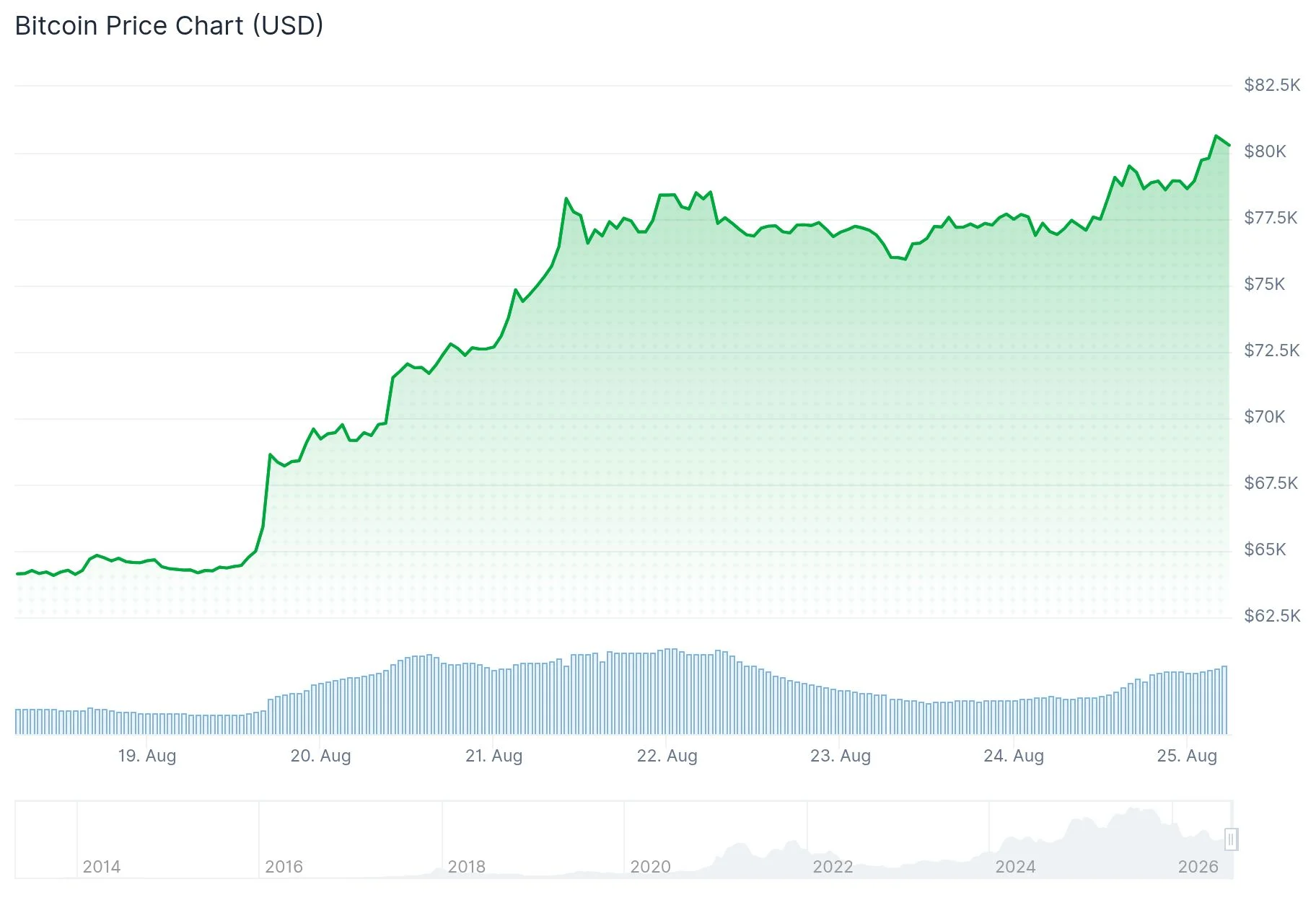
Bitcoin (BTC) climbed above $80,000 on Monday for the first time since May 15, extending a recovery that has picked up pace over the past week and marking its highest level since mid-May. The breakout came during the Wall Street open, with BTC/USD rising around 3% on the day before pulling back slightly after the European close.
Measured from its late-June and early-July lows, where the price briefly dipped below $58,000, Bitcoin has now gained roughly 38%.
Treasury backdrop eases financial conditions
The recovery has been helped by shifting U.S. Treasury policy. The Treasury doubled its planned buybacks of long-dated government bonds through early November, funding those purchases with short-term debt. The buyback program, which targets older, less-liquid bonds, is intended to improve trading conditions in the secondary market for Treasuries. On Monday, the department also suggested it could use its nearly $1 trillion General Account — the Treasury's operating cash balance at the Federal Reserve — to fund those buybacks.
Falling Treasury yields offered broader relief to risk assets, including crypto, after months of tight financial conditions.
ETF demand returns
Spot Bitcoin ETFs listed in the United States pulled in around $1.9 billion last week, the largest weekly inflow since October 2025. The funds, which launched in January 2024 and hold BTC directly, allow traditional investors to gain exposure without holding the underlying asset, and the latest figures point to renewed interest from that cohort. Since then, the ETF suite — which includes funds from major asset managers such as BlackRock, Fidelity and Grayscale — has become one of the main channels for traditional Bitcoin exposure, making weekly flow data a closely watched gauge of institutional demand.
Source:
— Wu Blockchain (@WuBlockchain) August 25, 2026
More than $220 million in shorts liquidated
The break above $80,000 also triggered a wave of short liquidations — the forced closure of leveraged positions that bet on falling prices. Because closing a short requires buying the asset back, forced buying of this kind can amplify short-term price moves. Data from CoinGlass, a tracker of crypto derivatives markets, showed over $220 million in crypto short liquidations during the 24 hours around the move. A cluster of bid liquidity sits near $76,700, which analysts see as a potential support level if prices pull back.
Bitcoin is up 25% month-to-date in August, its best August performance since 2017.
Analysts watch for sustained strength
Analyst Ali Charts posted on X that Bitcoin has reclaimed its 1,130-day simple moving average, a long-horizon trend indicator many traders use to separate bull regimes from bear regimes. According to Ali Charts, this level has marked the end of previous bear markets across four market cycles. Bitcoin lost the moving average on June 1, 2026, and spent 80 days below it before reclaiming it on August 20, after breaking above $74,000. If history repeats, Ali Charts noted, the market bottom may already be in.
BITCOIN: ANOTHER BULLISH SIGNAL $BTC has just reclaimed its 1,130-day simple moving average as support, a level that has consistently marked the end of previous bear markets. Over the past four market cycles, Bitcoin began a new bull market shortly after reclaiming this moving… pic.twitter.com/Re8TYnDe5o
— Ali Charts (@alicharts) August 24, 2026
Trader and analyst Rekt Capital noted that Bitcoin achieved its first weekly close above the 50-week exponential moving average since November 2025. The average currently sits at $77,251.
“If this is a Bear Market Relief Rally, then Bitcoin could pullback as early as this week, or at least over the next few weeks,” Rekt Capital wrote. “Now it’s all about Bitcoin proving sustained strength.”
During Bitcoin’s 2022 bear market, BTC saw two weekly closes above the 50-week EMA before dropping to cycle lows — a precedent that frames the current divide between analysts calling a cycle bottom and those still treating the rebound as a bear-market rally.
Focus turns to PCE data
Attention now shifts to the Federal Reserve’s preferred inflation gauge — the Personal Consumption Expenditures (PCE) index, published by the U.S. Bureau of Economic Analysis — which is due this week and feeds into expectations about the future path of interest rates. The Fed’s 2% inflation target is formally defined in terms of PCE inflation, which is why the release carries weight for rate expectations and, by extension, for the yield and liquidity backdrop that has accompanied crypto’s recent rebound.
Source: CoinCentral

