Atiku Abubakar Alerts Authorities Over Potential Breach of Private Banking Information
Key Takeaways
- •An unknown individual deposited unsolicited funds into Atiku Abubakar's strictly private bank account with the narration "Contribution Electioneering Campaign."
- •Neither Atiku nor his campaign team had any prior knowledge of the sender or authorized the transaction in any way.
- •Security agencies have been put on notice, and the suspicious transaction falls within the investigative remit of the Nigerian Financial Intelligence Unit.
- •Atiku's camp warned that if a former Vice President's private banking details can be compromised, ordinary citizens are equally vulnerable to financial privacy breaches.
- •The unsolicited and unattributed deposit into a presidential candidate's account could complicate compliance with campaign finance disclosure requirements under the Electoral Act 2022.
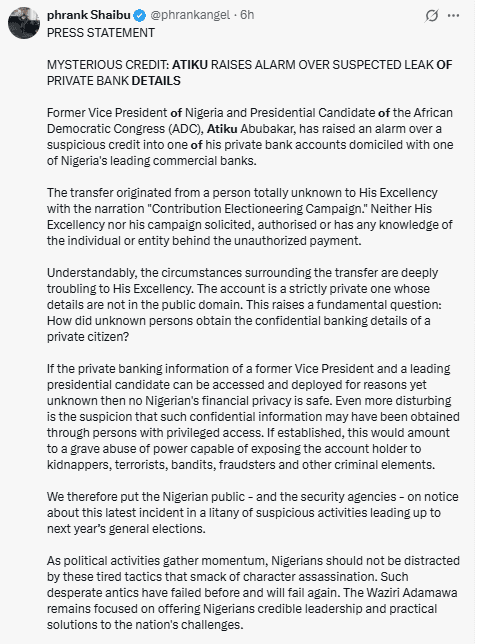
Former Vice President Atiku Abubakar has alerted the public to a potential breach of his private banking information after an unsolicited credit was deposited into one of his personal bank accounts by an unidentified individual.
In a press statement issued on Thursday by his Senior Special Assistant on Public Communication, Phrank Shaibu (source statement), Atiku's camp revealed that the transfer bore the narration "Contribution Electioneering Campaign." The statement emphasized that the funds originated from an individual unknown to both Atiku and his campaign team, and that neither party had authorized or solicited the deposit.
The account in question is described as strictly private, with details that are not publicly available. This forms the central concern raised by the statement: if the account information was not in the public domain, the question arises as to how an unknown individual obtained it.
"If the private banking information of a former Vice President and a leading presidential candidate can be accessed and deployed for reasons yet unknown, then no Nigerian's financial privacy is safe," the statement read.
The camp declined to identify the bank involved, noting only that it is one of Nigeria's leading commercial banks. The specific amount credited was also not disclosed. However, the emphasis was placed on the circumstances: a private account, an unknown sender, and a narration linking the transfer directly to electioneering — raising questions about whether the account details were obtained through someone with privileged access to financial systems.
Under Nigeria's Bank Verification Number (BVN) framework, administered by the Central Bank of Nigeria, all bank accounts are tied to biometric identifiers, and financial institutions are required to enforce Know Your Customer (KYC) protocols. The Nigeria Data Protection Act, signed into law in 2023, additionally imposes obligations on data controllers — including banks — to safeguard personal and financial data, with penalties for unauthorized disclosure or processing of customer information.
Atiku is the presidential candidate of the African Democratic Congress (ADC) for the 2027 general election. The statement frames the incident not merely as a personal violation but as a broader warning: if someone with the profile, legal protections, and resources of a former Vice President cannot maintain the privacy of their banking details, the implication is that ordinary citizens are equally vulnerable.
The camp also highlighted the potential dangers associated with the exposure of financial information. Knowledge that a specific individual holds an account at a particular bank, and that funds flow through it, could be exploited by kidnappers, fraudsters, or other criminals targeting high-value individuals.
Shaibu confirmed that relevant security agencies have been put on notice. Suspicious or unsolicited transactions of this nature typically fall within the investigative remit of the Nigerian Financial Intelligence Unit (NFIU), which is responsible for receiving and analyzing reports of unusual financial activity. While the statement stopped short of directly accusing any institution or individual, the reference to "persons with privileged access" suggests the possible involvement of an insider with access to banking systems or customer records.
The incident comes as political activities intensify ahead of Nigeria's 2027 general elections. Atiku's camp contextualized the transfer as part of a series of suspicious activities leading up to the elections, further underscoring concerns about the security of financial information during a politically sensitive period. Under the Electoral Act 2022, political donations and campaign contributions are subject to reporting and disclosure requirements, and the Independent National Electoral Commission (INEC) is tasked with monitoring compliance — a framework that an unsolicited, unattributed deposit into a candidate's private account could complicate.

