America's 'True' Religion: Why Millions Are Quietly Quitting Jesus
Key Takeaways
- •A 2010 Gallup poll found that many Americans could not identify basic Christian teachings, including the Ten Commandments and the four Gospels.
- •Pew Research Center data cited in the article shows the religiously unaffiliated share of the U.S. population rising from about 16 percent in 2007 to nearly 30 percent in recent years.
- •The article says Donald Trump’s supporters largely ignored his Michigan rally remark that he had been better to young attendees than their parents, despite its conflict with the commandment to honor parents.
- •Trump also used the Bible as a campaign prop, sold branded Bibles, and posted AI-generated images of himself as pope and as Jesus, both of which were later removed.
- •The piece cites the 1797 Treaty of Tripoli and argues that America’s Christian-nation claim is weakened by both constitutional history and the conduct of self-identified Christians.
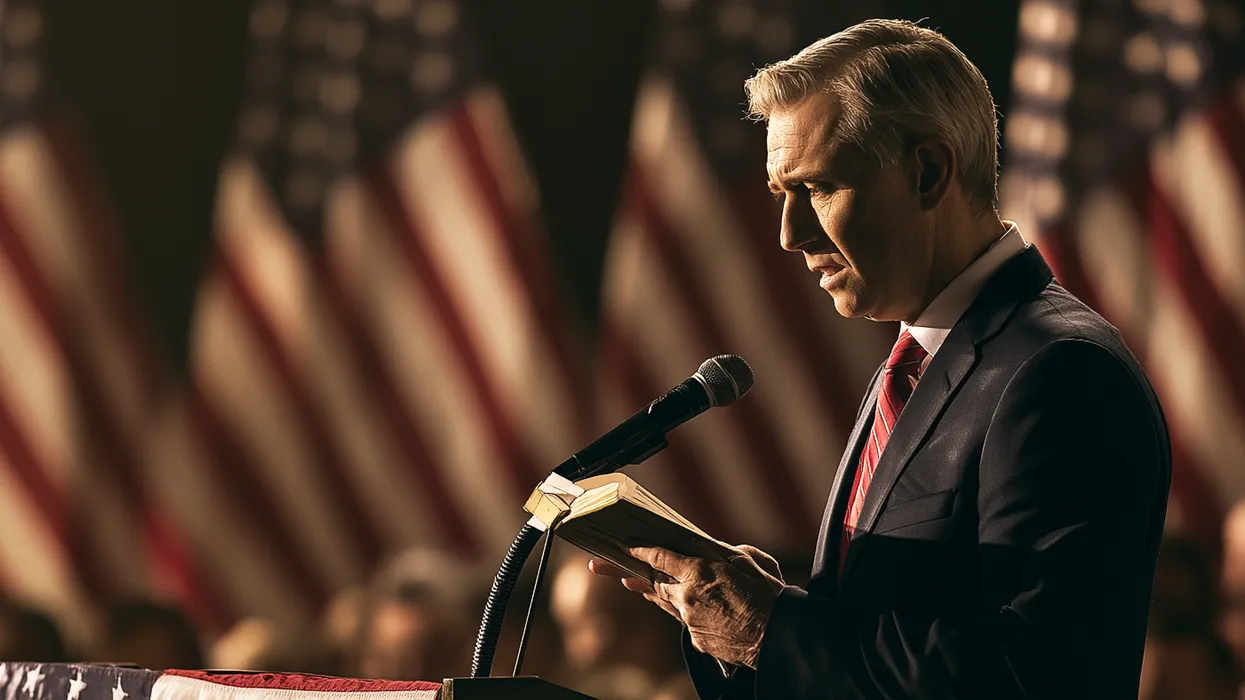
The United States is not a Christian nation. Despite persistent claims to the contrary, the assertion falls apart not only under historical and constitutional scrutiny but also when measured against the actual religious knowledge and conduct of those who identify as Christian—particularly supporters of President Donald Trump.
The question of how a nation can be called Christian when its Christians know so little about Christianity arises in an essay by Hannibal Hamlin, an English professor at Ohio State University, published in the Pittsburgh Review of Books. Hamlin observed that although the United States is frequently described as the most religious nation on earth, "Americans are ill-informed about even their own religion."
A 2010 Gallup poll underscored the point: only slightly more than half of Americans knew that the Golden Rule is not one of the Ten Commandments, and just under half could name the four Gospels. A mere 16 percent recognized that salvation through faith alone is a Protestant doctrine rather than a Catholic one. Anecdotal evidence reinforces the data—one educator recalled having to explain to a Catholic school graduate that belief in transubstantiation is not optional within Catholic doctrine. Several evangelical pastors have also recently reported declining attendance after parishioners discovered, to their displeasure, that Jesus instructed followers to turn the other cheek.
These patterns unfold against a broader backdrop of religious decline. Research by the Pew Research Center has tracked a steady rise in the religiously unaffiliated—often called "nones"—who grew from roughly 16 percent of the U.S. population in 2007 to nearly 30 percent in recent years. Yet among those who remain affiliated, particularly white evangelical Protestants, the fusion of religious identity with partisan loyalty has only deepened, complicating the claim that America's Christianity reflects theological conviction rather than political alignment.
Widespread ignorance of Christianity and the so-called "Judeo-Christian tradition," however, is only part of the picture. More telling is the indifference among many self-identified Christians when Trump does something that amounts to an affront to the Christian faith—not in reference to personal conduct such as womanizing, greed, or corruption, but actions that effectively mock the God they claim to worship.
At a recent rally in Michigan, held in support of the Republican Senate candidate, Trump addressed young attendees with a striking declaration: "I've done more for you than your parents, OK? Your parents are good. I'm not gonna knock your parents. But I have been better to you than your parents."
As Hamlin suggests, the American public may have grown so accustomed to the "casual blasphemy" of the Trump administration that few registered the gravity of the statement. Yet devout Christians should have taken notice. The fourth commandment—"honor your father and mother"—ranks below keeping the Lord's day holy but above the prohibition against murder. Jesus himself addressed the consequences of violating it, as recorded in Matthew 15:4-9: "For God said [through Moses], 'Honor your father and mother,' and, 'He who speaks evil of or insults or treats improperly father or mother is to be put to death.'"
That Trump's remark drew no meaningful backlash from Christian communities only reinforces the argument that the nation's Christian identity is more rhetorical than real.
Secular critics of Christian nationalism typically prefer to counter the "Christian nation" narrative with historical and constitutional arguments, citing the actual words of the Founding Fathers rather than the claims of modern religious nationalists. The 1797 Treaty of Tripoli, unanimously approved by the U.S. Senate and signed by President John Adams, stated plainly that "the Government of the United States of America is not, in any sense, founded on the Christian religion." That approach is valid. However, secularists who overlook the actual tenets of Christianity risk granting Christian nationalists more credit than they deserve. These self-proclaimed defenders of the faith champion the Ten Commandments in public spaces yet show far less enthusiasm for the Sermon on the Mount. The teachings of Jesus Christ demand too much from them. Their true religion, arguably, is a belief in rules for others—not for themselves.
The disconnect is stark. Many of the same Christians who declare America a Christian nation have chosen as their leader a man who routinely insults and mocks God, or who claims for himself the power and the glory that belong to God alone.
Consider the evidence: Trump has used the Holy Bible as a political prop, signed copies as though the word of God were his personal property, and sold "Trump Bibles" in "presidential, first lady and vice-presidential editions"—commercializing scripture as though it could be reduced to a mundane commodity. According to PRRI, a vast majority of Christian nationalists and evangelical Protestants continue to support him despite his habitual violation of the first and most important commandment: "Worship no god but me."
Further evidence emerged last May, during the selection of a new pope. Trump posted an AI-generated image of himself as the next pontiff. When his Catholic base reacted negatively, rather than fully retreating, he doubled down—posting another AI-generated image, this one depicting him dressed as Jesus performing a miraculous healing of a sick man.
The images were subsequently removed, and the White House offered extensive rationalizations. Trump claimed he thought the depiction showed him as a doctor, not Jesus. Yet as Hamlin wrote: "Could even Trump have imagined the Jesus picture wouldn't generate a tsunami of backlash?" Very conservative Protestants hold that there is no possibility of forgiveness for such an act. Nevertheless, Trump's Christian followers appeared willing to overlook it—something that might have surprised even a figure as cynical as the president.
Christianity, when taken seriously, demands a great deal. Walking the straight and narrow is difficult, particularly when surrounded by wrongdoing that masquerades as ordinary behavior. While it may be hard to gauge whether one is practicing the faith correctly, the cost of doing so is unmistakable. Righteousness that comes easily and without consequence is no righteousness at all.
And yet the nation has a president who claims to be Christian and claims to speak for a Christian nation, yet who has never borne the consequences of either meeting or failing the exacting standards of that faith—even when those failures have been as public and dramatic as his. Trump's signature appeal has always promised the rewards of struggle without the sacrifice. That message translated seamlessly to a Christian nationalist audience, and even Trump himself could not have predicted how strong and enduring the appetite would be for reaping the glory without paying any price.
Secular arguments against the idea that America is a Christian nation remain worthwhile. But they should not grant the claim's proponents more credibility than they have earned. They seek the status of being called Christian without the burden of living by Christian teachings. They demand that others obey their moral rules while reserving the right to break them at will. Trump is the purest expression of that true religion. America is not a Christian nation. His election is the proof.

