2026 Week 33 Global Macro Market Watch: U.S. Inflation Meets China’s Demand Test
Key Takeaways
- •U.S. CPI data scheduled for August 12 represents the week's single largest potential catalyst for interest-rate repricing, with investors focused on shelter and core services components as indicators of disinflation durability.
- •The Reserve Bank of Australia's August 11 policy decision serves as an early test of how commodity-exporting economies interpret Chinese demand signals alongside domestic inflation pressures.
- •China brackets the trading week, with July CPI and PPI on August 9 setting the opening tone and July national economic performance data on August 17 testing any positions carried through the weekend.
- •OPEC and IEA will both publish monthly oil market reports on August 12, providing a dual assessment of supply, demand, and inventory dynamics that could influence inflation expectations and energy-sensitive assets.
- •The most favorable cross-asset outcome would require compatible signals from U.S. disinflation data, European growth figures, and Chinese demand indicators, as conflicting results across regions would leave markets without a clear directional narrative.
Why Week 33 Matters
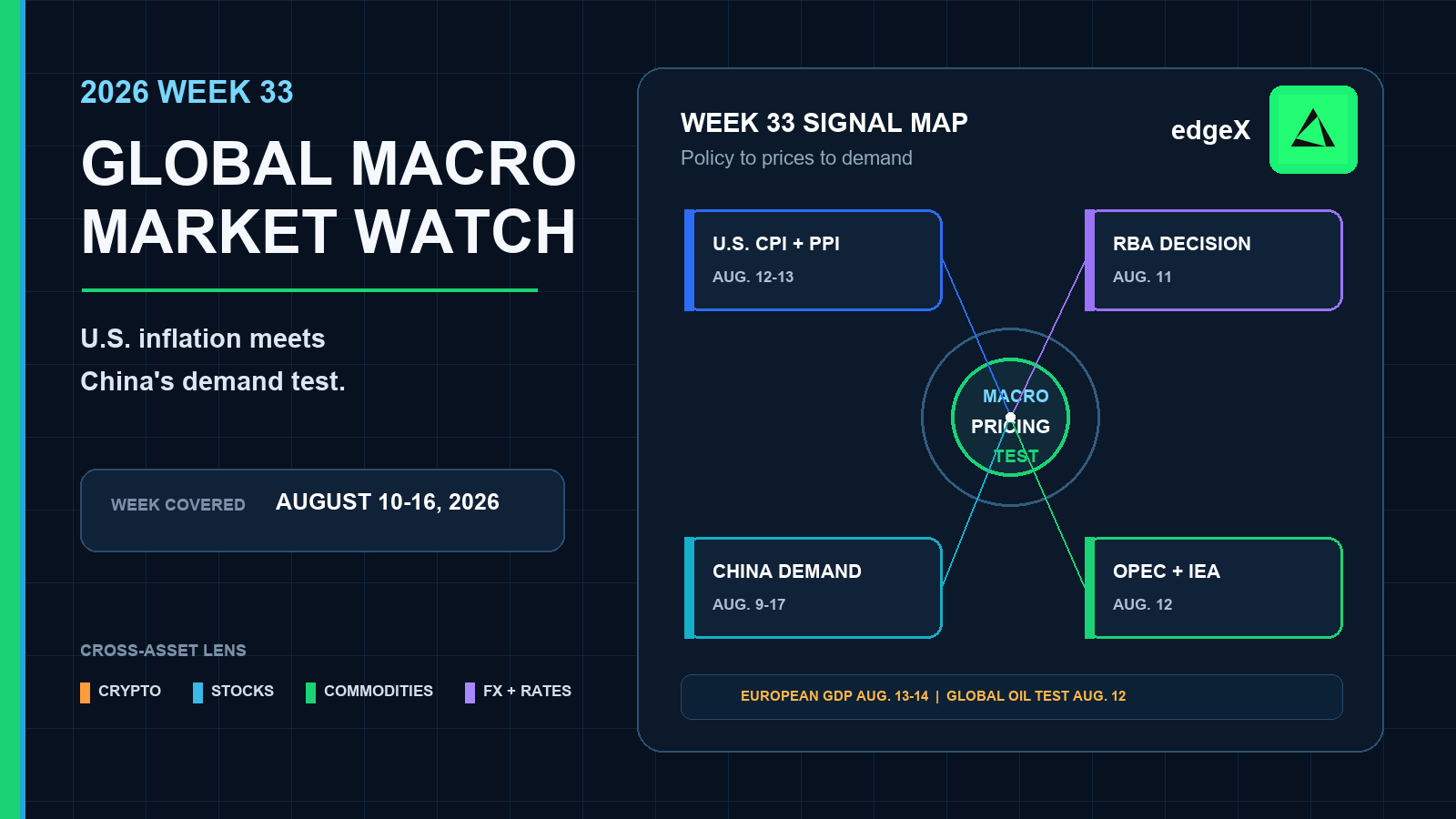
Week 33 asks whether inflation can ease without global demand deteriorating too quickly. U.S. prices and retail sales test disinflation and household spending. China's inflation, credit, and activity signals test whether policy support is reaching businesses and consumers. UK and euro-area GDP examine the same growth question from Europe, while the RBA translates it into policy for an economy closely linked to China.
Oil connects the two sides. OPEC and the IEA publish monthly reports alongside U.S. CPI, but their demand assumptions become harder to trust if Chinese activity remains soft. Markets are therefore pricing a network of signals, not a collection of isolated releases.
The sequence matters more than any isolated print
China’s August 9 CPI and PPI shape Monday’s opening tone. Tuesday brings the RBA; Wednesday brings U.S. CPI and the oil reports. Thursday adds U.S. PPI, UK GDP, Japan’s corporate-goods prices, and euro-area industry. Friday closes with U.S. retail sales and euro-area GDP, before China's August 17 activity data test weekend positions.
The sequence moves from Chinese pricing power to policy, U.S. inflation, and global demand. The first reaction may be about rates; the lasting move should depend on whether the United States, China, and Europe tell a coherent growth story.
Week 33 Macro Calendar and Boundary Signals
| Date | Region | Scheduled Event | Why Markets Care |
|---|---|---|---|
| August 9 | China | July CPI and PPI | Sets the opening signal for domestic demand, industrial pricing power, CNH, Hong Kong equities, and commodities. |
| August 11 | Australia | RBA monetary-policy decision and Statement on Monetary Policy | Can move AUD, Australian yields, banks, miners, and broader Asia-Pacific risk sentiment. |
| August 12 | United States | Consumer Price Index and real earnings for July | The week's main test of the Fed path, real yields, USD, growth stocks, gold, and crypto liquidity. |
| August 12 | Global energy | OPEC Monthly Oil Market Report and IEA Oil Market Report | Updates supply, demand, inventories, refining, and the oil channel into global inflation. |
| August 12 | United States | EIA Weekly Petroleum Status Report | Provides a near-term inventory and product-demand check alongside the longer-horizon oil reports. |
| August 13 | United States | Producer Price Index for July | Tests pipeline inflation and the cost environment facing corporate margins. |
| August 13 | United Kingdom | First estimate of second-quarter GDP and June monthly GDP | A major read on sterling, UK rates, domestic equities, and European growth sentiment. |
| August 13 | Japan | Corporate Goods Price Index for July | Shows upstream price pressure relevant to BOJ expectations, JPY, and exporter margins. |
| August 13 | Euro area | Industrial production for June | Measures factory momentum before the broader GDP and employment release. |
| August 14 | United States | Retail sales for July and preliminary August consumer sentiment | Tests household demand, inflation expectations, earnings resilience, and recession risk. |
| August 14 | Euro area | Flash GDP and employment for Q2; international trade for June | Connects growth, labor resilience, exports, EUR, rates, and cyclical equity performance. |
| August 17 | China | July national economic performance data | Tests retail demand, industrial output, investment, property activity, and the global commodity outlook after weekend positioning. |
U.S. Inflation Is the Week’s Main Repricing Risk
U.S. CPI on August 12 is the calendar's clearest rate-volatility event. Markets will look through the headline to shelter, services, goods, food, and energy. They will also compare the result with China's August 9 inflation data: sticky U.S. prices alongside weak Chinese pricing power would expose a difficult mix of restrictive rates and uneven global demand.
Broad U.S. cooling without a sharp activity decline could ease Treasury yields and the dollar. If Chinese demand indicators improve too, the relief can extend from growth shares and crypto to miners and industrial commodities. A hot U.S. report would revive the discount-rate problem; paired with soft China data, it would leave markets with little macro cushion.
CPI and PPI need to tell the same story
PPI follows on August 13, showing whether pressure is building earlier in the pricing chain. Cooler CPI paired with firm PPI would question whether consumer disinflation can last; consecutive upside surprises would deliver a clearer warning.
Producer prices also affect margins. The comparison with Chinese PPI matters for manufacturers: U.S. pipeline pressure alongside Chinese factory-price weakness may signal divergent demand and pricing power rather than synchronized global inflation.
The RBA Puts Central-Bank Policy Back on the Screen
The Reserve Bank of Australia's August 10-11 meeting is the week's first major decision. Its forecasts must balance domestic inflation against an external economy heavily exposed to China through commodities, trade, and regional confidence.
Markets should focus on the reaction function, not only the cash rate. A hawkish message could lift Australian yields, yet AUD strength may be harder to sustain if Chinese demand disappoints. A balanced tone paired with better China signals could help miners and banks; dovishness caused by weaker regional growth would carry a less constructive message.
Growth Returns to the Center of the Trade
UK GDP on August 13 and euro-area GDP and employment on August 14 will show whether the world is relying too heavily on U.S. demand while China is still trying to strengthen domestic momentum. The UK release connects the second-quarter estimate with June output.
For sterling and UK equities, the composition matters. Stronger growth may support GBP but lift rate expectations; weakness may help gilts while pressuring domestically exposed shares.
Eurostat adds industrial production, GDP, employment, and trade. Resilient growth would support a soft landing, especially if Chinese activity improves demand for European exporters. Weakness in both regions would be more troubling for luxury goods, autos, machinery, and other China-sensitive sectors than a Europe-only slowdown.
U.S. retail sales deliver the final demand test
Friday's U.S. retail-sales report may decide whether the inflation reaction survives into the weekend. Stable spending after softer inflation would be comfortable; weak sales would raise earnings concerns. The result then meets China’s activity release, giving markets a near-simultaneous read on consumers in the world's two largest economies.
University of Michigan sentiment and inflation expectations arrive the same day, checking whether households remain willing to support growth after the week’s price signals.
Oil Gets a Double Fundamental Check
OPEC and the IEA publish their August oil-market reports on August 12. Their different assumptions make revisions to demand growth, non-OPEC supply, production, inventories, and refining useful points of comparison. China is central to the demand side: weak industrial activity or consumer mobility can undermine an otherwise tighter balance.
A tighter balance can support crude and energy equities but complicate inflation. A looser balance can weigh on producers and oil-linked currencies. The EIA adds a U.S. inventory check, while China's August 17 data provide the broader demand confirmation. Oil needs both a credible supply story and evidence that major consumers can absorb it.
China Frames Both Ends of Week 33
China's July CPI and PPI on August 9 establish Monday's demand backdrop. Soft consumer inflation would reinforce concern about domestic demand, while deeper producer-price weakness would signal limited industrial pricing power. Firmer readings could ease deflation anxiety, provided they reflect healthier consumption rather than only costlier inputs.
Firmer Chinese demand can support Hong Kong equities, CNH, copper, crude, AUD, and miners. Persistent weakness can reverse that pattern, especially when falling prices accompany property stress or cautious households.
Credit data can test whether policy is reaching the real economy
The PBOC's mid-month release has no fixed calendar day. Aggregate financing, new yuan loans, and M2 can show whether liquidity is reaching households and private businesses. Credit driven mainly by government financing would carry a weaker demand message than broad loan growth.
China's July activity data arrive on August 17. Industry, retail sales, investment, property, and energy output will test whether support is reaching factories and consumers, confirming or challenging the global-growth narrative formed by U.S. retail sales, European GDP, and oil forecasts.
Japan adds a parallel test. Corporate goods prices can move BOJ expectations and the yen, while August 17 GDP tests domestic demand and trade. Together, China and Japan determine whether Asia validates the week's global story.
Cross-Asset Market Impact Map
| Macro Mix | Crypto | Stocks | Commodities | FX and Rates |
|---|---|---|---|---|
| U.S. disinflation, firmer China demand | Lower yields and better risk appetite can support BTC and ETH if spot demand confirms. | Growth shares, Hong Kong equities, miners, and cyclicals can participate. | Copper and crude gain demand support; gold benefits if real yields fall. | USD may soften; CNH and AUD can strengthen. |
| Sticky U.S. prices, firmer China demand | Higher yields restrain crypto even as growth sentiment improves. | Value and resources may beat long-duration growth. | Industrial inputs can hold; gold faces a real-yield test. | USD and front-end yields rise; AUD gets competing signals. |
| U.S. easing, weak China demand | Liquidity relief helps, but narrow participation would question durability. | Defensives may beat China-sensitive cyclicals and exporters. | Gold can outperform copper and crude. | Bonds rally; CNH and AUD remain vulnerable. |
| Sticky U.S. prices, weak China demand | Tight liquidity and weak risk appetite create a difficult setup. | Multiples compress while cyclicals lose demand support. | Oil and metals weaken unless supply dominates. | USD strengthens; CNH and high-beta FX face pressure. |
The most constructive mix would combine U.S. disinflation, steady retail demand, resilient European growth, improving Chinese demand, and no renewed oil squeeze. Sticky U.S. inflation, weak growth in Europe and China, and tighter oil balances would instead leave markets facing higher costs and less policy flexibility.
What Traders Should Watch Next
First, watch whether real yields and the dollar confirm the U.S. inflation reaction. Then use CNH, AUD, Hong Kong equity breadth, copper, and iron ore as checks on the China interpretation. Crypto still needs spot demand rather than only futures leverage, while crude's supply signal should agree with evidence from major consumers.
The August 17 releases can immediately test any Friday move. If China's retail sales, industry, investment, and property indicators disagree with the week's risk-on narrative, markets may reopen with a different view of global demand. Japan's GDP adds a second Asian check.
Trade with an Edge
In fast-moving markets, execution matters just as much as direction. That's why more traders are turning to decentralized venues like edgeX for perpetuals and spot trading.
Unlike traditional centralized platforms, edgeX is built around self-custody, meaning you keep control of your assets and authorize fund movements yourself. For active traders, that offers a meaningful advantage: market access without handing custody to an exchange.
edgeX also combines the core benefits of DeFi with a trading experience designed for serious execution. The platform emphasizes deep liquidity, high-speed order matching, and low-slippage performance, helping traders stay responsive during volatile conditions. With support for high leverage, it gives experienced market participants more flexibility in how they express macro views and manage risk.
Beyond execution, decentralized trading infrastructure can offer structural advantages: greater transparency, on-chain verification, and reduced dependence on centralized intermediaries. For traders who want performance without giving up control, that model is increasingly compelling.
edgeX is built for that balance: bringing together a professional trading experience with the core principles of decentralized markets.
For readers looking to explore a more capital-efficient, self-custodial way to trade, edgeX is worth a closer look.
Frequently Asked Questions
What is the most important macro event in Week 33 of 2026?
U.S. CPI on August 12 is the largest single rate catalyst, but China supplies the week's broader demand test. A durable cross-asset move will likely require U.S. inflation, Chinese activity, and global growth signals to point in a compatible direction.
When is the Reserve Bank of Australia decision?
The RBA's Monetary Policy Board meets on August 10-11, with the decision statement and Statement on Monetary Policy scheduled for August 11. Markets will watch the policy decision, forecasts, and communication for signals on inflation and household demand.
Why do the OPEC and IEA reports matter for markets beyond oil?
Their supply-and-demand forecasts can change expectations for crude prices, inflation, trade balances, and corporate margins. A tighter oil outlook can support producers while pressuring importers, consumers, transport companies, and rate-sensitive assets.
Why do China's releases matter when some fall outside Week 33?
China's August 9 inflation release shapes Monday's opening, while the August 17 activity report affects positions carried through the weekend. The mid-month credit window may also fall during the week. Together they influence CNH, Hong Kong equities, commodities, AUD, miners, and the global demand outlook.
What should crypto traders monitor around the macro releases?
Watch Treasury yields, the dollar, spot trading volume, ETF flows, funding rates, open interest, and liquidation levels. A favorable macro headline is more durable when spot demand and market breadth confirm it rather than when the move is driven mainly by leverage.

