AI's Productivity Boom Is Building a 'Winner-Takes-All' Economy, EY's Chief Economist Warns
Key Takeaways
- •EY-Parthenon's Gregory Daco says technological advances create a winner-takes-all environment, with labor's share of national income falling to 52.8%, the lowest since records began in 1947, while corporate margins hit a record 14.9% of GDP.
- •JPMorgan analysts say rising bond yields are now driven by global fiscal deficits, hyperscaler debt issuance, and rising refined product prices rather than Federal Reserve policy uncertainty.
- •Deutsche Bank expects nonfarm payrolls to rebound by 65,000 with the unemployment rate steady at 4.1%, a report that could clear the way for a Fed rate hike in September.
- •Pimco notes that 90-day delinquency rates on subprime auto loans have risen significantly in recent years while prime delinquencies stayed stable, reflecting a K-shaped economy.
- •In morning trading, KOSPI rose 1.64%, the Nikkei 225 added 1.26%, Brent crude stood at $95.17 per barrel, and Bitcoin traded just under $81,000.
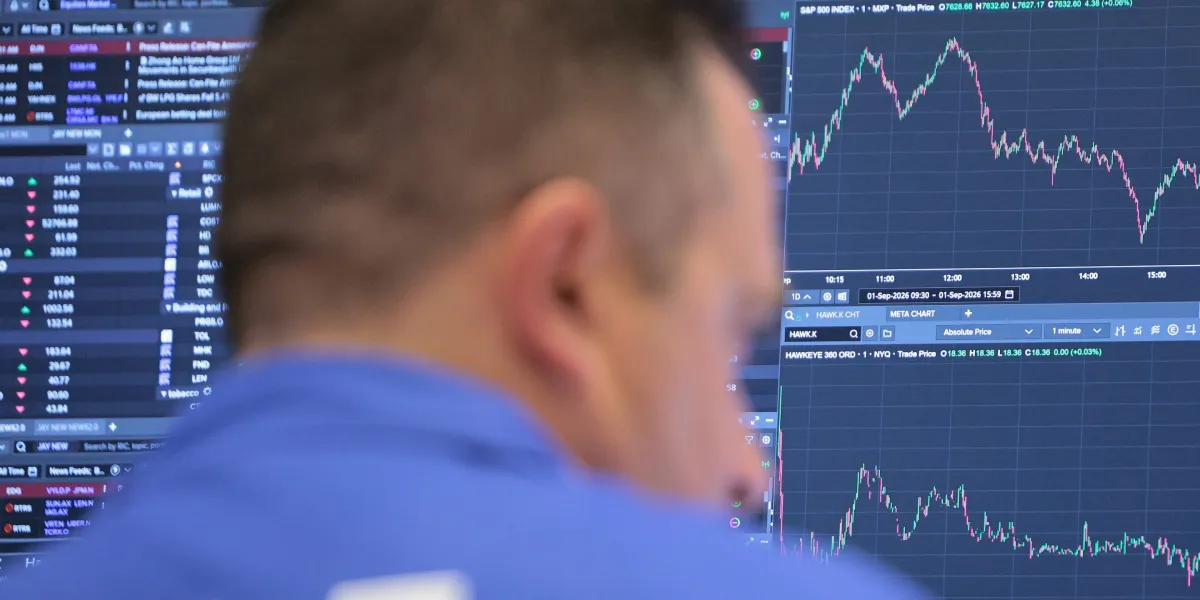
Good morning. On Fortune's radar today: Who are the real winners of AI transformation? JPMorgan says don't blame the Fed for rising bond yields. Markets are cautiously optimistic ahead of key jobs data. A chart shows cracks forming in subprime auto loans. And Suze Orman says eating out is a waste of money.
One Big Thing: 'Winner takes all' in tech advances
Despite promises that AI could prove to be society's great equalizer, Gregory Daco, the EY-Parthenon chief economist, argues that "productivity growth protects margins, not income."
"You tend to have greater concentration and more of a winner-takes-all type of environment when you have these technological advances," Daco said in an interview with Fortune's Eva Roytburg. In almost every technological revolution—the railroad boom of the late 19th century, or the 90s dot-com revolution—large, vertically-integrated firms initially capture the gains, while smaller firms face "persistent cost pressures, persistent policy uncertainty, higher interest rates," Daco noted. The labor share he tracks—the portion of national income paid to workers as wages and benefits rather than accruing to capital owners—is one of the most-watched gauges of how evenly growth is being distributed.
In 2026, economic output grew 1.7% in the second quarter on just 0.3% more hours worked. Compensation rose 2.6%, which, set against a spring and summer of oil-driven inflation, comes out to "flat to slight contraction" in real terms, Daco added.
Meanwhile, margins hit a record 14.9% of GDP, while the labor share fell to 52.8%, the lowest since the government started counting in 1947. Daco said that 50% is not a floor and that labor's share could fall even further. The tension at the heart of the debate: the same productivity gains AI boosters celebrate as economy-expanding can, if the gains flow to capital, widen the gap between corporate profits and household paychecks.
It's not the Fed anymore
The upward march in bond yields no longer stems from uncertainty around Federal Reserve policy, write JPMorgan's Kriti Gupta and Nick Roberts in a note shared with Fortune. While the initial move in bonds stemmed from a disconnect between a hawkish Fed and softer data, "the logic has shifted."
"It's a combination of worries around global fiscal deficits, an increase in hyperscaler issuance, and the rise of refined product prices," the pair wrote. "That's on top of economic growth in the U.S. economy." Hyperscaler issuance refers to debt sold by the giant cloud and AI infrastructure companies to help finance their massive data-center buildouts—a rapidly growing slice of the corporate bond market that adds to the supply of debt investors must absorb.
Trouble is also brewing "under the hood" of the economy, the note adds. While oil prices haven't spooked markets the way they did when the Middle East conflict began earlier this year, American refineries—largely built to convert heavy crude into refined products—are nearing maximum capacity.
"So, even though light crude is readily available, it doesn't necessarily alleviate the rising prices of those refined products, or the potential readthrough into more consumer-facing products, like airfares." The relationship has created a synergy between refining margins and bond yields.
"As investors measure the impact of the conflict, the building relationship shows pressure in that part of the commodities market is starting to align with the move in bond yields," the note adds.
The markets: waiting on key jobs report
The U.S. jobs report is released today under more scrutiny than usual. Investors and analysts have been waiting to see whether the Federal Open Market Committee (FOMC) follows through on its hawkish narrative with concrete action at its September meeting. If the jobs report comes back ok-ish, that frees up the FOMC to deliver a hike markets have been waiting on.
But as Deutsche Bank's Jim Reid noted: "The most recent jobs report for July was much weaker than expected, with payrolls unexpectedly contracting, along with downward revisions to the previous couple of months. So that casts further doubt on a September hike."
He added: "Our U.S. economists are expecting nonfarm payrolls to rebound by +65k, with the unemployment rate holding steady at 4.1%. So if realized, that would cement the view that the labor market is holding up and keep the Fed's focus on inflation."
S&P 500 futures were up 0.045% this morning. In Europe, the Stoxx 600 gained 0.072% in early trading, while the U.K.'s FTSE 100 slipped 0.073% before lunch. In Asia, South Korea's KOSPI rose 1.64%, Japan's Nikkei 225 added 1.26%, India's Nifty 50 gained 0.27%, and China's CSI 300 edged down 0.099%. Brent crude was $95.17 per barrel this morning. Bitcoin traded just under $81,000.
Chart of the day: subprime auto loans show signs of distress
"The clearest signal of stress remains concentrated in subprime consumer credit," according to Pimco's Tiffany Wilding and Lotfi Karoui. "90-day delinquency rates on subprime auto loans have risen significantly in recent years, even as the rate for prime auto loans has remained relatively stable." The divergence mirrors the "K-shaped" economy Pimco describes, in which higher-income households keep spending while lower-income households fall behind—something to watch alongside the labor-share erosion Daco flags, since both point to gains concentrating away from workers and lower earners.
The rising delinquencies suggest that low-income households would be hit hard if the economy experiences a reversal: "It's worth considering whether today's subprime weakness is a leading indicator of broader stress to come, or whether any broader stress would require an exogenous catalyst—a genuine labor-market shock, or an abrupt end to the AI capital-expenditure cycle—to materialize."
Number of the day: 3%
The percentage of British people who have gambled online and have done so while in hospital "or during the birth of a child," according to a survey of 2,001 adults by Gamble Mind, a website that ranks online casinos.
The front pages today
- The inflation genie could be out of the bottle—and bond markets are sounding the alarm — CNBC
- Volkswagen jumps 6% on plans to cut 50,000 jobs amid tariffs, China competition — CNBC
- Anthropic finalizing $15 billion pre-IPO credit facility — Bloomberg
- US grip on Venezuelan oil threatens billions owed to China — Bloomberg
- OpenAI says it has overtaken Anthropic with its latest AI model — FT
- Musk's Boring Co. pushes investors for recruiting, business help — WSJ
- U.S. diesel prices set new high — NYT
One more thing: Suze Orman says eating out is a big waste of money
Suze Orman has spent decades as a best-selling author and TV host teaching people how to invest, save for retirement, and manage their money. She has also built a fortune of her own, with a net worth in the tens of millions. But one category of spending has always bothered her: eating out at restaurants, which she has called one of the biggest wastes of money, Fortune's Prestone Fore writes.
"Look up McDonald's. Look up Taco Bell. Are you kidding me? $23, $30 just to go to McDonald's for whatever you eat there," Orman once complained.
She has a particular hatred for the daily Starbucks habit: "You need to think about it as: You are peeing $1 million down the drain as you are drinking that coffee," Orman said to CNBC in 2019. "Do you really want to do that? No."
That said, if you do go out to eat with Orman, you are in for a treat—because she will insist on paying. "If we go out to eat, the deal is we have to pay because I am not going to let people, who I know don't have the kind of money that we have, waste their money on ... eating out," she said.
