AI-Related Imports Flatten Out, Investment Decelerates in Q2 2026
Key Takeaways
- •AI-related imports, approximated using computers, peripherals, and semiconductors, have flattened out after several quarters of rapid growth according to the BEA's 2026 Q2 advance release.
- •Investment in information equipment and software has decelerated, signaling a potential inflection point for data center and digital transformation sectors.
- •Semiconductor imports surged significantly while finished computing equipment imports declined slightly, revealing a sharp divergence consistent with strong chip demand driven by AI accelerator and memory needs.
- •The BEA's advance estimate of $730 billion SAAR for nominal imports exceeded the author's approximately $700 billion estimate based on April and May trade data, suggesting June figures were higher than preliminary data indicated.
- •Price divergences across components raise methodological concerns, as computer and peripherals import prices have risen roughly 15% faster than software prices over the past year.
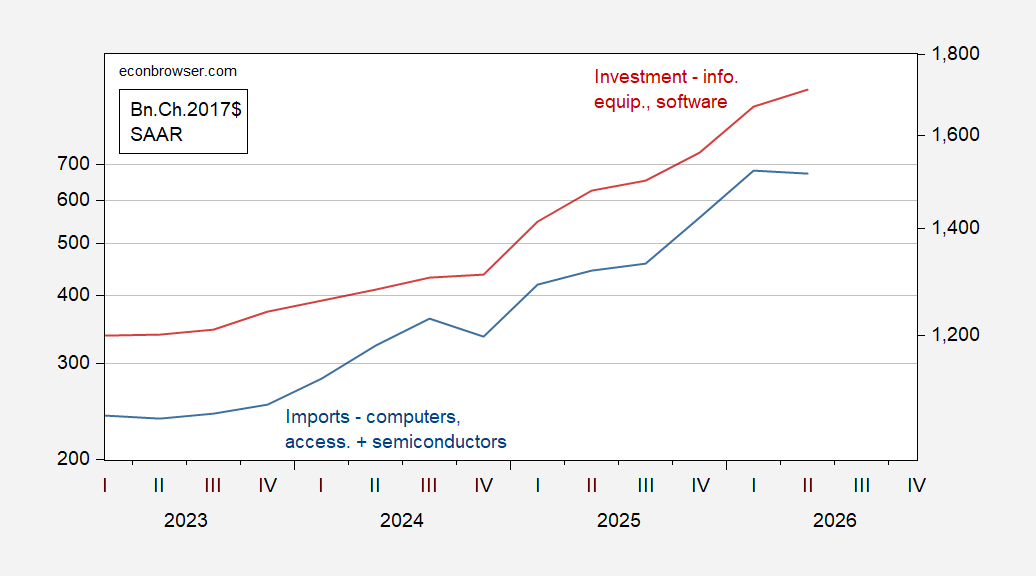
Direct observations on items solely related to artificial intelligence are not available, so the following analysis relies on closely related proxy categories.
According to the U.S. Bureau of Economic Analysis (BEA) 2026 Q2 advance release, imports of computers, computer peripherals, and semiconductors—used as an approximation for AI-related goods—appear to have flattened out, while investment in information equipment and software has decelerated. This comes after multiple quarters of rapid growth in technology-related imports and capital spending, making the deceleration a notable inflection point for sectors tied to data center buildouts and enterprise digital transformation.
The summed components shown in the BEA data are calculated using simple arithmetic. This approach is not entirely appropriate when the relative prices of the underlying series have changed meaningfully. For greater accuracy, a Tornquist index approximation would be preferable. Over the past year, computer and peripherals import prices have risen approximately 15% faster than software prices, while information equipment prices have risen about 8% faster than software. Over longer time spans, simple addition could distort the picture, though the distortion may be less pronounced in the short term. There is also a separate question regarding the accuracy of the price deflators used.
Notably, the apparent increase in summed imports masks a sharp divergence between equipment and semiconductors. Semiconductor imports jumped enormously, while equipment imports declined slightly. This divergence is consistent with the broader industry pattern in which chip demand—driven in part by AI accelerator and memory requirements—has remained strong even as spending on finished computing hardware has softened.
Based on April and May trade data, the author's estimate of nominal imports was approximately $700 billion (seasonally adjusted annual rate, or SAAR) for Q2 2026. The BEA's advance estimate came in at $730 billion, suggesting that the agency's internal figure for June was somewhat higher than the preliminary May data indicated. The BEA will release its second estimate for Q2 2026 GDP in the coming weeks, which could revise these import and investment figures.
Source: BEA 2026 Q2 advance release

