Coal, Growth and the Postwar Boom: 81 Years Without a World War
Key Takeaways
- •World War 2 officially ended on September 2, 1945, when Japan surrendered to the Allies, and the 81 years since represent the longest modern period without direct war among major powers.
- •Contrary to a common narrative, the Philippines was not Asia's second-largest economy after WW2; in 1950 China, India and Indonesia all had larger economies.
- •China's economy, one-sixth the size of the US in 1950, was 1.4 times larger than the US by 2025 at purchasing power parity, and China has been the world's largest goods exporter since 2009.
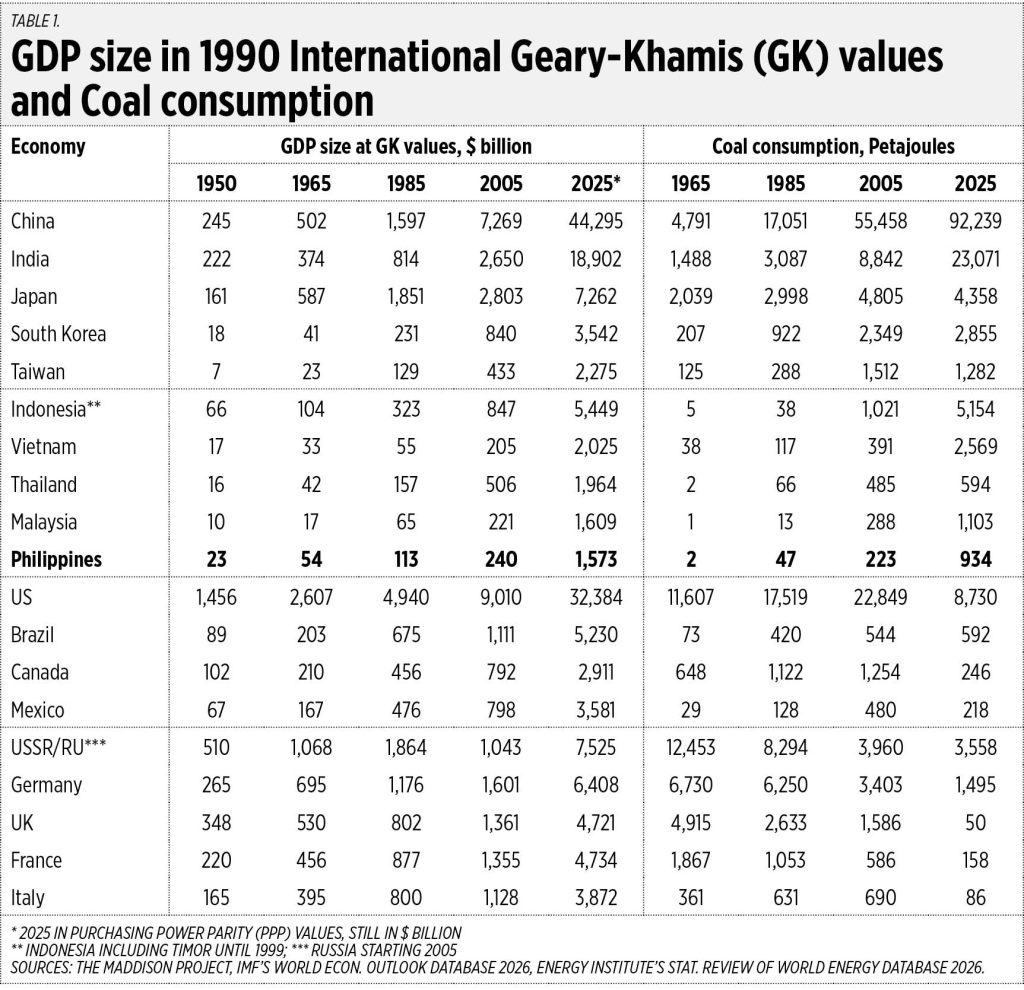
- •China's 2025 coal use of 92,239 Petajoules is six times the combined coal use of all G7 countries, and economies with high coal use posted the fastest GDP and export growth since 1965.
- •The author argues the Philippines should reject coal phase-out and the roughly P2 trillion in planned AFP military procurement, instead helping prolong the 81 years without a world war.
Tomorrow marks the 81st anniversary of the end of World War 2 (WW2). On Sept. 2, 1945, Japan signed its official surrender to the Allies, following Germany's surrender in May of that year. Eighty-one years without a world war is something to celebrate about human rationality. That stretch — the longest in modern history without a direct war among the major powers — coincided with the construction of institutions such as the United Nations, the Bretton Woods system and later the World Trade Organization, frameworks designed to channel rivalry into commerce rather than armed conflict, even as the nuclear age raised the cost of great-power war to unprecedented levels.
Yet conflicts persist: wars between neighbors such as Russia versus Ukraine and NATO countries, Israel versus Lebanon's Hezbollah and Gaza's Palestine, Saudi Arabia versus Yemen's Houthis, and the large war between the US and Iran. Civil wars continue in some countries, and war preparations are underway elsewhere, including China versus Taiwan, and Japan and the Philippines versus China.
This piece examines the improvement in human development after WW2, and the economic and energy prosperity that followed. For GDP size dating back to the 1800s, the author uses the Maddison Project, established by Angus Maddison and younger faculty of the University of Groningen in the Netherlands. The database covers GDP size at 1990 values of Geary-Khamis (G-K) international dollars up to 2008; for 2025, IMF data is used.
The numbers show the following:
First, the common narrative that the Philippines was the "second-largest (or richest)" economy in Asia after Japan after WW2 is wrong. In 1950, China, India and Indonesia all had larger economies than the Philippines.
Second, in 1950, China's economy was only one-sixth the size of the US economy, and one-third in 1985. By 2025, at purchasing power parity (PPP) values, China's economy was 1.4 times larger than that of the US.
Third, Germany and Italy, the invaders of Europe in WW2, experienced economic contraction during and after the war. Germany fell from $377 billion in 1940 to $302 billion in 1945 and $265 billion in 1950; Italy fell from $155 billion in 1940 to $87 billion in 1945, recovering to $165 billion in 1950. Their subsequent recoveries were embedded in the broader West European reconstruction and integration effort, from the Marshall Plan to the founding of the European Coal and Steel Community — an arrangement built, notably, around coal.
Fourth, Japan, the invader of Asia in WW2, suffered an even deeper contraction — from $210 billion in 1940 to just $103 billion in 1945, recovering to $161 billion in 1950. Japan's postwar industrial ascent, like West Germany's, was energy-intensive and initially coal-based before shifting heavily toward oil.
Fifth, coal was the fuel of industrialization in the West until the 1980s, especially for the USSR/Russia, Germany, the UK, the US and Canada. The UK, the birthplace of the industrial revolution, powered its 19th-century rise largely on coal, and the US built its manufacturing dominance on abundant domestic coal as well as oil.
Sixth, Asia industrialized with coal belatedly, picking up speed only since the 1980s. China's coal use of 92,239 Petajoules (PJ) in 2025 is six times the combined coal use of all G7 countries, at 15,123 PJ. Japan is the only G7 country that recognizes the value of coal in sustaining its industrialization and has increased coal use up to today (see Table 1). This divergence sits at the center of global climate negotiations: most G7 members have pledged to phase down unabated coal power under the Paris Agreement framework, while many fast-growing Asian economies maintain coal as a baseload source while expanding renewables at the same time.
Seventh, in merchandise exports from 1965 to 1985, US exports were eight to nine times larger than China's. In 2025, China's exports were 1.7 times larger than those of the US — consistent with the trend in GDP expansion between the two countries noted above, and with China's role since 2009 as the world's largest goods exporter.
Eighth, over the 60 years from 1965 to 2025, export expansion was largest in Vietnam, at 22,520 times; South Korea, at 4,100 times; and China and Taiwan, each with more than 1,400 times.
Ninth, in GDP size expansion over the past 60 years, the largest multiples — above 46 times — were all in Asia except Japan and the Philippines. Among the large economies of the Americas and Europe, none expanded above 26 times. Economists often describe this as the greatest and fastest convergence in living standards ever recorded, lifting hundreds of millions out of extreme poverty in East and Southeast Asia.
Tenth, countries with high coal use also posted high expansion in GDP size and exports: China, India, South Korea, Taiwan, Indonesia, Malaysia and Vietnam. Countries that reduced coal use experienced slower expansion in GDP and exports: Germany, the UK, France, the US and Canada (see Table 2). The association the author highlights reflects, in part, timing: Asian economies industrialized later, when their labor costs were low and global demand for manufactured goods was high, while the coal-reducing Western economies had already completed their industrialization and shifted toward services.
The author argues that the Philippines should aspire to greater economic prosperity — a larger GDP, faster growth, more exports, and more manufacturing and industrialization. The stakes are concrete: coal remains the single largest source of electricity in the Philippine power grid, and the country has among the region's higher electricity prices, a recurring concern for manufacturers. To attain this, the country should not, in his view, bow to the climate establishment's degrowth and deindustrialization agenda of eliminating coal from power generation.
Nor, he argues, should the Philippines bow to the agenda of groups advocating war preparations — spending some P2 trillion of taxpayers' and borrowed money on AFP procurement alone for missiles, jetfighters and the like, on top of the regular annual budget. That debate has intensified as Manila deepens defense ties with Washington and other partners amid South China Sea tensions.
He concludes that the country should contribute to prolonging the 81 years without a world war, rather than cutting it short with another war on top of the existing conflicts in Europe and the Middle East.
Bienvenido S. Oplas, Jr. is the president of Bienvenido S. Oplas, Jr. Research Consultancy Services, and Minimal Government Thinkers, and an international fellow of the Tholos Foundation. Contact: minimalgovernment@gmail.com.
