Wall Street’s Bitcoin ETF Boom Redefines Institutional Crypto Demand
Key Takeaways
- •U.S. spot Bitcoin ETFs reached approximately $180 billion in assets by 2026, with BTC holdings remaining around 1.2 million after peaking near 1.38 million during periods of strong buying.
- •The SEC approved spot Bitcoin ETFs in January 2024 after rejecting dozens of similar applications over the preceding decade, marking a watershed moment for regulated crypto access.
- •Financial institutions favor ETFs over direct Bitcoin ownership because they eliminate challenges related to private-key management, custody, auditing, and compliance while using existing trading infrastructure.
- •Competing ETF products from issuers like BlackRock, Fidelity, and Bitwise charge management fees of roughly 0.12% to 0.25%, significantly undercutting earlier vehicles such as the Grayscale Bitcoin Trust.
- •If Japan develops a domestic Bitcoin ETF market, capturing 0.5% to 1% of its approximately ¥300 trillion in investment assets could generate ¥1.5 trillion to ¥3 trillion in new inflows.
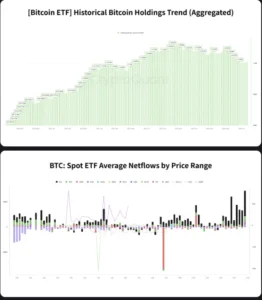
Wall Street’s demand for spot Bitcoin exchange-traded funds is reshaping how major financial institutions approach digital assets, with U.S. spot Bitcoin ETFs holding roughly $180 billion in assets by 2026 after their approval in January 2024 — a milestone that came only after the SEC had rejected dozens of similar applications over the prior decade, making the approval a watershed moment for regulated crypto access in the United States.
Since that approval, large financial firms have moved from cautious observation to active participation. Regulated ETF structures have made it easier for banks, pension funds, asset managers and other institutions to gain Bitcoin exposure through familiar investment channels. The shift marks a significant change in Bitcoin’s ownership base and in the way institutional capital interacts with the digital asset market — a transition accelerated by the launch of competing products from issuers including BlackRock, Fidelity, and Bitwise, whose management fees ranging from roughly 0.12% to 0.25% made Bitcoin exposure far more cost-effective than earlier vehicles such as the Grayscale Bitcoin Trust, which had traded at significant premiums before its own conversion to an ETF.
U.S. spot Bitcoin ETF holdings climbed from about 620,000 BTC shortly after approval and later peaked near 1.38 million BTC during a period of strong buying. Despite market corrections, holdings remain around 1.2 million BTC. Inflows continued in recent months even as Bitcoin traded between $115,000 and $125,000.
Why Institutions Chose ETFs Over Direct Bitcoin Ownership
Direct Bitcoin ownership has historically created major operational challenges for traditional financial institutions. Private-key management, custody arrangements, auditing requirements and compliance controls all presented hurdles for firms that lacked infrastructure designed to hold digital assets securely.
Bitcoin ETFs addressed those issues by providing exposure through standard brokerage accounts. Institutions can use existing trading systems, operational processes and custodial relationships rather than building specialized crypto infrastructure or handling private keys directly.
That accessibility helps explain Wall Street’s interest in Bitcoin ETFs. For banks, pension funds, asset managers and registered investment advisers, the ETF format removes one of the largest barriers to participation while keeping exposure within a regulated investment framework — one that compliance and risk management teams already understand.
The continued inflows at elevated Bitcoin prices indicate that many institutions are not only waiting for lower entry points. Instead, they are treating Bitcoin exposure as a longer-term portfolio allocation decision through vehicles that fit established market practices.
Institutional Demand Changes Bitcoin’s Market Structure
The investor base behind Bitcoin ETFs has expanded beyond early adopters. Asset managers, hedge funds and registered investment advisers now sit alongside banks and endowments, while corporations and pension-related investors have also entered the market.
This broader mix reflects Bitcoin’s increasing presence in mainstream finance. The potential scale of institutional demand remains large across global portfolios. A 1% allocation from a $1 trillion portfolio would equal $10 billion, showing how relatively small allocation changes can have a meaningful effect on Bitcoin’s market capitalization.
Traders are also watching Bitcoin’s historical price cycles alongside institutional buying trends. One analyst known as Crypflow described recurring patterns across previous recoveries.
$BTC (1W) – The breakout that ended every bear market. Every cycle tells the same story. After each Bitcoin cycle top… → Price trended lower creating lower highs. → A downtrend formed. → That downtrend eventually broke. And when it did… A new bull market followed.… pic.twitter.com/gegAuAz1oo — CRYPFLOW (@Crypflow) July 25, 2026
$BTC (1W) – The breakout that ended every bear market.
Every cycle tells the same story.
After each Bitcoin cycle top…
→ Price trended lower creating lower highs. → A downtrend formed. → That downtrend eventually broke.
And when it did…
A new bull market followed.… pic.twitter.com/gegAuAz1oo
— CRYPFLOW (@Crypflow) July 25, 2026
The commentary said downtrends that follow price tops eventually break before new rallies begin. Such observations reflect continued market attention on Bitcoin’s next major move, particularly as ETF flows introduce a new class of buyers whose allocation decisions may not follow the same cyclical patterns as earlier cohorts.
Bitcoin ETFs have done more than support short-term price appreciation for holders. They have created regulated financial infrastructure linking Wall Street directly with digital asset markets. That infrastructure allows long-term global capital to enter Bitcoin more efficiently than before, while regulatory clarity continues to support institutional confidence in the asset class. These vehicles sit alongside other institutional developments — including regulated custody services, derivatives markets, and clearinghouse integration — that together signal traditional finance's engagement with digital assets has moved from experimental to operational.
Japan could see similar institutional dynamics if a domestic Bitcoin ETF market develops. Capturing just 0.5% to 1% of Japan’s roughly ¥300 trillion in investment assets could generate approximately ¥1.5 trillion to ¥3 trillion in new inflows. Under that scenario, Wall Street’s ETF model could increasingly serve as a template for other markets.

