Hyperliquid RWA Trading Volume Overtakes All Other Asset Categories in Record Week
Key Takeaways
- •Tokenized real-world assets generated $25.1 billion in trading volume on Hyperliquid between July 13 and July 19, accounting for 52% of the platform's total weekly volume.
- •Hyperliquid's RWA trading volume exceeded the combined crypto perpetual volume of all other decentralized exchanges during the same period.
- •RWA holders grew 32% over the past month to 1.25 million users, while the total value of tokenized RWAs rose 3.5% to $36.7 billion.
- •Hyperliquid generated $7.6 million in weekly revenue, ranking third among all crypto applications behind stablecoin issuers Tether and Circle.
- •Intercontinental Exchange CEO Jeffrey Sprecher has urged regulators to establish a level playing field for 24/7 on-chain perpetual futures contracts as tokenization initiatives accelerate.
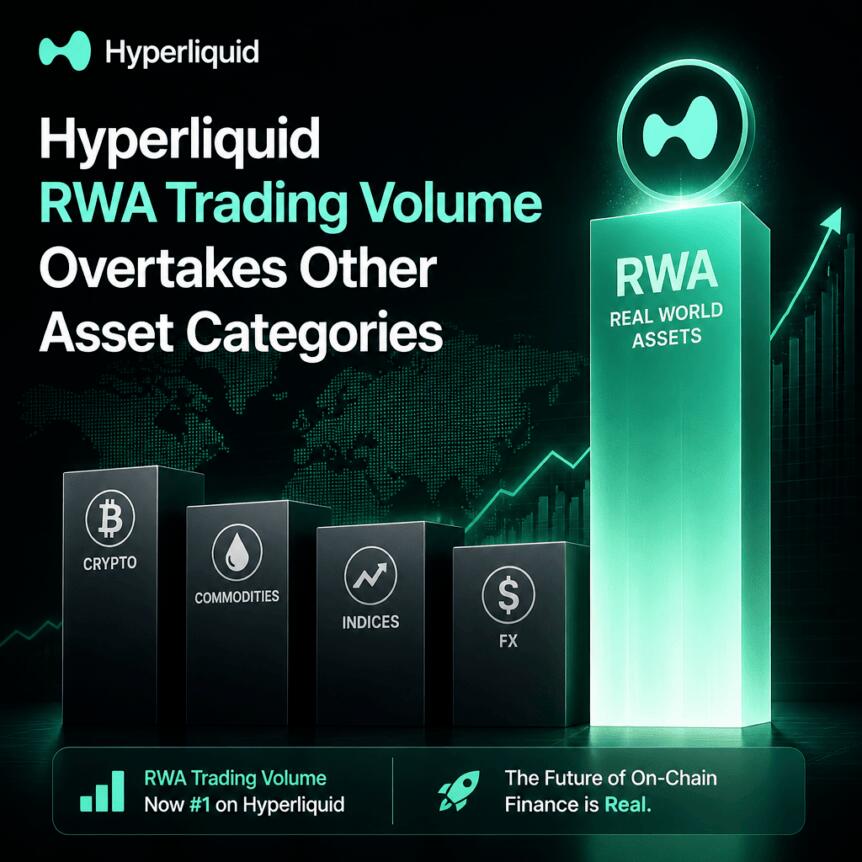
Hyperliquid's decentralized perpetuals exchange has reached a significant milestone, with tokenized real-world assets (RWAs) becoming the dominant category on the platform for the first time. According to Blockworks analytics, RWA trading generated $25.1 billion in volume between July 13 and July 19, surpassing the combined total of every other asset class on Hyperliquid.
That figure represented 52% of Hyperliquid's total weekly trading volume of $48.2 billion. Lorenzo Valente, research director at ARK Invest, underscored the magnitude of the milestone in an X post, noting that Hyperliquid's RWA market alone exceeded the combined crypto perpetual volume of every other decentralized exchange (DEX).
RWA Volume Leads on Hyperliquid's Perps Market
The milestone is specific to Hyperliquid's perpetual exchange, where traders transact on continuous contracts rather than instruments with dated expirations. Blockworks' weekly data for July 13–July 19 showed tokenized RWAs as the single largest volume driver on the platform—an inflection point for a category that has been gaining traction across the broader cryptocurrency ecosystem.
Valente's comparison—that RWA volume on Hyperliquid exceeded the combined crypto perp volume of all other DEXs—highlights how activity is concentrating around tokenized, off-chain-linked instruments on a perpetuals venue. While DEX-based perps are not new, the pronounced weighting toward RWAs suggests capital and liquidity are increasingly drawn to tokenized claims on real-world assets rather than trading interest confined to native crypto commodities.
Broader RWA Adoption Accelerates
The volume record coincides with broader growth in the underlying RWA market. Data from RWA.xyz, cited in the report, shows that RWA holders expanded by 32% over the past month to reach 1.25 million users. During the same period, the total value of tokenized RWAs rose 3.5% to $36.7 billion.
Those figures give the trading spike a wider backdrop because they track participation and tokenized value, not only short-term exchange turnover. Trading volume can shift quickly from week to week, while holder growth and total tokenized value are separate indicators of whether RWAs are being used beyond a single period of elevated market activity.
The combination of weekly trading dominance and month-over-month growth in both holder count and total tokenized value points to sustained demand in the near term, though market participants are watching whether the trend extends beyond the July 13–July 19 window.
Revenue and Ranking Among Crypto Applications
Hyperliquid's revenue provides additional context for whether the volume surge translates into measurable economic activity. DefiLlama data shows Hyperliquid generated $7.6 million in revenue over the past week, ranking third among all crypto applications by that metric.
The two applications ahead of Hyperliquid were stablecoin issuers Tether and Circle, which generated $112 million and $45 million respectively. The ranking places an RWA-focused perpetuals venue in direct competition for economic relevance with the foundational segments of the stablecoin ecosystem—components widely regarded as core infrastructure for on-chain trading.
Industry Leaders Describe a "Structural Shift"
Prominent figures across crypto and traditional finance are increasingly characterizing RWA growth on-chain as an ecosystem-level transition. Circle co-founder and CEO Jeremy Allaire described the growing RWA trading on Hyperliquid as a "major structural shift" in crypto markets. In a Friday X post, he framed the development as a departure from "speculating on endogenous digital commodities" toward trading instruments linked to external real-world assets.
Other industry voices have echoed a similar trajectory for perpetual futures as an instrument class. Earlier in July, Pantera Capital suggested that perpetual futures could become a dominant trading tool beyond crypto, citing structural advantages over traditional derivatives, including 24/7 trading availability, the absence of contract expiries, simplified position management, and continuous price discovery.
Regulatory and Competitive Landscape
Regulatory and competitive dynamics are also intensifying. The report references Intercontinental Exchange (ICE), parent company of the New York Stock Exchange, and its CEO Jeffrey Sprecher urging regulators to create a "level playing field" for the launch of 24/7 on-chain perpetual futures contracts. If on-chain perps continue attracting mainstream liquidity, market participants are expected to seek consistent rules across venues offering continuous trading and automated settlement.
Broader tokenization initiatives are already integrating traditional market infrastructure concepts into blockchain environments. In March, the NYSE partnered with tokenization platform Securitize to develop blockchain-based stock trading infrastructure designed for 24/7 trading and settlement.
While these initiatives differ from Hyperliquid's perpetuals market, taken together they illustrate a broader pattern: tokenized assets are transitioning from conceptual use cases toward active trading and infrastructure development across both crypto-native and legacy financial channels. The comparison also underscores why regulators and incumbent exchanges are paying attention: continuous on-chain markets can blur the operational boundaries between crypto-native venues and traditional market infrastructure.
Whether Hyperliquid's RWA volume share holds beyond the July 13–July 19 period, and whether platform revenue continues to scale alongside growth in RWA holders and total tokenized value, will be closely watched. The long-term sustainability of the shift—along with the regulatory response to 24/7 on-chain derivative trading—will likely determine whether this marks a durable change in market structure or a temporary rotation of liquidity.

