Transportation Capacity Falls Faster in July While Rates Remain Elevated, Logistics Managers' Index Shows
Key Takeaways
- •Transportation capacity on the LMI registered 28.4 in July, tying the second-fastest contraction rate in the index's 10-year history as regulatory enforcement and a structural driver shortage tightened supply.
- •Werner Enterprises reported a 28% year-over-year increase in revenue per truck per week after restructuring its one-way fleet to a 34% smaller size while improving its adjusted operating ratio by 270 basis points.
- •Schneider National secured double-digit rate increases on contract renewals and characterized the truckload market as being in the early stages of rate recovery.
- •Retailer inventory levels dropped nearly 20 points into contraction territory at 46.3, supporting the hypothesis that recent import surges were driven by pre-tariff stockpiling rather than sustained demand.
- •Logistics managers project constrained conditions over the next 12 months, with future capacity at 40.4, utilization at 71.8, and pricing at 89.2, anticipating higher costs across inventory, warehousing, and transportation.
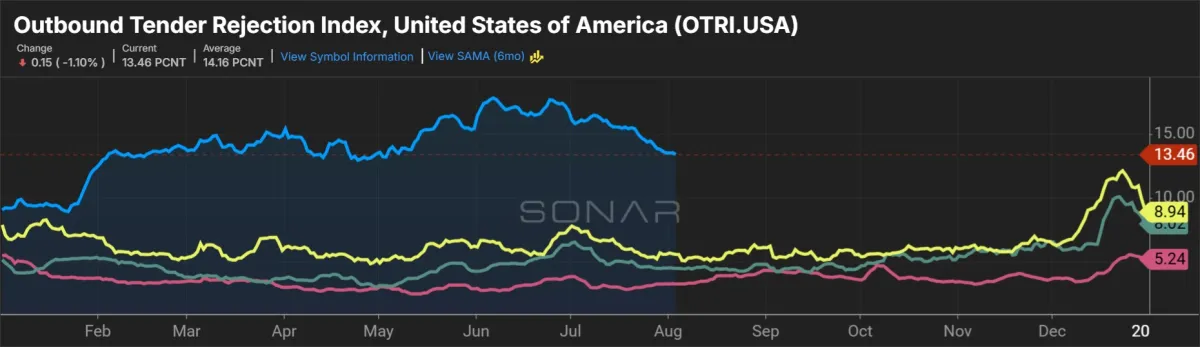
Transportation market conditions moderated slightly in July compared to a seasonally robust June but remained highly constrained, according to the latest Logistics Managers' Index (LMI), a monthly survey of supply chain professionals widely followed as a real-time barometer of freight and inventory conditions. Key transportation metrics within the index showed mixed signals, with capacity contracting at an accelerated pace while pricing growth eased only marginally.
The LMI is a diffusion index in which readings above 50 indicate expansion and readings below 50 signal contraction. The transportation capacity component registered 28.4 in July, declining 2.4 percentage points faster than in June and tying the second-fastest contraction rate recorded in the dataset's 10-year history. The all-time low remains 23.8, set in September 2020.
A regulatory crackdown aimed at removing unsafe drivers has notably tightened truckload market supply, compounding a structural driver shortage that industry groups have tracked for years. In addition, most publicly traded carriers are refraining from adding equipment, instead focusing on improving the utilization of existing assets.
Initiatives to enhance asset utilization were visible in second-quarter earnings results.
Omaha, Nebraska-based Werner Enterprises (NASDAQ: WERN) announced a formal restructuring of its one-way truckload fleet in February. The strategy included exiting unprofitable accounts and repurposing or disposing of underutilized tractors. In the latest quarter, revenue per truck per week (excluding fuel surcharges) rose 28% year over year, driven by a 16% increase in miles per truck and a 10% gain in revenue per total mile. Werner expects rate per mile to climb 10% to 13% year over year in the third quarter.
The carrier's one-way fleet was 34% smaller during the quarter, contributing to a 270-basis-point improvement in its total truckload segment adjusted operating ratio, which moved to 94.5%. Although roughly 10 points worse than the prior peak, the figure represents the unit's strongest margin performance since the fourth quarter of 2023.
The LMI report, released Tuesday, showed transportation utilization at 65 — down 9.7 points from June but still elevated by historical standards. Transportation price growth registered 86.9, decelerating 5.5 points yet remaining at what the report described as a "very robust expansionary rate."
"The lack of available fleet capacity has caused the lead time for tender bookings to increase," the report stated, citing SONAR data. "In late July bookings were being made at an average of 3.74 days before the tender needs to move, up 11% from the same time last year."
Werner noted that one-way contractual bid negotiations are producing some of the strongest rate increases seen in a decade.
Green Bay, Wisconsin-based Schneider National (NYSE: SNDR) reported that its one-way fleet secured double-digit rate increases on contract renewals during the quarter. The company said mini-bid activity has risen as shippers grow increasingly concerned about securing capacity ahead of peak season, the stretch from late summer through the December holidays when retail shipping volumes typically surge. Schneider has expanded its exposure to the spot market, observing that June closely resembled March 2021, the previous cycle peak. Spot market rates for immediate transactional freight have historically led contract rate movements in trucking cycles. The carrier believes the truckload market is "only in the early stages of rate recovery."
Supply Chain Costs Remain Elevated
The overall LMI stood at 68.9, down 2.2 points from a four-year high reached in June. Despite the modest pullback, the index is on pace for its highest annual reading since the freight market's boom cycle in 2021, when pandemic-driven demand shifts and supply chain disruptions pushed shipping costs to record levels.
Inventory levels fell to 55, down 5.5 points for the month. Downstream companies such as retailers registered a nearly 20-point decline, slipping into contraction territory at 46.3. Upstream respondents — manufacturers and wholesalers — reported little change, returning a reading of 59.
"This seems to support the hypothesis laid out last month that some of the surge in imports was due to retailers rushing some goods imports ahead of new potential tariffs," the report said. "It is not clear if there will be a repeat of what we saw last year where the bulk of this inventory was held Upstream at the wholesale level and then only pulled down right before the holiday shopping season."
Despite the slowdown in inventory growth, inventory costs reached 77, growing at a "very robust rate" and rising 1.1 points from June.
Warehousing capacity came in at 46.3, down 1.2 points, which pushed warehouse prices up 1.7 points to 75.5 — the second-highest reading since July 2022, described in the report as "the height of the post-covid inventory bullwhip."
The data revealed a significantly tighter warehousing market for upstream companies, with warehouse prices 12 points higher at the wholesale level of the supply chain.
Aggregate logistics costs — encompassing inventory, warehousing, and transportation — declined 2.6 points to 239.5 in July. May's reading of 250.9 marked the fastest rate of expansion for the all-in cost dataset since March 2022.
Forward Outlook
Logistics managers surveyed expect the transportation market to remain highly constrained over the next 12 months, projecting future readings of 40.4 for capacity, 71.8 for utilization, and 89.2 for pricing.
The 12-month outlook placed inventory levels at 64.4, with inventory costs (77.6) and warehouse prices (76.3) showing no anticipated retreat.
"Essentially, respondents are anticipating having to fit increasing inventories into tighter capacities at higher costs over the next 12 months," the report noted.
The LMI is a collaborative research effort among Arizona State University, Colorado State University, Florida Atlantic University, Rutgers University, and the University of Nevada, Reno, conducted in partnership with the Council of Supply Chain Management Professionals.

