Robinhood Chain Tokenized RWA Value Nears $70 Million Within Two Weeks
Key Takeaways
- •Robinhood Chain accumulated approximately $70 million in tokenized real-world asset value within about two weeks of its mainnet transition.
- •The network ranked fourth among blockchains by decentralized exchange trading volume, reflecting active early platform usage.
- •Robinhood designed the Layer 2 blockchain to support tokenized equities alongside an expanded crypto offering that includes perpetual futures and staking in EU and US markets.
- •Binance Wallet added launchpad filters for Robinhood Chain, broadening discovery and access channels for the newly launched network.
- •Whether tokenized asset inflows on Robinhood Chain will be sustained beyond the initial launch period remains an unresolved question for evaluating long-term viability.
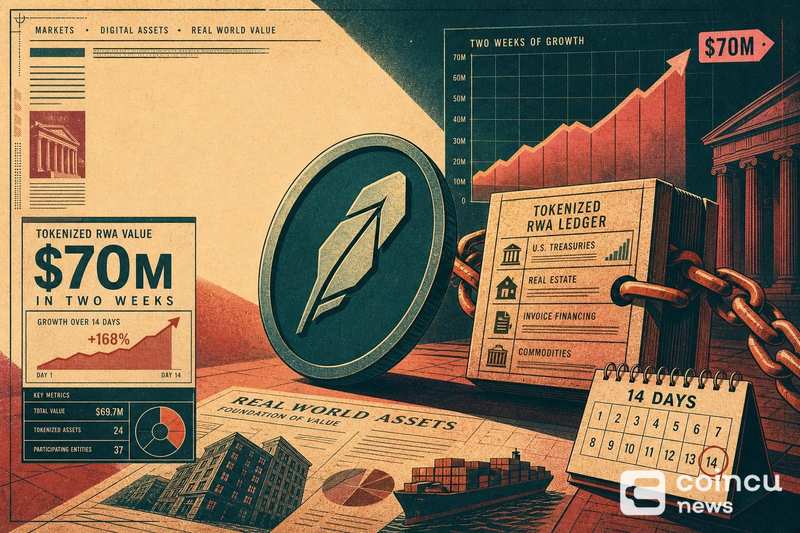
Robinhood Chain's tokenized real-world asset (RWA) value has reached approximately $70 million in roughly two weeks, marking an early signal of traction for the retail brokerage's push into on-chain tokenized assets. Tokenized real-world assets refer to traditional financial instruments—such as stocks or funds—represented as blockchain-based tokens.
The figure represents rapid early accumulation for a network that only recently transitioned toward mainnet. According to Robinhood's own announcement covering Robinhood Chain mainnet, stock tokens, and agentic trading, the company has positioned the chain as core infrastructure for tokenized equities and an expanded cryptocurrency suite.
Robinhood first outlined the network alongside its stock token rollout, detailing a Layer 2 blockchain and a broader EU and US crypto expansion that included perpetual futures and staking. According to the company's official announcement, this foundational positioning set the stage for the tokenized asset activity now building on the chain.
Factors Behind Early Demand on Robinhood Chain
An early value build of this magnitude likely reflects Robinhood's established retail brand, which can quickly direct user attention toward new product offerings. The chain's early momentum has already surfaced in trading activity metrics, with Robinhood Chain ranking fourth among chains by DEX volume.
The result may also stem from the strength of the RWA narrative, which has been one of crypto's most durable crossover themes for both retail and institutional participants. Robinhood has paired tokenized stocks with more speculative on-chain activity, a combination reported in coverage of Robinhood Chain memecoins and tokenized stocks.
A rapid asset-value increase over a two-week window typically signals early curiosity and accessibility rather than settled, durable demand. Distribution channels have widened quickly as well, with Binance Wallet adding launchpad filters for Robinhood Chain. For a new chain, wallet access and trading interfaces matter because tokenized assets need both issuance infrastructure and usable routes for discovery, transfer, and exchange.
Significance for the Tokenized RWA Sector
Fast value accumulation can be interpreted as evidence of market appetite for tokenized traditional assets, though it primarily reflects platform-specific traction rather than sector-wide validation. The broader demand backdrop is visible in data showing tokenized stock transfer volume reaching billions in June.
Asset value and transfer volume measure different parts of adoption: asset value indicates how much tokenized exposure is represented on-chain, while transfer and DEX activity show how often users are moving or trading those assets. That distinction matters when comparing Robinhood Chain's early RWA value with broader market activity across tokenized stocks.
A new entrant reaching notable value quickly can also intensify competition among platforms pursuing RWAs. That competitive landscape is broadening, with Coinbase moving into tokenized equities on its own timeline.
However, early traction does not guarantee long-term market dominance. The distinction between a company-specific milestone and a broader sector signal is relevant for assessing how much weight to place on a two-week figure.
Risks and Open Questions After the First Two Weeks
Short-term growth can appear strong without proving durable user retention, and the initial valuation may partly reflect launch-driven curiosity. Whether inflows sustain beyond the opening weeks remains a more meaningful test of the network's viability.
Tokenized asset adoption ultimately depends on liquidity, regulatory compliance, and product breadth over time—not headline value alone. Robinhood's positioning across the EU and US, as outlined in its stock token and Layer 2 disclosures, will be evaluated against those benchmarks.
The next key milestone will be whether tokenized asset value on Robinhood Chain continues to grow after the initial momentum subsides, and whether trading participation deepens in parallel.
FAQ
What is Robinhood Chain?
Robinhood Chain is the company's Layer 2 blockchain, disclosed alongside its stock token rollout, designed to support tokenized equities and an expanded cryptocurrency suite.
What are tokenized real-world assets?
Tokenized real-world assets are traditional financial instruments—such as stocks or funds—represented as tradable tokens on a blockchain.
Why is approximately $70 million in two weeks notable?
The pace indicates unusually fast early accumulation for a newly launched network, though it reflects initial traction rather than proven long-term demand.

