XRP May Face Extended Consolidation Until 2028 as Bollinger Bands Echo Previous Accumulation Cycle
Key Takeaways
- •A TradingView analysis indicates that XRP's current Bollinger Bands pattern resembles its 2022–2024 accumulation cycle, suggesting a potential consolidation phase lasting until 2028.
- •Ripple's enterprise growth, including the RLUSD stablecoin's approximate $1.5 billion market capitalization, has not translated into proportionate demand for XRP because banks are not required to use the token for settlement.
- •Weekly inflows into U.S. spot XRP ETFs have fluctuated between approximately $2 million and $12 million, reflecting modest institutional capital deployment since their 2025 approval.
- •Polymarket data places the probability of the CLARITY Act being signed into law in 2026 at 33%, highlighting continued regulatory uncertainty around digital assets.
- •The analysis presents two divergent scenarios in which either weaker demand and regulatory delays drive additional retail selling or sustained whale accumulation establishes a stronger price floor before any future breakout.
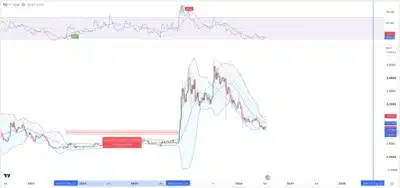
XRP could remain locked in a prolonged consolidation phase lasting until 2028, according to a TradingView analysis that compares the token's current chart structure with its previous multi-year accumulation cycle.
The analysis indicates that XRP's Bollinger Bands pattern has begun mirroring the accumulation structure observed between 2022 and 2024. Based on this model, the asset may continue trading within a narrow range for another extended period before any significant price movement materializes.
During the previous cycle, XRP consolidated for 791 days before surging to a peak of $3.55. That rally ultimately reversed into a lengthy correction, returning the asset to another phase of compressed price action.
At present, XRP trades between approximately $1.06 and $1.10. Bollinger Bands on higher time frames have once again started contracting — a technical signal that typically reflects declining volatility and prolonged consolidation.
Ripple's Enterprise Growth Diverges from XRP Price Performance
Ripple's expanding business operations have not translated into proportionally stronger demand for XRP, according to the analysis. The company's enterprise growth appears increasingly decoupled from the token's short-term price trajectory.
Ripple recently reinforced its stablecoin ecosystem through Ripple Mint, a platform supporting the RLUSD stablecoin. RLUSD has since grown to a market capitalization of approximately $1.5 billion, reflecting broader adoption of Ripple's financial infrastructure.
However, banks that adopt Ripple's payment solutions are not required to purchase XRP for settlement purposes. As a result, enterprise expansion alone may not generate the buying pressure that many investors had previously anticipated.
Institutional demand through U.S. spot XRP exchange-traded funds has also remained modest. Weekly inflows have reportedly fluctuated between approximately $2 million and $12 million, signaling a slower pace of capital deployment than many market participants expected following the 2025 approval of spot XRP ETFs.
Regulatory Uncertainty Persists
Beyond softer institutional demand, regulatory uncertainty continues to influence market sentiment around XRP. According to Polymarket data cited in the analysis, the probability of the CLARITY Act being signed into law in 2026 currently stands at 33%.
The CLARITY Act is one of several proposed bills aimed at establishing a comprehensive federal framework for digital asset regulation, including delineating oversight responsibilities between the SEC and CFTC. XRP has operated under heightened regulatory scrutiny since the SEC's 2020 lawsuit against Ripple, which concluded in 2024 with a court ruling that programmatic sales of XRP on exchanges did not constitute securities transactions.
This uncertainty has given rise to two competing market scenarios. The bearish outlook suggests that weaker ETF inflows, limited organic demand, and regulatory delays could encourage additional selling by retail investors. Conversely, the bullish case posits that large holders — or whales — may steadily absorb selling pressure while building stronger long-term positions.
According to the TradingView projection, sustained whale accumulation could establish a firmer price floor before any future breakout develops. However, confirmation of that scenario would require consistently stronger buying activity over an extended period.
Technical Projection, Not a Guaranteed Outcome
The Bollinger Bands projection represents a technical scenario rather than a definitive forecast. Nonetheless, the TradingView analysis notes that XRP's current market structure bears a close resemblance to its previous accumulation cycle, leaving traders monitoring whether historical patterns repeat or whether new demand catalysts — such as further regulatory clarity or expanded institutional adoption — ultimately reshape the token's long-term trajectory.

