Bitcoin Slips Below $65,000 as Tech Stocks Fall, Oil Surges and AI Spending Concerns Grow
Key Takeaways
- •Intel posted second-quarter revenue of $16.1 billion, up 25% year-over-year for its fastest growth in over 15 years, led by a 59% increase in its Data Center and AI business.
- •An escalation in the Iran conflict sent Brent crude above $100 per barrel and raised the probability of a Federal Reserve rate increase to nearly 40%, contributing to a 2.3% decline in the Nasdaq.
- •Google fell sharply after raising its 2026 AI-related capital spending guidance to a range of $195 billion to $205 billion and reporting its first negative quarterly free cash flow since going public.
- •U.S.-listed spot bitcoin ETFs attracted nearly $1 billion in inflows over seven consecutive trading days even as Bitcoin traded below $65,000 amid broader risk-off sentiment.
- •Goldman Sachs CEO David Solomon publicly supported the Clarity Act, stating it would create a clearer regulatory framework and level playing field for digital asset markets ahead of a possible Senate vote.
Intel rises after revenue beats estimates on AI-driven demand
Intel (INTC) rose about 8% in after-hours trading after the chipmaker reported second-quarter revenue that exceeded expectations, supported by demand for AI computing and data center chips.
The company posted $16.1 billion in revenue, up 25% from a year earlier, marking its fastest quarterly growth in more than 15 years, according to its second-quarter 2026 financial results. Adjusted earnings were $0.42 per share. Revenue growth was led by a 59% increase in Intel's Data Center and AI business.
CEO Lip-Bu Tan said AI demand continues to support growth across Intel's processor, foundry and advanced packaging businesses.
Intel also gave a stronger outlook for the current quarter, forecasting revenue of $15.8 billion to $16.8 billion and adjusted earnings of $0.38 per share.
The report helped ease pressure on technology shares after a difficult session. Nasdaq 100 futures recovered from their lows, cutting losses to about 1.6%.
BitMine and Strategy lead declines in crypto stocks as Nasdaq falls
Crypto-linked equities ended Thursday sharply lower as a sell-off in large technology stocks weighed on risk assets.
Strategy (MSTR), the largest corporate holder of bitcoin, declined 6.5%. BitMine Immersion (BMNR), Tom Lee's Ethereum treasury company, fell 6.8%. Circle (CRCL), issuer of the USDC stablecoin, dropped 6.3%.
The Nasdaq closed 2.3% lower, leaving the technology-heavy index close to a two-month low and about 8% below its June peak, near correction territory.
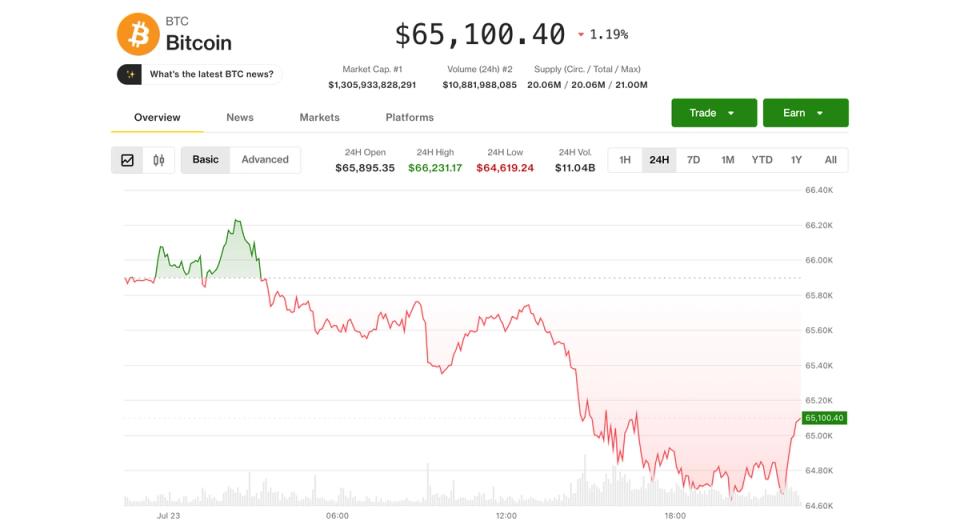
Cryptocurrency prices also weakened, though the moves were smaller. Bitcoin (BTC) slipped 1.8% to around $64,800, while ether (ETH) lost about 3% to trade near $1,870.
Robinhood says Vlad Tenev's X account was hacked in meme coin scam
Robinhood (HOOD) said CEO Vlad Tenev's X account was compromised after hackers used it to promote a fake meme coin called "Vladhood" ($VLAD) and falsely claimed it would be listed on the trading platform.
The fraudulent post appeared Thursday before Robinhood's earnings release. It described the token as the "official Robinhood chain mascot" and encouraged users to buy it.
"Our CEO Vlad Tenev's X account was compromised and posted a fake promotion for a meme coin," Robinhood said on X.
The incident followed a similar case a week earlier, when hackers compromised Airbnb co-founder and CEO Brian Chesky's X account to promote tokenization-related scams. The episodes underscored a growing pattern of cybercriminals targeting high-profile executives' social media accounts to draw crypto investors into fraudulent token launches.
Bitcoin falls below $65,000 as Wall Street losses accelerate
A routine down day on Wall Street worsened in late-morning trading as geopolitical and technology-sector concerns converged.
An expansion in the Iran war sent crude oil sharply higher, with Brent crude rising more than 7% and moving above $100 per barrel for the first time in two months. The move increased inflation expectations and, in turn, interest rates, with traders pricing in nearly a 40% probability of a Federal Reserve rate increase the following week. Those odds had been in the single digits only a few days earlier.
Concerns over AI spending added to the pressure. Tesla and Google reported second-quarter results the previous evening, and both companies raised expected AI-related capital expenditure far above analyst estimates.
Google reported its first negative quarterly free cash flow since going public more than 20 years ago and said it expected that condition to continue for the foreseeable future.
Tesla traded 14% lower and Google fell 8% on Thursday, helping push the Nasdaq down 2.65%. The S&P 500 declined 1.5%.
Bitcoin had been attempting to hold the $65,000 level but later fell below it, trading down about 2% over the previous 24 hours at $64,700. Ether (ETH), XRP (XRP) and solana (SOL) posted somewhat larger declines.
Defense and energy shares moved higher. Lockheed Martin rose 11%, RTX gained 7.5%, and Exxon and Chevron were each up just under 3%.
Google's AI capex forecast pressures hyperscalers while data center names rise
Google (GOOG) fell 6% after raising its expected AI-related capital spending guidance for the year to $195 billion to $205 billion, with expectations for a "significant" increase in 2027.
The announcement weighed on other large AI compute consumers. Meta and Amazon both declined about 3%, Apple fell 1.75%, and Microsoft was down 0.5%.
Companies positioned as beneficiaries of that spending, including former bitcoin miners now operating in AI compute, moved higher. Cipher Mining (CIFR), Riot Platforms (RIOT) and Hut 8 (HUT) each gained about 7%. TeraWulf (WULF), Keel Infrastructure and IREN (IREN) rose in the 3% to 4% range.
Arthur Hayes comments on BitMEX shutdown
BitMEX co-founder Arthur Hayes commented on the exchange's planned shutdown in a post on X.
"Thank you to my partners, my BitMEX employees, and most importantly our clients," Hayes said. "It was an amazing ride. We did something special together. And I'm so proud of what we created and that we will shut down responsibly on our own terms. F-ck TradFi, F-ck the Banks, F-ck the man. Satoshi for life."
The post was published at https://x.com/CryptoHayes/status/2080286601125482771.
Hayes was one of the three co-founders of BitMEX in 2014. At its peak, BitMEX was among the highest-volume crypto derivatives exchanges globally, known for popularizing the perpetual swap contract. Hayes has not held an operational role at the company for several years.
Trump threatens retaliation after Houthi attack
President Trump said in a Truth Social post that the Houthis had resumed attacks, writing: "Unfortunately, now [the Houthis] are starting up again, shooting at two Saudi Arabian ships last night."
"Please let this TRUTH serve to represent that if they do this again, the U.S. will hold Iran responsible, in that the Houthis are a Surrogate and/or Proxy of Iran, and major military punishment will be inflicted upon Iran and, of course, the Houthis, themselves," he continued.
The post appeared at
Oil remained 5% higher on the day, while Nasdaq 100 futures fell to session lows, down 1.3%. Bitcoin was also near its low for the day at $65,100.
ECB holds rates steady as U.S. jobless claims fall sharply
The European Central Bank left its benchmark interest rates unchanged at its latest policy meeting, as expected.
The central bank maintained a hawkish tone. "The full inflationary impact of the energy shock has yet to play out," the governing council said in its statement.
In U.S. economic data, weekly initial jobless claims fell to 187,000, compared with expectations for 212,000. The figure was the lowest since 1969.
The data added pressure on the bond market and on the Federal Reserve to raise rates. The 10-year U.S. Treasury yield rose five basis points to 4.71%, its highest level of the year.
The Fed was scheduled to meet the following week, and market expectations for a rate increase had risen to nearly 40% from roughly zero only days earlier.
Goldman Sachs CEO supports Clarity Act ahead of possible Senate vote
Goldman Sachs CEO David Solomon expressed support for the Clarity Act, saying the legislation would help create a clearer regulatory framework for digital assets and allow the market to develop more effectively.
"The CLARITY ACT — like all legislation — is not perfect," Solomon told Politico. "But I think one of the most important things that it does is that it creates a level playing field to enhance market stability and allow these markets to develop appropriately."
Solomon added that he was "very supportive of moving the CLARITY ACT forward, so we can get some market structure in place and start to move the innovation process along."
His comments came as Republican senators circulated updated text of the bill before a possible Senate floor vote the following week. The Clarity Act is part of a broader legislative push to define the boundary between assets regulated as securities by the SEC and those treated as commodities under CFTC oversight.
Solomon's remarks were consistent with comments he made in February, when he criticized the economic effects of excessive regulation. "When you burden this system with excessive regulation, you start to extract capital," he said. While stressing the need for thoughtful oversight, he added: "It's got to be done thoughtfully, and we've got to get it right."
Strategy joins Bitcoin Security Consortium focused on quantum threat
The Bitcoin Security Consortium launched as "an initiative dedicated to supporting the long-term security and resilience of the Bitcoin network, backed by an aggregate $15 million in member pledges over the next three years," according to a Thursday morning press release from Strategy:
The founding members are Anchorage Digital, ARK Invest, BlackRock, Block, Blockstream, Coinbase, Fidelity Digital Assets, Galaxy and Strategy. The consortium's quantum-focused mandate reflects longstanding concern in the cryptography community that sufficiently powerful quantum computers could eventually break the cryptographic algorithms underpinning Bitcoin's security.
The Smarter Web Company sells bitcoin to repay convertible debt
U.K.-based The Smarter Web Company announced the sale of about 178 bitcoin, raising roughly $11.7 million to repay convertible debt held by the TOBAM Group, according to the company's announcement:
The company said it now holds 2,700 bitcoin.
"We do not currently believe [convertible debt] represents the right capital solution for The Smarter Web Company," CEO Andrew Webley said.
Although the amounts were relatively small, the sale added to a broader series of developments among 2025 bitcoin treasury companies, including BTC sales, executive departures, reverse stock splits and liquidations.
Bitcoin edges lower as Iran war expansion sends oil higher
Oil supply concerns increased after Iran-backed Houthis claimed an attack on two Saudi oil tankers in the Red Sea.
WTI crude oil rose nearly 5% to $91 per barrel, its highest level since early June.
The move added pressure to the bond market. The 10-year U.S. Treasury yield rose four basis points to another cycle high of 4.70%, while the 2-year yield climbed to 4.33%. Traders had priced in nearly a 40% probability of a Fed rate increase the following week.
Nasdaq 100 futures were down 0.75%, led by a 4% decline in Google after the company's earnings report the previous evening. Bitcoin (BTC) was down 0.5% over the previous 24 hours at $65,500.
Spot bitcoin ETFs see nearly $1 billion of inflows over seven days
U.S.-listed spot bitcoin exchange-traded funds attracted nearly $1 billion over seven consecutive trading days.
Investors allocated almost $500 million during the week alone, the strongest performance since early May, according to data source SoSoValue.
Bitcoin's price had recently topped $66,000 for the first time since mid-June and was last seen around $65,680.
Bitcoin holds near $65,400 as Alphabet's higher AI spending supports chip trade
Bitcoin traded near $65,400 on Thursday, down 0.3% on the day and up 1.4% for the week, according to CoinDesk data.
The market stayed relatively quiet through Alphabet's earnings report, which investors had been awaiting for signals on AI spending.
Alphabet delivered mixed results. Revenue rose 24% to $119.8 billion and cloud revenue grew 82%, both ahead of expectations. However, the company raised its 2026 capital spending forecast again, to $195 billion to $205 billion from $180 billion to $190 billion, citing a "supply-constrained" scramble to meet AI demand.
Alphabet shares fell after hours as investors weighed higher spending against slimmer free cash flow.
While Alphabet shareholders faced a larger spending bill, increased investment in AI infrastructure has supported chip stocks. Asian chipmakers rose again Thursday, with the Kospi up 3.6% and Samsung and SK Hynix each gaining more than 2% on expectations they would capture some of that spending.
Major cryptocurrencies were little changed at that point. Ether traded near $1,916, XRP at $1.13 and Solana at $77. Hyperliquid was the outlier, down 11% for the week.
Oil continued to climb, extending a July rally that revived inflation concerns. The next focus for markets was the Federal Reserve meeting on July 28 and 29.

