South Korea's Danuri Orbiter Captures Rare Before-and-After Images of SpaceX Rocket Impact on the Moon
Key Takeaways
- •The Falcon 9 rocket's upper stage struck the Moon's far side near Einstein Crater at 3:34 p.m. Wednesday Korea time, as announced by the Korea Aerospace Administration.
- •Danuri is among the first missions to document a lunar impact with both pre-event reference images and post-impact observations, capturing the site eight times in total.
- •The orbiter used its Lunar Terrain Imager at approximately five meters per pixel resolution and its Polarimetric Camera to measure changes in surface reflectance and polarization from 340 to 350 kilometers above the Moon.
- •Scientists plan to analyze the crater's dimensions, ejecta distribution, and polarimetric properties, with the data supporting NASA Lunar Reconnaissance Orbiter follow-up studies and broader international lunar geology research.
- •The uncontrolled debris impact has prompted warnings from scientists about increasing risks to future lunar operations as cislunar space becomes more congested with scientific, commercial, and national missions.
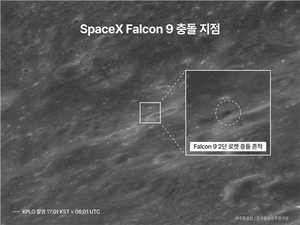
South Korea's first lunar orbiter, Danuri, has captured rare before-and-after images of a SpaceX Falcon 9 rocket stage striking the moon, providing scientists with one of their clearest opportunities yet to study how a human-made object alters the lunar surface.
The Korea Aerospace Administration announced Thursday that the rocket's upper stage impacted the moon's far side near Einstein Crater at 3:34 p.m. Wednesday (Korea time). Unlike most previous lunar impacts, which have typically been studied only after new craters were discovered, Danuri recorded the site both before and after the collision.
Danuri began photographing the area approximately 30 minutes before impact and continued making observations afterward, capturing the site eight times in total. The orbiter had also secured reference images of the location last month to establish a baseline for comparison.
Images released by the agency show a newly formed dark mark spreading outward from the impact site, along with visible changes to the surrounding terrain caused by debris ejected by the collision.
To capture the event, Danuri adjusted its orbit to pass directly over the impact site while flying about 340 to 350 kilometers above the lunar surface. Using its high-resolution Lunar Terrain Imager, the orbiter photographed the area at a resolution of approximately five meters per pixel.
The mission also deployed its wide-angle Polarimetric Camera to measure changes in the moon's surface reflectance and polarization. This data will help scientists analyze the size and density of surface particles and the distribution of material ejected by the impact.
The Korea Aerospace Administration likened the feat to photographing a collision in Busan while flying 150 kilometers above Seoul at a speed of 1.5 kilometers per second, underscoring the extraordinary precision required for the observation.
Scientists plan to use the images to analyze the crater's size and shape, the distribution of ejecta — material blasted out from an impact — and changes in the moon's reflective and polarimetric properties. Because the moon lacks an atmosphere, impact craters and their ejecta patterns are preserved far longer than on Earth, making each well-documented strike a valuable natural laboratory for understanding impact physics. The data will also help NASA plan follow-up observations using its Lunar Reconnaissance Orbiter, with findings expected to contribute to international research on lunar geology and impact processes — research that carries growing relevance as multiple nations, including the United States through its Artemis program and China through its own lunar exploration plans, pursue sustained missions and eventual surface infrastructure.
Korea Aerospace Administration Administrator Oh Tae-seok told local media: "The achievement will provide an important foundation for expanding the country's lunar research and future space exploration strategy."
The impact drew international attention because it involved uncontrolled space debris. As cislunar space becomes increasingly trafficked by scientific, commercial, and national missions, scientists have warned that such debris could pose growing risks to future lunar operations.
