Crypto Advocacy Groups Urge Senate to Advance CLARITY Act Amid Ethics Provision Disputes
Key Takeaways
- •The Crypto Council for Innovation, the Digital Chamber, and the Blockchain Association asked Senate leadership to prioritize a floor vote on the CLARITY Act before the August recess.
- •The bill would generally give the SEC authority over digital asset securities and the CFTC authority over spot markets for digital commodities.
- •The legislation has cleared the Senate Banking and Agriculture committees, and the House passed its own version earlier in July.
- •Several Democratic senators may withhold support unless ethics provisions on public officials and cryptocurrency conflicts are strengthened.
- •Kalshi event contracts showed an approximately 40.3% implied probability of a Senate vote before the August recess as of Friday.
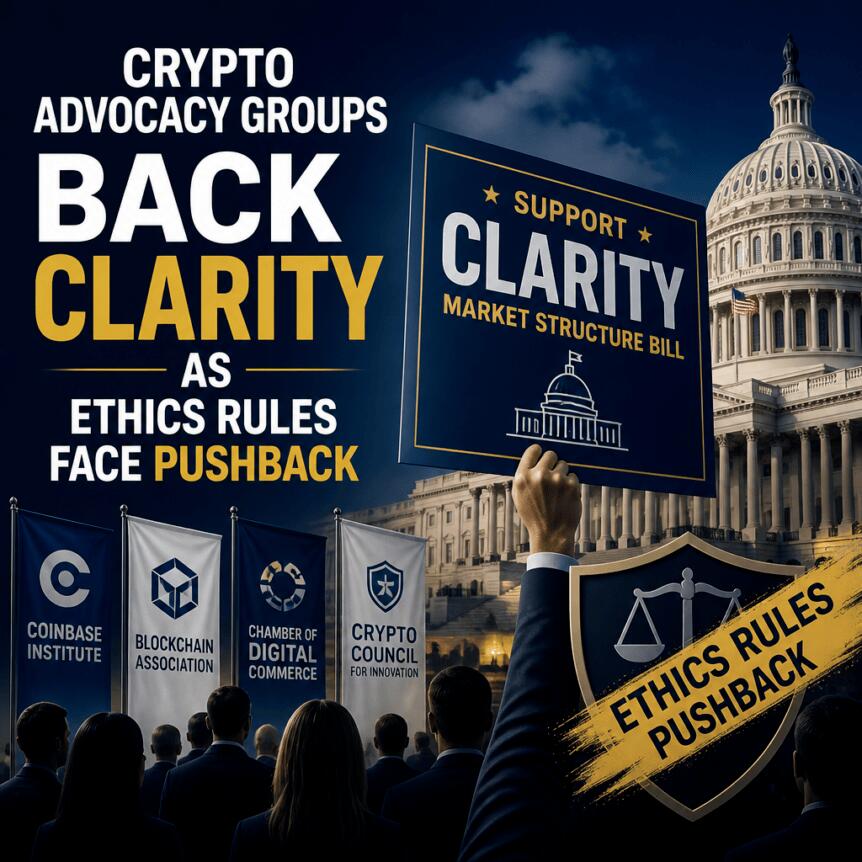
Three major U.S. cryptocurrency advocacy organizations have called on Senate leadership to bring the Digital Asset Market Clarity (CLARITY) Act to the chamber floor, describing the legislation as a rare opportunity to establish a comprehensive federal framework for digital assets. The bill would draw a regulatory boundary between the SEC and the CFTC, generally assigning oversight of digital asset securities to the SEC while placing spot markets for digital commodities under CFTC jurisdiction—a structural realignment the industry has sought as agencies have increasingly relied on enforcement actions rather than tailored rulemaking.
In a joint letter sent Friday to Senate Majority Leader John Thune and Minority Leader Chuck Schumer, the Crypto Council for Innovation, the Digital Chamber, and the Blockchain Association urged lawmakers to prioritize floor consideration before the Senate departs for its August state work period. The legislation has already cleared both the Senate Banking Committee and the Senate Agriculture Committee, and the House passed its own version of the CLARITY Act earlier in July, adding momentum for Senate action. But it remains uncertain whether the bill can secure the 60 votes required for passage. Republicans currently hold a 52–47 majority over Democrats, and several Democratic senators have indicated they may withhold support until the bill's ethics-related provisions are strengthened—particularly provisions addressing conflicts of interest involving public officials and cryptocurrencies.
Advocacy Groups Press for Floor Action
In their Friday letter, the three organizations framed floor consideration as the logical next step following committee approval. They acknowledged that bipartisan negotiations remain ongoing and encouraged those discussions to continue, stressing that they are not demanding a "take it or leave it" decision. Rather, they want the bill brought to the Senate floor without additional delay.
The groups' appeal aligns with a broader Republican effort to schedule a vote before the August recess. Even with committee advancement, however, floor scheduling in the Senate typically hinges on whether the parties can bridge disagreements on contentious provisions—particularly those involving ethics rules and enforcement boundaries.
Ethics Provisions Remain the Central Sticking Point
CLARITY is widely regarded as one of the most consequential pieces of U.S. crypto regulation legislation, and its trajectory through the Senate underscores the difficulty of achieving bipartisan consensus. The bill requires 60 votes to pass, and while Republicans hold a 52–47 edge, Democratic support is far from assured.
Earlier in the week, Republicans released the full text of the market structure bill, which includes ethics provisions that would prohibit public officials from issuing or sponsoring cryptocurrencies. Democrats who have criticized or questioned these measures argue they fall short of adequately addressing corruption risks, according to reporting from Politico and Cointelegraph.
Senator Ruben Gallego, who criticized the GOP's ethics counterproposal, told Politico that the latest Republican response did not reflect a serious effort. He argued that following months of collaborative work with Republican colleagues, the updated approach failed to match what Democrats consider necessary to meaningfully strengthen safeguards:
"[…] After all the work that we've done with our Republican colleagues, that they would take the months and months of work and somehow interpret that and turn around and think what they offered was even remotely close."
For investors and crypto companies, this disagreement carries significant weight. Ethics provisions and conflict-of-interest rules could shape how politicians, regulators, and politically connected actors engage with cryptocurrency-related activity. If those provisions remain contested, the practical consequences could include delayed scheduling or amended text that alters how compliance obligations are structured.
Industry Leaders Argue CLARITY Provides a Needed Framework
Beyond Senate vote arithmetic and ethics debates, industry participants have focused attention on what the bill could mean for the treatment of cryptocurrency products in the United States.
Coinbase CEO Brian Armstrong said in a Wednesday post on X that the U.S. lacks a federal framework for digital assets, and that the absence of regulatory clarity allows harmful behavior to reach consumers while much of the industry operates offshore. Armstrong argued that CLARITY would establish consumer protections, equip law enforcement with necessary tools, and create a pathway for U.S. leadership in the sector. His perspective reflects what many businesses have sought across recent regulatory cycles: rules designed specifically for digital assets rather than retrofitted into legacy financial categories.
DeFi-focused legal leadership has also weighed in. Orest Gavryliak, chief legal officer of 1inch, discussed the bill on Cointelegraph's Chain Reaction podcast on Friday. He stated that CLARITY could help build a regulatory structure that recognizes non-custodial protocols rather than relying on what he described as "regulating with enforcement." He also criticized approaches that attempt to fit non-custodial systems into custodial frameworks.
Gavryliak suggested that if regulators insist on treating non-custodial projects as though they must adopt custodial models, the resulting obligations could misalign with how decentralized protocols actually function. For protocol developers, trading venues, and tooling providers, that distinction could affect everything from risk disclosure requirements to compliance strategies.
Timing Risks: August Recess and the Midterm Calendar
Legislative timing may prove as consequential as the bill's content. If lawmakers fail to hold a vote before the Senate breaks in August, consideration could shift into the weeks preceding the 2026 U.S. midterm elections. That scenario would likely complicate negotiations, as election-year political incentives frequently reshape how quickly contentious measures advance.
As of Friday, Kalshi listed event contracts tied to whether the Senate would vote on CLARITY before the August recess. The market-implied probability stood at approximately 40.3%, indicating that traders viewed a pre-recess floor vote as uncertain. While event markets are not official forecasts, they can reflect how participants interpret political momentum—particularly when core legislative milestones such as committee approval have been achieved but the votes to reach the 60-vote threshold appear difficult to secure.
The central question for those tracking CLARITY is whether Senate leadership can convert committee progress into floor scheduling while simultaneously resolving the ethics provisions that Democrats say remain inadequate. If those disputes intensify or timelines extend beyond August, the bill's final form—and the compliance burden it would impose on non-custodial and consumer-facing segments of the crypto ecosystem—may not become clear until later than many industry participants had anticipated.

