Pi Coin Tests $0.08 Support as Analyst Maps Path Back to $0.10
Key Takeaways
- •PI fell 7.12% over 24 hours to approximately $0.0825, bringing it close to the psychologically important $0.08 support level.
- •Crypto analyst Gopal identified a falling wedge pattern on the four-hour timeframe, with a confirmed breakout above $0.09 needed to signal a potential reversal toward $0.104.
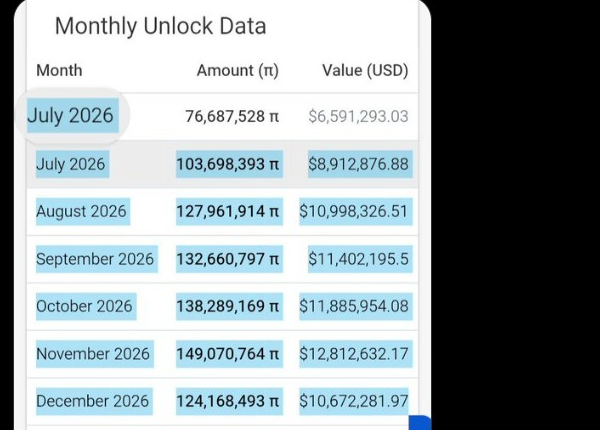
- •Pi Network's token unlock schedule will release roughly 775.8 million PI between July and December, with November representing the largest monthly unlock at approximately 149.1 million PI.
- •Speculation about a Bitcoin integration involving Pi Network remains entirely unconfirmed, with no commitment from Michael Saylor or any Bitcoin-affiliated company.
- •A projected $50 PI price target for 2027 is unsubstantiated by any announced roadmap milestones or ecosystem fundamentals and should not be treated as investment guidance.
Pi Network's native token, PI, has extended its recent decline, trading near $0.0825 after shedding 7.12% over the past 24 hours. The pullback brings PI dangerously close to the lower boundary of a four-hour falling wedge pattern, with buyers defending a critical July support zone around the $0.08 level. The project, developed by Stanford graduates Dr. Nicolas Kokkalis and Chengdiao Fan, launched in 2019 with a mobile-first mining model that has since attracted tens of millions of users — though the token's exchange-traded price discovery remains in its early stages.
The next price reaction near $0.08 is widely viewed as a decisive moment — it will determine whether the technical pattern yields a recovery toward prior highs or triggers a deeper breakdown.
Pi Network Price Under Pressure at the $0.08 Floor
PI is currently changing hands near $0.0825, slightly below the $0.0837 area identified in an earlier four-hour chart analysis. The continued slide confirms that sellers remain in control of the short-term structure, with PI persistently trading beneath a descending resistance trendline.
Crypto analyst Gopal identified a falling wedge that took shape after PI was rejected from the $0.10 region. The upper trendline continues to cap rallies with a series of lower highs, while the lower boundary now sits just below the current market price.
Buyers are attempting to hold the $0.081–$0.083 area, though the response has been muted. A meaningful recovery would require PI to reclaim $0.09, where wedge resistance overlaps with a recent consolidation range.
Conversely, a sustained close below $0.081 would put the psychological $0.08 level under immediate pressure. A loss of that zone could open the door to $0.078, followed by the broader July demand area between $0.075 and $0.072.
Falling Wedge Signals Building Momentum
Gopal further noted that momentum is accumulating as price action compresses within the narrowing wedge. A decisive break above the upper boundary could signal a trend reversal, indicating that buyers are beginning to regain control. Falling wedges are traditionally viewed by technical analysts as bullish reversal formations, particularly when accompanied by rising volume on an eventual breakout — though these patterns can fail if support gives way before compression resolves.
The wedge pattern emerged after PI rebounded from approximately $0.072 and rallied above $0.10. Sellers subsequently drove the price into a sequence of lower highs and lower lows, producing the tightening structure visible on the four-hour timeframe.
A confirmed breakout above $0.09 could reopen the path toward the recent high near $0.10, with a projected target around $0.104. However, stronger trading volume would be needed to sustain such a move and reduce the likelihood of a false breakout.
If rejection below $0.09 persists, PI would remain confined within the wedge, keeping downside risk active and amplifying the importance of the $0.08 support test.
Token Unlock Schedule Adds to Supply Overhang
Market observer Chix flagged Pi Network's token unlock schedule extending through the end of 2026. The data indicates the following monthly releases:
- July: approximately 103.7 million PI
- August: nearly 128 million PI
- September: 132.7 million PI
- October: 138.3 million PI
- November: roughly 149.1 million PI (the largest remaining monthly release)
- December: approximately 124.2 million PI
From the second July release through December, the cumulative unlock total approaches 775.8 million PI, representing a substantial portion of uncirculating supply set to enter the market. Such scheduled releases are common across major crypto ecosystems — Ethereum, Solana, and others use vesting schedules to gradually expand circulating supply — and they can create recurring selling pressure when recipient demand to liquidate outpaces market absorption capacity.
While token unlocks do not automatically translate into selling pressure, they do increase the number of coins available to holders. With PI already down 7.12% in a single day, the market may require stronger demand to absorb the incoming supply without deepening the decline.
Speculative Bitcoin Integration and Long-Term Price Targets
Market commentator Satoshi Nakamoto discussed the possibility of deeper ties between Bitcoin and the Pi Network ecosystem. However, the material shared does not confirm any commitment from Michael Saylor or any Bitcoin-affiliated company toward such an integration. The discussion remains entirely speculative and should not be interpreted as an active market catalyst.
The same commentator also referenced a highly optimistic $50 PI price target for 2027. Such long-range projections remain unsubstantiated by any announced roadmap milestones or ecosystem fundamentals and should not be interpreted as investment guidance.

