How Beginners Can Buy Their First Bitcoin in India
Key Takeaways
- •Indian residents must use exchanges registered with the Financial Intelligence Unit India (FIU-IND), as only these platforms are legally permitted to facilitate crypto trades.
- •Bitcoin is divisible, allowing users to purchase fractions starting from as little as Rs 100 on Indian exchanges rather than buying a whole coin.
- •India imposes a 30% tax plus 4% cess on all profitable crypto sales with no provision to offset losses, and requires 1% TDS on sales exceeding Rs 10,000 per financial year.
- •Tax record-keeping begins with the first Bitcoin purchase, and all crypto transactions must be declared in Schedule VDA of ITR-2 or ITR-3 by July 31 after each financial year.
- •Since January 2026, FIU-registered exchanges are required to use AI liveness detection during onboarding to verify that applicants are real persons rather than photographs or deepfakes.
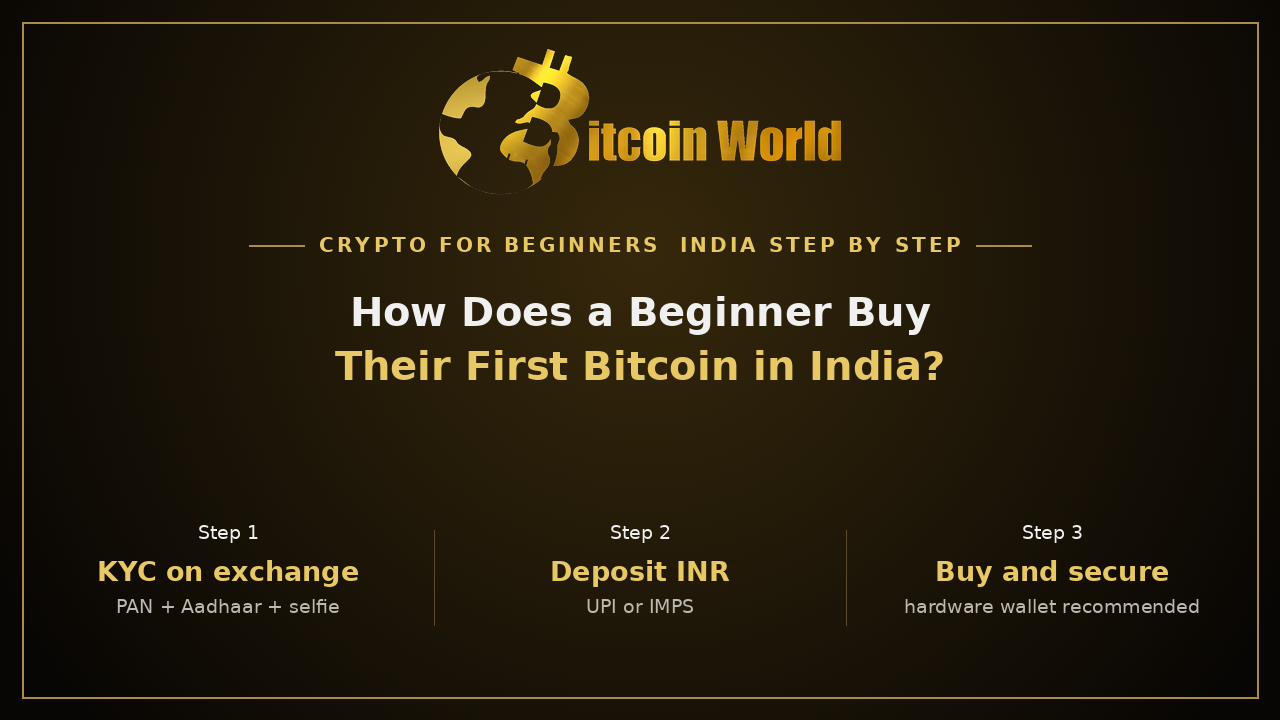
Buying a first Bitcoin in India in 2026 can be completed through six basic steps, and the process does not require technical knowledge of how blockchain technology works. A new user typically chooses a registered exchange, completes identity verification, deposits Indian rupees, places a buy order, and then decides how to store the Bitcoin purchased.
Bitcoin is divisible, meaning a user does not need to buy a whole Bitcoin. Indian exchanges allow purchases for as little as Rs 100 or Rs 500, and the platform assigns the corresponding fraction of a Bitcoin to the user's account. This makes the entry threshold far lower than many first-time buyers expect.
For many first-time users, the difficult part is not the purchase process itself but the tax and record-keeping requirements attached to crypto transactions in India. Those obligations can begin with the first purchase, because the purchase price and date become part of the user's future tax records.
India classifies cryptocurrencies as virtual digital assets, or VDAs, rather than as legal tender or currency. The Reserve Bank of India has not authorised Bitcoin as a payment instrument, and the government introduced a dedicated tax framework for VDAs in the Union Budget 2022, which remains the basis for the rules described below.
Step 1: Select a Registered Indian Exchange
For a beginner, the choice of platform is one of the most important decisions because it affects legal compliance, tax handling, rupee deposits and withdrawals, and overall ease of use.
Indian residents should use a platform registered as a reporting entity with the Financial Intelligence Unit India, or FIU-IND. Only FIU-registered platforms are legally permitted to facilitate crypto trades for Indian residents. Registered platforms include CoinDCX, ZebPay, CoinSwitch, Mudrex, and WazirX. Users can verify a platform's registration directly on the FIU-IND website instead of relying only on claims made by the platform.
The FIU-IND registration requirement for virtual digital asset service providers was formalised in March 2023 under the Prevention of Money Laundering Act. Platforms that did not comply were blocked or restricted from operating in India, which is why all legally accessible Indian exchanges today carry this registration.
A key feature for beginners is whether the exchange automatically deducts the 1% tax deducted at source, or TDS, on sales and reflects it in Form 26AS. FIU-registered Indian exchanges are required to do this, which reduces a significant compliance burden for users.
Fees should also be checked before depositing funds. Most Indian platforms charge between 0.1% and 0.5% per trade, along with a flat fee for INR withdrawals. For small first-time purchases, a higher percentage fee has a larger relative impact, so fee comparison remains important.
UPI support can make the rupee deposit process faster than platforms that depend only on NEFT or IMPS transfers, which may take hours on banking days. Most major Indian exchanges now support UPI deposits up to at least Rs 1 lakh.
Step 2: Open an Account and Complete KYC
A user cannot deposit money or buy Bitcoin until identity verification is complete. KYC on Indian crypto exchanges is typically more detailed than on many other financial apps.
The process begins with signing up using an email address and mobile number, both of which are verified through OTPs. Using a personal email address and the mobile number linked to the user's bank account can help avoid mismatches later.
Two-factor authentication should be enabled immediately after account creation. Authenticator apps such as Google Authenticator or Authy are generally used for this purpose. SMS-based 2FA is less secure because SIM-swap attacks are a common route for account theft in India.
A PAN card must be submitted. This requirement is mandatory because the PAN links crypto transactions to the user's tax record.
A second government identity document is also required. Aadhaar is usually the fastest option because it supports instant e-KYC through OTP, linking the Aadhaar number to the crypto account without waiting for manual review. A passport, voter ID, or driving licence can also be used, but these documents usually require a slower video KYC process.
Since January 2026, FIU-registered exchanges are required to use AI liveness detection during onboarding. The app asks the user to look at the camera and make small movements to confirm that the applicant is a real person rather than a photograph or deepfake.
The user must also link a bank account. The platform verifies the account through a penny drop test by sending Re 1 to the account and confirming that the name matches the KYC details exactly. This step must be completed before INR can be withdrawn from the platform.
Step 3: Deposit Indian Rupees
After the account is verified and the bank account is linked, depositing rupees is usually straightforward.
UPI is generally the fastest deposit method. The user selects UPI, enters the deposit amount, and completes authorization in the bank's UPI app. Funds typically appear in the exchange wallet within seconds to a few minutes.
If UPI is not available or the user prefers a bank transfer, IMPS is the next option. IMPS is processed instantly 24 hours a day, including weekends. NEFT is processed in batches during banking hours and may take 2 to 4 hours.
A beginner does not need to deposit more than the amount intended for the first purchase. Funds left idle in an exchange wallet earn no return, so users commonly deposit the amount they plan to use and add more only when they are ready to buy again.
Deposit fees should be checked before transferring funds. Most Indian exchanges do not charge for INR deposits through UPI or NEFT, but some may charge a small fee for certain payment methods.
Step 4: Place the First Bitcoin Buy Order
Once rupees are available in the exchange wallet, the user can buy Bitcoin.
The first step is to find the BTC/INR trading pair. Indian exchanges generally provide a search or browse function for trading pairs. The user can search for Bitcoin or BTC and select the INR pair.
For a first purchase, a market order is the simplest order type. A market order buys immediately at the current best available price. A limit order allows the user to set a specific price and waits until that price becomes available. A market order is simpler because it executes immediately.
Most platforms allow the user to enter either the rupee amount to spend or the BTC amount to receive. Entering the rupee amount is usually easier for beginners because the platform calculates the Bitcoin fraction automatically.
Before confirming the transaction, the order summary should be reviewed. The summary shows the total INR being spent, the trading fee deducted, and the Bitcoin amount to be received. These figures should match the user's expectations before confirmation.
After confirmation, the Bitcoin usually appears in the exchange wallet within seconds and can be viewed in the portfolio or holdings section.
There is no TDS on the first purchase because no sale has taken place. However, if a user's cumulative crypto sales in a financial year exceed Rs 10,000, the exchange will deduct 1% TDS from sale proceeds automatically.
Step 5: Understand Tax Obligations From the First Purchase
In India, tax record keeping for Bitcoin starts with the first purchase, not only at the time of sale.
The purchase date and price should be recorded. Users need to keep a note of when they bought, how much INR they paid, the BTC amount received, and the exchange rate at the time of purchase. This becomes the cost of acquisition and is used to determine taxable gains when the Bitcoin is eventually sold.
A 30% tax applies to every profitable sale. When Bitcoin is sold for more than its purchase cost, the gain is taxed at 30% plus 4% cess, producing an effective rate of 31.2%. This applies regardless of how long the Bitcoin was held or how small the gain was. These provisions were introduced in the Union Budget 2022 and took effect from 1 April 2022.
Losses cannot be offset. If Bitcoin is sold at a loss, that loss cannot be used to reduce tax liability elsewhere. This is a major difference from equity investing in India and means that sale timing can have tax consequences.
Crypto transactions in a financial year must be declared in Schedule VDA of ITR-2 or ITR-3 by 31 July after the end of the financial year. This includes the first Bitcoin purchase and any later sales.
The 1% TDS deducted by the exchange on sales is advance tax, not the complete tax obligation. It is credited against the 30% liability. If the final tax due is higher than the TDS already deducted, the user must pay the remaining amount as advance tax or self-assessment tax.
Step 6: Decide Where to Store the Bitcoin
Keeping Bitcoin on an exchange is convenient, but the risks increase as the amount held grows.
Exchange wallets are custodial. When Bitcoin is held on an exchange, the exchange controls the private keys. If the exchange is hacked, becomes bankrupt, or freezes withdrawals, the user's access depends on the exchange's situation. WazirX users encountered such risks in 2024 when the exchange reported a cybersecurity breach resulting in the loss of customer funds, and withdrawals were subsequently restricted.
A personal software wallet provides more direct control. Apps such as Trust Wallet or Exodus allow users to hold Bitcoin in a wallet where they control the private keys. These wallets are free to set up and use. Withdrawing Bitcoin from an exchange to a software wallet usually requires a one-time network fee of Rs 150 to Rs 500, depending on blockchain congestion.
A hardware wallet is considered the safest option for significant holdings. Devices such as Ledger or Trezor store private keys offline in a physical device that does not directly connect to the internet. At an approximate cost of Rs 5,000 to Rs 12,000, a hardware wallet may be considered once a Bitcoin holding exceeds Rs 50,000.
A seed phrase should never be photographed or stored digitally. When setting up a personal wallet, the user receives a 12-word or 24-word recovery phrase. It should be written on paper and kept in a physically secure place. Losing the phrase means losing access to the Bitcoin permanently, with no recovery option. Sharing it with anyone can result in the immediate loss of everything in the wallet.
Frequently Asked Questions
How long does KYC take on Indian crypto exchanges?
On most major Indian exchanges, Aadhaar e-KYC takes 15 to 30 minutes if the documents are clear and the phone number is linked to both Aadhaar and the exchange account. If a passport or voter ID is used instead of Aadhaar, manual review may take 24 to 48 hours.
Can Bitcoin be bought directly with a UPI app without signing up for an exchange?
No. UPI is only a payment method for moving INR between bank accounts. To buy Bitcoin, a user needs an account on an FIU-registered crypto exchange, deposits INR through UPI, and then uses the funds to purchase Bitcoin through the exchange's trading system.
What is the safest Indian exchange for a beginner buying Bitcoin?
All FIU-registered exchanges meet the same basic regulatory standard. Safety differences depend on each platform's security architecture rather than registration status alone. For beginners, a platform with a clear track record of keeping customer funds separate from company funds and with IMPS withdrawal support for fast INR access may be more relevant than any single safety ranking.
Does a user need to inform the bank before buying crypto?
No. There is no legal requirement to inform a bank before depositing into a crypto exchange. However, some banks may still flag outgoing transfers to crypto exchanges as unusual, place a brief hold, or ask the customer to confirm the transaction. This is a bank-level caution, not a legal restriction, and is usually resolved when the transfer is confirmed.
Conclusion
Buying a first Bitcoin in India can take less than an hour from opening an exchange account to seeing Bitcoin in a wallet. The process is structured, major platforms offer beginner-focused interfaces, and KYC is designed to be completed on a phone without visiting an office.
The more demanding part is ongoing tax record keeping, which begins with the first purchase. Users need to document every trade with the date, rupee amount, BTC received, and exchange rate, because these figures determine Schedule VDA accuracy and the actual after-tax result. The purchase process is simple, but accurate records are essential for navigating India's crypto tax system and avoiding problems later.

