Bittensor TAO Price Forecast 2026-2032: Technical Analysis and Market Outlook
Key Takeaways
- •TAO traded at $190.13 on July 25, 2026, down 0.49% over 24 hours, with resistance near $197 and support around $185.
- •Cryptopolitan forecast TAO could trade between $134 and $368.91 by the end of 2026, with an average price of $257.98.
- •The same forecast projected TAO between $1,145.75 and $1,241 in 2032, with an average price of $1,192.74.
- •More than 70% of TAO’s circulating supply is locked in staking and subnet validation, while Bittensor reported $43 million in AI usage revenue in Q1 2026.
- •Recent ecosystem updates include the subtensor repository moving to the Rao Foundation and OKX unveiling OKX AI with support from the Opentensor Foundation.
Bittensor (TAO) price forecasts cited by Cryptopolitan project a possible high of $368.91 by the end of 2026. The same forecast places TAO between $501.56 and $589.68 in 2028, with an average price of $542.55, and between $1,145.75 and $1,241 in 2032, with an average price of $1,192.74.
Bittensor is an AI-focused decentralized network designed to combine blockchain infrastructure with artificial intelligence. The network uses Proof of Learning (PoL) technology, which is intended to support user privacy while reducing errors. Bittensor’s model centers on decentralized AI systems that are designed to remain flexible and compatible with ongoing technological developments.
The Bittensor network also emphasizes cross-chain integration and native token expansion as part of efforts to support collaboration among decentralized AI networks. TAO is used to incentivize node operators and AI developers. The network uses authentication methods and the PoL consensus process to secure the transfer of nodes and support the development of more advanced AI systems within blockchain environments.
TAO technical analysis
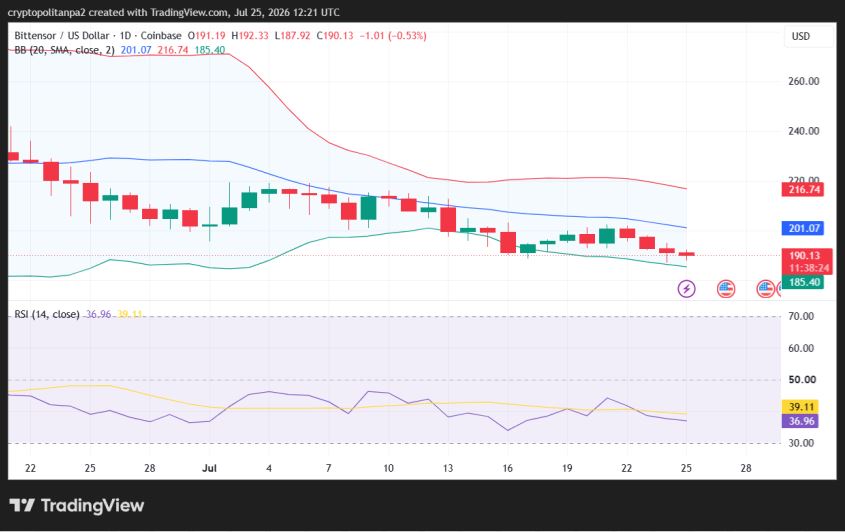
On July 25, 2026, Bittensor’s price analysis showed a bearish daily trend, with TAO trading at $190.13. The token was down 0.49% over the previous 24 hours, with the decline attributed to continued selling pressure for a fourth consecutive day. TAO faced overhead resistance at $197 and had support around $185.
For readers comparing the chart signals with the longer-term forecasts, the technical analysis reflects short-term trading conditions rather than a guarantee that the multi-year projections will be reached. Indicators such as Bollinger Bands and RSI are commonly used to track volatility and momentum, while the broader forecast also depends on token supply, staking, network activity, and the AI-crypto narrative cited later in the article.
TAO/USD one-day chart
The one-day TAO/USD chart showed a bearish trend for Bittensor. The pair recorded a further intraday correction to $190.13 after a bearish move. Relatively low volatility suggested a reduced probability of either a sharp reversal or further steep depreciation.
Bollinger Bands showed a narrow gap, indicating low market volatility. The upper Bollinger Band, which marked resistance, had moved to $216, while the lower band, described as a broken support level, had moved down to $185.
The Relative Strength Index (RSI) remained in neutral territory even as other technical indicators appeared bearish. The RSI curve declined to 36 during the day. The falling price movement reflected what the source described as an imbalanced trading setup, with a further decline in the RSI possible if bearish momentum accelerated.
TAO/USD four-hour chart
The four-hour Bittensor chart showed an hourly bullish trend, with price movements turning upward as buyers attempted to regain control. In the preceding hours, TAO recovered to $190.13 after finding support. Green candlesticks on the chart indicated renewed buying interest.
Bollinger Bands were wider on the four-hour chart, showing higher volatility and greater market unpredictability. The upper Bollinger Band moved to $199, marking resistance, while the lower Bollinger Band stood at $186, marking support.
Several technical indicators remained bearish, but the RSI was rising into neutral territory. The RSI reading of 41, together with its upward movement, indicated buying interest. The upward curve on the indicator reflected stronger buying activity and short-term bullish progress on the hourly chart.
Short-term outlook from technical indicators
Cryptopolitan’s analysis said Bittensor’s current market setup remained bearish. TAO/USD had declined further to $190.13 as bearish momentum dominated the market. Most technical indicators signaled weakness, and the price charts favored sellers, suggesting a potential move toward $175.
Bittensor and TAO fundamentals
TAO has attracted attention as AI development and machine learning continue to expand within the crypto sector. At the same time, the token remains exposed to the same uncertainty and volatility that affect other cryptocurrencies. Cryptopolitan said its forecast considered potential profit and expected movement from 2026 through 2032, while also noting that the forecast is not investment advice and that investors should conduct their own research based on risk tolerance.
The article said TAO’s recent weakness was primarily caused by selling pressure from traders following earlier bullish price action. That earlier move was linked to strong market sentiment around speculative AI tokens and the broader AI industry. Instability near expected support levels also contributed to a return of bearish pressure as traders began selling. TAO’s price fell further after undergoing a correction during the previous 24 hours.
Bittensor (TAO) is not a stock. It powers the Bittensor Network, while stocks are typically traded on stock exchanges and represent ownership in a company. Buying TAO gives holders certain rights within the Bittensor Network, including possible governance participation, but does not represent company ownership. TAO can be bought and traded on exchanges including Binance, Bitget, Coinbase, KuCoin, and Kraken.
That distinction matters because TAO’s valuation framework is tied to network usage, token incentives, liquidity, and participation in Bittensor rather than corporate earnings or shareholder claims. The source’s forecast therefore treats TAO as a crypto asset whose price can be affected by both project-specific developments and wider market conditions.
The highest TAO price prediction for 2026 in the source is around $368.91. The article noted that Bittensor price movements are difficult to predict because of volatility and that TAO’s performance is tied to global retail and institutional interest in AI and machine learning.
The article projected that Bittensor could surpass $1,000 by 2031, when it forecast TAO to trade between $987.45 and $1,076. It framed this projection around long-term trends in decentralized AI development, while also noting the speculative nature of the forecast.
The source identified Bittensor’s support levels at $201, $195, and $185, with resistance levels at $228, $247, and $265. It also said large holders, or “whales,” can have a substantial impact on TAO price movements because Bittensor’s market size is relatively small compared with traditional assets.
Bittensor has a fixed maximum supply of 21 million tokens. The article said this structure could contribute to supply shocks because of algorithmic emission halvings. Other factors cited as affecting Bittensor price forecasts included token supply dynamics, institutional exposure, network revenue, and the AI-crypto market narrative.
More than 70% of TAO’s circulating supply is locked in network staking and subnet validation, creating high staking illiquidity, according to the source. Bittensor generated $43 million in real AI usage revenue in Q1 2026. As of May 2026, the Bittensor ecosystem had expanded to Solana by bridging the TAO token to that network, a move described as improving DeFi liquidity.
Those metrics give readers concrete items to monitor beyond price charts: staking concentration affects freely tradable supply, subnet validation is tied to network participation, and cross-chain access can influence how easily TAO moves through DeFi venues. The article does not treat any single metric as decisive, but presents them as part of the overall forecast backdrop.
The article said many market observers expect Bittensor TAO to trade higher over the coming years, with machine-learning models projecting an estimated upward trend for the network. It said this would reflect the long-term potential of the underlying blockchain technology and its value as a digital asset. However, it also noted that market crashes or difficult regulatory conditions could invalidate the bullish outlook.
Bittensor was described as an asset that could benefit from legislative clarity in the United States, including momentum around the CLARITY Act. The article added that TAO price action is primarily driven by supply and demand, which can be affected by fundamental events such as hacks and other real-world developments.
Recent Bittensor developments
The subtensor repository was officially moved to the Rao Foundation account as part of Opentensor’s decentralization plan.
NEWS: The subtensor repository has officially moved from "opentensor/subtensor" to "RaoFoundation/subtensor" as part of @opentensor 's ongoing decentralization. Check out the official Bittensor discord for more details. — taostats τ (@taostats) July 2, 2026
NEWS: The subtensor repository has officially moved from "opentensor/subtensor" to "RaoFoundation/subtensor" as part of @opentensor 's ongoing decentralization. Check out the official Bittensor discord for more details.
OKX also unveiled OKX AI with support from the Opentensor Foundation. The product is described as turning agent capabilities into onchain services, tasks, and reputation.
. @OKX unveiled OKX AI, with support from Opentensor Foundation. OKX AI turns agent capabilities into onchain services, tasks, and reputation. And Bittensor subnet APIs are coming soon, bringing subnet intelligence directly into the OKX AI Marketplace. — Openτensor Foundaτion (@opentensor) June 30, 2026
. @OKX unveiled OKX AI, with support from Opentensor Foundation. OKX AI turns agent capabilities into onchain services, tasks, and reputation. And Bittensor subnet APIs are coming soon, bringing subnet intelligence directly into the OKX AI Marketplace.
These developments are relevant to the outlook because they relate to decentralization of core infrastructure and potential distribution of subnet intelligence through an exchange-linked AI marketplace. The article does not state that either development directly changed TAO’s price, but both fit the broader themes of ecosystem expansion and network utility.
Bittensor price prediction for July 2026
For July 2026, the source said a break above resistance could lead to a “mini bull run,” with the next target at $290 during the month. The average price was forecast at $225. In a bearish scenario, TAO could fall as low as $175.
Bittensor price prediction for 2026
For the end of 2026, the source said technical indicators were bullish on TAO. The token was forecast to trade between $134 and $368.91, with an average price of $257.98.
Bittensor price predictions for 2027-2032
2027
TAO was forecast to gain bullish momentum in 2027. According to the updated Bittensor forecast, the token is expected to trade between $391.26 and $479.63, with an average price of $430.25.
2028
The Bittensor outlook was described as strengthening further in 2028. Analysts cited by the source expected TAO to trade between $501.56 and $589.68, with an average yearly price of $542.55.
2029
The 2029 Bittensor price prediction placed TAO between a minimum of $621.86 and a maximum of $741.25. The source forecast an average price of $693.84 for the year.
2030
For 2030, Bittensor price predictions indicated a trading range of $802.15 to $934.35, with an average expected price of $869.14.
2031
In 2031, the Bittensor price prediction projected TAO to trade between $987.45 and $1,076, with an average price of $1,021.44.
2032
For 2032, the Bittensor forecast placed TAO between $1,145.75 and $1,241, with an average price of $1,192.74.
Cryptopolitan’s TAO forecast
Cryptopolitan said TAO could recover to $368.91 by the end of December 2026. It also projected that TAO could maintain a $391.26-$479.63 trading range in 2027, with an average price of $430.25. The article again stated that the predictions are not investment advice and that readers should seek independent professional consultation or do their own research.
Because the forecast spans several years, the ranges should be read alongside the article’s stated risk factors, including volatility, supply-demand changes, regulatory uncertainty, and security events. The historical performance below also shows that TAO has previously experienced large drawdowns and sharp rebounds within relatively short periods.
Bittensor historic price performance
TAO launched on March 6, 2023, at $93.4 but fell below its opening price within a week, sliding into the $76 range. By early April 2023, it had lost half its value, falling to $47, and then continued down to a low of $30.83 in May before recovering gradually to $63 by the end of that month.
The token rose to $86.18 in July 2023, just below its launch price, before pulling back again and trading near $54 through October. Momentum returned in November, taking TAO into the $95 range, and the token then climbed sharply to a peak of $379 on December 15, 2023.
TAO declined into early 2024 but later surged to its all-time high of $757.60 in March. It then corrected quickly to $522 in April and continued weakening through midyear, reaching $216 in July. A brief rebound to $357 faded as TAO returned toward the mid-$200s by late summer, according to crypto market price history cited in the source.
Momentum returned in October 2024, pushing TAO into the $660 range before it cooled to $468. The token rose again to $679 in November but ended 2024 at $440.69 as the broader crypto market turned bearish again.
TAO opened 2025 at $439.73 and reached $565 in January before declining to the $324 level in February. The source said this reduced the token’s market capitalization as technical indicators turned bearish because of some fundamental factors. In March, TAO fell to $259 and declined further to $228 in April, before recovering to $467 in May as the Bittensor market revived.
In October 2025, TAO recorded its lowest prices of the year, extending toward $200.44. It opened November at $506, lost 46% of its value, and closed the month at $269.11. At the start of December, TAO traded between $256.29 and $298.90.
At the beginning of January 2026, TAO traded near the $223 range as the market shifted bearish. In March, TAO traded below the psychological $200 level but rose past $300 in April. At the start of May, TAO again fell to the $260 range. As July began, TAO continued trading in the year’s middle price range, above $200, while the source described current market sentiment as decidedly bearish.

